|
Amazon
Category:
Cooking/Food/Wine
Publisher: University of South Carolina Press
ISBN-10: 1570033005
Type: Non-Fiction
Pages: 256
Copyright: May 1 1999
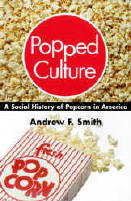
The history, legends, and cookery of America's favorite snack food. Whether in movie theaters or sports arenas, at fairs or theme parks, around campfires or family hearths, Americans consume more popcorn by volume than any other snack. Within American food lore, popcorn holds a special place, for it was purportedly shared by Native Americans at the first Thanksgiving. In Popped Culture, Andrew F. Smith tests such legends against archaeological, agricultural, culinary, and social findings. While debunking many myths, he discovers a flavorful story of the curious kernel's introduction and ever-increasing consumption in North America. Contains more than 160 recipes that typify popcorn cookery prior to 1924.
Whether in movie theaters or sports arenas, at fairs or theme parks, around campfires or family hearths, Americans consume more popcorn by volume than any other snack. To the world, popcorn seems as American as baseball and apple pie. Within American food lore, popcorn holds a special place, for it was purportedly shared by Native Americans at the first Thanksgiving. In Popped Culture, Andrew F. Smith tests such legends against archaeological, agricultural, culinary, and social findings. While debunking many myths, he discovers a flavorful story of the curious kernel's introduction and ever-increasing consumption in North America.
Unlike other culinary fads of the nineteenth century, popcorn has never lost favor with the American public. Smith gauges the reasons for its unflagging popularity: the invention of "wire over the fire" poppers, commercial promotion by shrewd producers, the fascination of children with the kernel's magical "pop," and affordability. To explain popcorn's twentieth-century success, he examines its fortuitous association with new technology—radio, movies, television, microwaves—and recounts the brand-name triumphs of American manufacturers and packagers. His familiarity with the history of the snack allows him to form expectations about popcorn's future in the United States and abroad.
Excerpt
Of all the types of corn raised in the United States, however, none is more commonly recognized than popcorn. Americans eat popcorn in movie theaters, amusement parks, sports arenas and around campfires. At home we pop corn in microwave ovens, through hot air-poppers, or on the stove's top with a covered frying pan. As a snack food, we feast on ready-to-eat savory and candied popcorn confections. Over two hundred million boxes of Cracker Jack alone are crunched and munched annually, and today Cracker Jack is outsold by Franklin Crunch ‘N Munch. Our intake of popcorn in all forms has more than doubled during the past two decades, and consumption abroad has expanded at an even faster pace. As trivial as popcorn may appear when compared to the total maize crop, Americans annually devour eleven billion popped quarts, which averages out to about forty-four quarts per person. By volume popcorn is America's favorite snack food.
It was not just consumption statistics or today's popularity that convinced me to write the book. Popcorn exploded onto the American mainstream in the nineteenth century. Unlike other fads that quickly passed from the culinary scene, popcorn thrived and became enshrined in our national mythology. To many outside the United States, popcorn is almost a defining component of American culture. How popcorn was introduced and why the mainstream embraced it is a story about broader historical trends that have influenced us over the past fifteen decades.
While I am concerned with what popcorn can tell us about larger social and historical issues, I remain fascinated by popcorn itself, as fascinated as when I was a child. Popcorn's story is an exciting tale of unexpected twists and turns that are even more amusing than the frequently regurgitated popcorn myths. It is peopled with archaeologists and anthropologists, street vendors and merchants, seedsmen and farmers, processors and grocers, nutritionists and health-food nuts, scientists and salespersons, poets and songwriters, and just plain Americans. It is a story filled with hot-shot inventors, high-flying promoters, risk-taking growers, efficiency-conscious processors, hard-hitting advertisers, and lip-smacking consumers-- all of whom have contributed to transforming popcorn into an American icon. As important, the popcorn story was interwoven with significant events, inventions and social movements in American history, such as the Depression and World War II, the inventions of movies, television and the microwave, and the rise of health food consciousness in America. It was a story worth telling.
|