Download to your Nook (eBook)
Download from Apple iTunes (eBook)
Download from Smashwords (eBook)
Barnes & Noble.com
Smashwords.com
Category:
Education/Training
Publisher: Smashwords.com
ISBN-10: 1465935002
Copyright: Sept 28, 2011
ISBN-13: 9781465935007
Price: $0.99 (eBook)
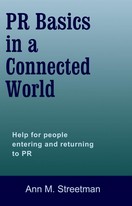
A good overview of basics in PR for newcomers or a brief refresher for people returning to the job market.
This book is for you if one of these scenarios fits: (1) you just inherited the PR function on top of your other responsibilities; (2) you are headed back into the PR job market after several years; (3) you want to acquire some PR savvy for a prospective new job; (4) you have a communications degree, but have never worked in PR; or (5) you are new to PR and want a few tips from a veteran.
Excerpt
Chapter 2 Writing Skills
Public relations and other communications professionals are working in an environment in which their audiences and their clients expect things to happen “now.”
The pace and some of the platforms are different, but one thing has not changed: good writing is still required. It is especially challenging to write it right in such a fast-paced environment.
Writing Strategies Forged from Experience
In handling a variety of projects, I have developed six practical strategies that can help you meet the time challenge for good writing.
Strategy 1. Never stare at a blank screen for more than 5 seconds. It’s counterproductive. Confirm in your mind your chosen stylebook (probably AP). Then just start tapping sentences into place, knowing that those words will be changed and re-arranged several times. (For me, the forerunner of the blank screen was a sheet of blank paper in a typewriter. I think one of my early journalism teachers nudged me in this direction, and I kept evolving and building on that good advice.)
Strategy 2. Be a tough editor of your own words. That’s hard. It comes with practice and a lot of time. If a phrase just does not seem right, rewrite it the first time you get that internal questioning nudge. If you don’t fix it the first time you question it, you’ll be wasting time. You can always put it back with some tinkering on another editing pass.
Strategy 3. When you are happy with the piece, do three editing passes with different criteria. In the first pass, look only at spelling, punctuation, and grammar. Never depend solely on the software spell checker. You may have spelled a real word correctly, but it may be the wrong word. In the second pass, look at consistency of style. Circle anything that may be inconsistent with your chosen stylebook. Confirm with the stylebook and adjust as needed. In the third pass, evaluate the piece only for flow. Make adjustments as necessary. Looking for different kinds of problems in separate passes helped me improve efficiency.
Strategy 4. Learn to let go. If you verge on being a perfectionist, this is hard to do. I have learned that any piece long or short could always be a little better. It is not professional or practical, however, to keep going over it, stretching the deadline. Furthermore, it is not fair to the people who are waiting for it. This was an especially hard, but important lesson for me to learn many years ago when I was breaking into book manuscript copyediting.
Strategy 5. Learn to compromise with your clients and your project partners when you disagree on requested changes. It’s always OK to explain why you included something or why you phrased something a particular way, but if the client or project partner still does not agree, compromise. The only caveat to such compromising is if doing so would result in the public receiving inaccurate or dishonest information (remember that PRSA Statement of Values quoted in Chapter 1).
Strategy 6. Use the writing style that fits the audience and the platform. Before you begin to write a new piece or form a response to a comment to a prior piece, clarify in your own mind the publics (audiences) to whom your communication will be addressed.
Writing styles are different for different kinds of platforms. You can write long sentences and longer content if you are writing a news release. If you are making a post on a blog or commenting on an article, your message should be only a few precisely-worded sentences. Don’t be surprised if it takes longer to compose a short message than a longer one. It is a fact of writing.
|


