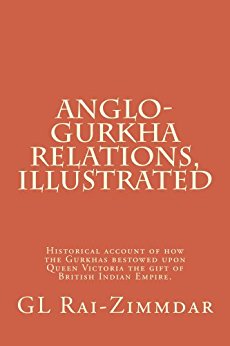
Category: History Publisher: Amazon.com
Pages: 213
Copyright: Jan 26, 2014
Price: $9.69 (eBook)
An account of how the Gurkhas bestowed upon Queen Victoria the gift of Indian Empire.
Britain and Nepal have been friends, friendly neighbours. As a neighbor the Gurkhas bestowed upon Queen Victoria the gift of Indian Empire and have never asked for a favour in return.
I quote General Sir Francis Tuker, "Nepal was an ally of Great Britain... always they have been a sovereign and independent .... Taken all in all, the Gurkha must, for his unusually fine qualities, be nearly unique in the modern world. For this alone the story of his race must be worth telling. Let any enquirer be assured that if he seeks to understand the meaning of courage and selfless devotion, then he should soldier with a Gurkha Regiment. He will return an enlightened and a better man from the experience."
To Tuker's name may be added the names of Lords Napier, Roberts, Slim and Ralph Turner, Eden Vansitart, Jack Masters, Tim Carews and endlessly on and every one of them have only positive words of praise lavished upon the Gurkhas. However, not until Dame Joanna Lumley came along none of them have ever done anything to repay the debt of honour to the Gurkhas.
Take for example the case of Tripartite Agreement signed by Britain, India and Nepal in 1947, a clause wherein lays down that all of the signatories may pay the Gurkhas equal amount of pay. Since then the situation has drastically changed and the Gurkhas whilst serving may receive pay and allowances at par with British soldiers are compelled to accept pension equal to what India and Nepal pays to their soldiers.
Who is pressurising the British Government not to pay the Gurkhas their due? If you can believe Great Britain has been treating its neighbour and friend justly, then please read on.
Excerpt
After the Treaty of Peace and Friendship was signed between England and Nepal in 1815, King George III had extended an invitation to the King of Nepal to visit Great Britain. However, with the memories of a bitter war still fresh in his mind, the Nepalese King had declined the invitation.
Three decades were to elapse before Queen Victoria renewed the invitaion and Jungbahadur Rana Magar, the then Prime Minister of Nepal, accepted it on behalf of his King. Thus Jung became the first ever oriental potentate to be entertained at the Court of St James.
Jung was treated with decorum and grace in extremely cordial atmosphere. The sprightly hillman greatly charmed Queen Victoria and so he was by her gracious hospitality. Jung was received and lavishly treated not only at the Court, but by all well known military dignitaries of the day. Jung returned home after nearly a year carrying with him fond memories of his sojourn in England.
Within a decade of his return, Indian Army had risen up in open rebellion and one can state without any fear of contradiction that had not Jung and his well trained Gurkhas intervened on their behalf, the British Empire in India would have died a premature death in 1857. Worst still, had Jung and his Gurkhas joined the Mutineers, he would not only have regained possessions of his lost territories, but would have rendered the cause of the Brits hopeless.
This is the account of why and how the Gurkhas quelled the Sepoy Mutiny and the events that followed on its wake. No Gurkha has ever written about themselves, this is the first time a Gurkha has decided to write and that is the reason why you want to read it. This monograph illuminates that Queen Victoria became Empress of India not by the Grace of God alone but by the forceful intervention of Jungbahadur Rana Magar and his fierce Gurkhas.
Anglo-Gurkha Relations is the historical account of how the Gurkhas bestowed upon Queen Victoria the gift of Indian Empire.
This is the story of the author’s great great grandparents, Edward Lewis and Sarah Crosby, who were convicts transported to Van Diemen’s Land in the 1840s. It is told from the perspective of a detective agency searching for what happened to Edward, w
325 letters my father wrote to my mother during his time in World War II.
Woven together in a timeline of events of three of his brothers, 5 brothers-in-law, and one cousin, all 10 of them were in WWII at the same time.
Neil Armstrong played the Dissolution of America Card After His Return From Space-- the Military Dishonor Card. He had a very messy DIVORCE after a military Platoon Experience for his wife and family.