
Kindle Edition
Amazon
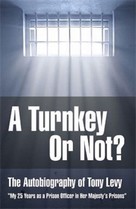
A Turnkey or Not?
Twitter
Category:
Biography
Publisher: Apex Publishing
ISBN-10: 190858260X
Type: Non-Fiction
Pages: 250
Copyright: 10 December 2011
ISBN-13: 9781908582607
Price: $9.01 (eBook)
Me a prisoner NO! I'm the officer who locks them up. A 62 year old Londoner who worked in the UK prison system for 25 years then wrote my autobiography about my time behind bars
The memoirs of an English prison warden, pure and simple. The author joined Her Majesty’s Prison Service in 1983 and served for 25 years in a number of establishments before taking early retirement.
Throughout his book the author considers the balance necessary between secure custody of the inmate as required by law and the level of empathy and dignity which makes life bearable for both jailer and jailed. A Turnkey or Not
The story is straightforward. The author’s application to join the Service is only semi-serious as is his attitude to the training period when he is unexpectedly selected. Throughout his career he sees himself as something of a maverick, speaking his mind to the consternation of his superiors, not one to toe the party line. Nonetheless he is conscientious and determined that he will always do a professional job.
As might be expected the author paints a picture of the daily routine of a prison officer – checks, counts, recounts, paperwork all done with military precision. However all involved are human and there are any number of anecdotes to spice up the monotony. He starts at Pentonville Prison in London and the distinctive stink of the place, though he becomes accustomed to it, he never forgets. Overtime rackets, sick leave rackets, they’re all here. From time to time the author half-heartedly seeks promotion, for the money rather than any real wish for recognition. He experiences different establishments and different categories of prisoners. Throughout he displays genuine empathy for those under his care and custody, comradeship with his peers but often certain contempt for his superiors who, in turn, treat him with suspicion.
Finally, with the Service changing rapidly, and not to his liking, the author takes early retirement.
This is my first every book to be published. A chance meeting on holiday in Majorca changed my life forever and launched me into a 25 year career in a job that I never would have considered previously: working in Her Majesty’s Prison Service. This book catalogues my personal experiences of working as a prison officer, from my early days at high security HMP Pentonville to my final years in therapy-based HMP Grendon. Filled with interesting observations and incidences, hilarious wind-ups and memorable characters, this autobiography is the story of a journey, from the happiest days in what will always be a potentially volatile environment to a complete state of disillusionment as an old dinosaur that no longer fitted into the modern prison service world. I give an honest account of my feelings, as someone who would never be a yes man and toe the party line, in the face of a constantly changing environment that had become increasingly controlled by political correctness gone mad and by budgetary needs rather than human needs. I am a man who cared, and even though my heart was sucked out of my job, I never lost my dignity or respect. Most importantly, I would never allow myself to be reduced to just a turnkey.
Excerpt
Chapter 25
The London Marathon
It was January 1991. I’d been at The Mount for a couple of years and
had been temporarily promoted for most of this time, yet my life was
just drifting. I lived on my own in the village of Bovingdon and went
out occasionally for a drink in the local pub, but I generally avoided
drinking in the officers’ club or with groups of my colleagues. It
seemed that whenever a group of prison officers got together all they
talked about was the job. It had become boring and I was beginning to
dislike everything.
I was fast becoming a grumpy, intolerant old man. In fact, although I
didn’t realise it at the time, I’d actually stopped liking myself and
therefore everything and everybody else, and I was beginning to let
myself go - a very dangerous position to be in.
One day a group of staff asked me if I wanted to go for a lunchtime
run with them, just for three to four miles around the village. Thinking
that I was pretty fit, despite being a smoker, as I still played football on
nonworking weekends and went training once or twice a week, I
decided to go. Piece of piss, I thought. It’ll be a doddle. Well, we set
off and I could only get as far as the end of the drive, which was about
half a mile, and I was struggling. Bloody hell, what’s happened to me?
One of my colleagues reassured me, saying that he felt the same when
he first started running and that it would get easier with time and I’d be
fine. Fine? I was bloody knackered.
I was smoking too much, not exercising sensibly or enough, eating
crap and generally letting myself go, so I made a conscious decision at
that point to sort myself out and get my life back on track. I’d lived
alone for long enough without any really serious relationships and I
was missing that closeness to another person. I’d already decided I
wasn’t going to find someone else, so I needed to find another interest
instead. Football was out, as my knee wouldn’t cope with anything
more than the casual playing and training I was already doing. Also, I
was fast approaching forty, so I wasn’t exactly in my prime. Maybe
this running lark was just what I needed?
Circumstances conspired to assist me. My father was rushed into
hospital with yet another heart attack, after suffering from heart
problems for some years now. It was a Thursday, and I got home from
work, put my pack of cigarettes on top of the television as usual, went
for a shower, changed and rushed out to visit my dad in Chase Farm
Hospital, Enfield, arriving back home pretty late.
In the morning I went off to work and, on arriving at my wing, I
reached for my first cigarette of the day. At that point I realised I’d left
them on top of my TV at home. A colleague offered me one of his, but
I declined. I decided I could manage without until lunchtime and then
pop home and get them. However, that never happened. My new
running mates said they were going for a run that lunchtime, so I
decided to join them instead. I never smoked again. Those cigarettes
sat on top of my telly for several weeks as a reminder that I’d stopped
smoking just like that. Well, I thought, if I can do that then I can
master this running lark; in fact, I’m gonna run the London Marathon
before I’m 41. My birthday was the following August.
I prepared for the London Marathon like some sort of military
exercise, training every day and gradually increasing the miles
covered. I just did a couple of miles per day at first, sometimes
alternating between running and walking when I started feeling tired. I
increased my run from five times a week to seven times a week, by
which time I was doing five miles per day. The buzz I was getting
from this exercise was indescribable; it was like taking drugs. I felt
great when I went for a run and utterly depressed when I couldn’t,
which thankfully wasn’t often. I would go out in the pouring rain and
even bought a special waterproof and windproof running suit so that I
could continue to train in bad weather. I also bought lots of books on
running, and from reading these I devised my own training schedule to
ensure a good level of fitness for the London Marathon.
I completed my entry form, knowing that there was no guarantee that
my application would be successful. The number of people that apply
to run the London Marathon is phenomenal and getting selected is a
difficult task unless you’re being sponsored by one of the big charities
or you’ve run it before. I wouldn’t find out if I could participate until
around
Christmas time, but I still had to continue my training. It would be no
good waiting until the end of December and then starting to train only
if I was accepted, as I just wouldn’t be able to get my fitness to an
adequate level before the event if I did that. Come December, I was
running around 30 miles during the week and around 15 miles in a
single session at weekends.
By this time I’d been running seriously in preparation for the marathon
for nearly nine months, I’d put my life on hold - no alcohol, no fatty
fryups, no cigarettes, and basically watching what I was eating and
trying to follow a healthy diet, comprising mainly chicken and pasta
meals with jacket potatoes, etc. I was probably fitter than I’d ever
been, and I certainly felt better about myself than I’d done for some
time.
Then a letter of rejection arrived. All that bloody work for nothing, I
thought, constantly pushing myself through the pain barrier to run
further and faster than my previous effort. Oh shit. I’d run in my lunch
breaks, in the evenings after work and even sometimes in the mornings
before I went to work. I’d even got caught short running along the
Grand Union Canal and had to squat over the side of the canal for a
pooh and wipe my bottom with large dock leaves. And all this for
what? To be rejected! Bloody hell, it just wasn’t fair.
However, there was a slight glimmer of hope when I noticed a
competition in my Today’s Runner magazine, the prize being an entry
into the London Marathon. You had to write about your training
experiences and why you wanted to run in the marathon, so I decided
to enter it.
In the meantime, I continued with my running, but during January I
was out in severe weather when something went in my ankle and I
ended up limping home in real discomfort. I went to the doctor, who
sent me to the local hospital for X-rays. It wasn’t good news. I’d
damaged my ankle ligaments and would have to rest up for some time.
Double bollocks!
Why did this have to happen now, when I’d been doing so well with
my training? Never mind, I thought, it’s not as if I’m going to be
running in this year’s marathon. It seemed as though my ambition to
do it before my 40th birthday was now well and truly out of the
window. Then, completely out of the blue, I received a letter from
Today’s Runner magazine. Yep, I’d won the competition and an entry
into the London Marathon, and they wanted me to do an interview
about my training. Bloody well typical. I did the interview, omitting
the part about my injury, and my story was featured in a future issue of
the magazine. The inter-prison magazine decided to do a feature about
all the staff throughout the country that had entered the London
Marathon and, without any prior warning, a reporter turned up at The
Mount to interview me. This interview proved quite interesting, as our
PO PEI tried to claim I was getting all the help I needed in regard to
my training schedule from his department! So I put the reporter
straight and told him I hadn’t received any help from the PE
department and wouldn’t have accepted any even if it had been
offered, as I was determined to do this thing by myself. I didn’t reveal
my injury in this interview either. I decided to seek the help and advice
of a sports injury specialist, who carried out a course of intensive
treatment on the ankle. When I explained that I needed to be fit enough
to run in that year’s (now 1992) London Marathon he just laughed at
me and said, “No way.” However, I was determined to participate in
that year’s race. There was a clause in the marathon agreement that
said that if competitors weren’t able to run due to injury their
applications would be held over for the following year’s event, but as
my entry was a competition prize this wasn’t guaranteed in my case.
I was left with a choice. I either backed out of the event due to injury
or I went ahead despite my ankle problems. I couldn’t face putting my
body through the pain barrier on long runs again, in preparation for the
following year, so I decided it was going to be this year or never at all.
And to me, never just wasn’t an option. So I continued with the
treatment, which was costing me £20 each session, and I strapped up
my ankle whenever I went for a run. Somehow I made it to Blackheath
and the start of the race on 21 April 1992.
My training goal had been to get me fit enough to complete the race in
a time of 3 hours and 30 minutes, which was a good standard for a 40-
something to achieve. It was pretty ambitious, but I was gonna do it.
I’d run my first competitive race, Lincoln Half Marathon, prior to
sustaining my ankle injury, and I’d managed to complete it in a
respectable time of 89 minutes. This had actually put me in the top 100
finishers and I was really proud of myself.
On the evening before the London Marathon I went to the famous
pasta party that is held every year in London before the race, and I
stayed in a hotel overnight so that I could be at Blackheath nice and
early the next morning.
When the race began, I couldn’t believe how long it took me to get
from my position in the throng of runners to the official starting line. It
was a huge distance, so much so that the organisers of the race actually
knocked off nearly 20 minutes from my time so that it started when I
crossed the actual start line. I clicked my stopwatch at this point, too,
so that I could keep track of my own time. The time I recorded was 20
seconds faster than the official one, but that’s splitting hairs really. In
the end my finish time was 3 hours and 22 minutes, so I crossed the
finish line 8 minutes inside my goal.
Something that amazed me was how many runners stopped within the
first mile of the race and yet started in front of others that could run
better.
I guess it’s just one of those quirks of having 35,000 runners in one
race I did have one really bad moment during the race. I’d just run past
the Tower of London, along the cobbled stones that line The
Embankment, and then through the gates and into the worst part of the
race, surrounded by big, tall buildings and with the wind blowing
straight into me. Then, as I came past Nelson’s Column, on my
approach to Admiralty Arch and The Mall, the dreaded wall hit me.
Yes, it really does feel like a wall. My legs just wouldn’t function
properly. My brain said run, but my legs didn’t listen. I struggled up to
Admiralty Arch, where there was a water station, and for the first time
in approximately 22 miles I stopped running. I started to pour water
over my head, my neck and my legs, as well as down my throat.
Somehow I had to get my legs moving again. Come on, you’re nearly
there, I said to myself. If only my bloody legs would get going.
My legs started to respond and I set off towards The Mall. I was just
going under the arch when a member of the public literally saved me.
He’ll never know it, but he really did. He shouted out, “Come on,
number … You can do it, mate.” Bloody hell, I thought, somebody is
shouting out my number. I don’t know who it is, but I could kiss him.
He thinks I can do it, so I bloody well will. And at that point my body
came back to life, my legs started working, my head cleared and I was
back to my race pace. Thanks a million, mate, whoever you are.
I continued on down The Mall, around past Buckingham Palace and up
over Westminster Bridge. All the while I could see the finish line. Yes,
I’m gonna do it. Come on legs, just keep going five more minutes,
then you can rest. Is that Sebastian Coe standing at the finish line? It
looks like him. Yes, it is, and he’s waving at me. I always liked Seb
Coe more than Steve Cram. I’m there, I’ve finished! I’ve just run 26
miles and 385 yards and then some prick sticks a gold medal that
weighs a ton and half around my neck and says well done, while I
practically collapse from the weight of the damn thing! Why can’t they
just hand it to you? Don’t they realise I’ve just run a bloody marathon?
I was then wrapped in silver foil and given more water, a Mars Bar and
an apple. Good, ’cause I’m bloody hungry. I was bent over, with my
hand on my knees, taking deep breaths. My damaged ankle was
throbbing and very sore and my legs were pretty shaky, but I was
feeling on top of the world. Then I heard a man’s voice saying to me,
“Well done. How do you feel?”
How do I feel? What a bloody stupid question, I thought. I was just
about to tell him to fuck off when I looked up and - oh my God - it was
Seb Coe. Thank God I’d checked who was speaking before I mouthed
off!
“Great,” I replied sheepishly. “How about you?”
“Fucking knackered, but elated,” he said, patting me on the back and
walking off. And that was that. I’d done it. I’d run the London
Marathon. I’d finished in pretty poor condition, but considering the
injury I was carrying and the time I’d done it was undoubtedly one of
my best achievements ever. Maybe I wasn’t such a bad bloke after all?
Maybe I actually did like myself again? Yes, running had dragged me
out of the doldrums and given me back a purpose.
Over the next few years I really got into my running. I loved it. I lived
for it. Running became my life. It helped me cope with the stresses and
strains of working in a prison and in particular in a YOI.
There were several other enthusiastic runners at The Mount and we
formed our own little running club. Every weekend we’d participate in
local runs, competing in 5 or 10 kilometre races, 10 mile races,
Borehamwood Half Marathon, and even a charity run around Brands
Hatch - my lap time was good, but not really in the same league as
Lewis Hamilton! I also completed Luton Half Marathon and the Great
North Run twice, the second time finishing in the top 3,000 with a
time of 90 minutes.
You may ask why this chapter is all about my running achievements
and me and has nothing to do with the prison service. It may seem to
have no relevance in this sense, but taking up running was a real
turning point in my life. Had the prison service not brought me to
Bovingdon, and had some of my colleagues not asked me to go
running on that particular day, the rest of my life would’ve turned out
very differently. Anyway, it’s my book, so I’m entitled to a little bit of
self-indulgence, don’t you think?
I’ve got to say, on a final note, that completing the marathon was
actually easier than collecting the money from those that had
sponsored me. However, in another one of those quirks of fate, getting
sponsorship money and running for charities led me to another major
life event: meeting my future wife.
|