A personal journey through the most exciting period in bicycling of the 20th Century.
I was the leader of a small group of bicycling hobbyists in Northern California during the 1970s. In addition to racing road bicycles, we modified old bikes from the 'thirties for riding off-road.
Starting in 1976 I promoted the first downhill races on a course we called "Repack." The competition led to the construction of bikes specifically for the purpose.
In 1979 Gary Fisher and I rented a garage in San Anselmo for a company we called "MountainBikes." There we assembled these new bikes, which came to the attention of major manufacturers.
The design of the bikes we sold became the worldwide template for the new type of bikes, which took their name from our company.
In 1980 I started published a little newsletter called the Fat Tire Flyer. It grew into the first magazine for the nascent sport. It remains the only documentation of that period.
There have been several attempts to describe this exciting era, none from a participant. My book is in the first person, because it is my own experience.
Excerpt
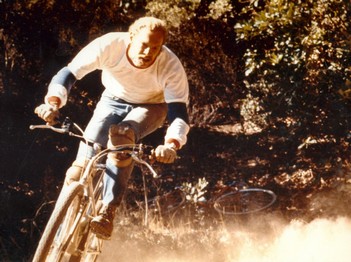
With a growing circle of clunker owners, by 1976 there were all sorts of informal group activities. Those of us who didn’t have to report daily to a form of employment started taking group rides, often throwing the bikes into the back of Fred’s pickup truck and taking them out to a new place to explore, such as Point Reyes National Seashore or Bolinas Ridge, which were inviting but a little remote to ride to from Fairfax. We pushed and pedaled to the top of Mount Barnabe and Pine Mountain and lesser peaks in between and explored every trail in the backcountry of Marin County, learning the lay of the land better than any but the rangers who patrolled it.
Before anyone thought to make rules about such things, we found every singletrack in the Water District and kicked off the primary political aspect of mountain biking when we offended hikers and equestrians by our mere presence in places once used only for their activities.
The first “Appetite Seminar” had taken place on Thanksgiving Day, 1975, when a dozen or so riders took a lap of the Pine Mountain Loop, the idea being that a long ride would set us up for a big dinner. The finish of the seminar was an exhilarating run down Repack, and the ride served as an introduction to it for the participants. Although the idea was spontaneous, we repeated it the following year. The Appetite Seminar is now the longest-running annual mountain bike event in the world and has become a Bay Area holiday tradition for upwards of a thousand mountain bikers.
Even with the new gearing, the bikes were still impossibly heavy, and pushing the bike efficiently was as much of an art as riding it. Sometimes pushing was faster even in areas where riding was possible. Trudging for half an hour up a steep hill beside a 50-pound clunker was not what most people consider fun, but we didn’t mind. It wasn’t any harder than trying to stay with the flying peloton in a road bike race, and even the trudging turned into a slow-motion speed contest as a couple of grim, sweaty riders tried to match each other stride for stride at 2 miles an hour. The reward for these efforts was standing on the peak, then shredding the dirt road back down.
As the group rides grew, perhaps a dozen clunker riders would push off a peak after picnicking at the top and recovering from the trudge it took to get there. This was the rush we had been working for all day, and we wanted all of it. Two or three riders are manageable on a fire road, but the groups were now bigger. “Dicing” on the downhill started to be a problem when everyone was equally competitive but not equal in size. It became obvious that you didn’t want to try to pass one of the bigger riders, who would ride you off a cliff to preserve his lead in a “race” that hadn’t really been declared. Pure downhill was fun, but fighting another rider for the fast line through the turn was a distraction. Eating dust and not being able to see the road was a bummer and so was having another guy stick his elbow in your ear. Everyone liked to see the road with no one in front and all options open, but on any given ride only one rider seemed to.
Professional Reviews
Wall Street Journal: Fat Tire Flyer by Charlie Kelly
The invention of the mountain bike might be the most intriguing story in the history of the bicycle. It is certainly the most unlikely. Around 1973, young hippie bike bums in California began riding pre-World War II, single-speed “cruiser bikes” downhill, at full tilt, on dirt trails—for fun. The aged bikes, nicknamed “clunkers,” were cheap and dispensable. Riders hammered them until they broke and then bought another one.
Slowly, the bikes changed. Nonessential parts were stripped off. New parts, cannibalized from every kind of two-wheeled vehicle, were added. Tires got fatter, frames were strengthened, brakes were improved, cranks got longer; in time, derailleur gears and thumb shifters appeared. All these features and components had been previously invented. It’s just that no one had put them all together, on one frame, with the specific aim of blitzing trails.
The greatest concentration of riders actively modifying clunkers was in Marin County, north of San Francisco. There fortune threw together a critical mass of athletic, inquisitive, competitive cyclists. None of them had gone to college. Few had proper jobs. They included Joe Breeze, a racing cyclist who also built frames, and Gary Fisher, an ex-Category 1 road racer and excellent mechanic. Later Tom Ritchey, a junior road racer and accomplished frame builder, joined the scene. At the center of it all was Charlie Kelly, the charismatic organizer—a rock-band roadie, writer and general outlaw with a passion for two wheels.
In the hands of this small coterie, the clunker evolved incrementally into the mountain bike, the form of the bicycle that would go on to blaze a technological trail through the late 20th century. It was the most significant innovation in the design of the bicycle since John Kemp Starley’s Rover Safety, which in 1885 introduced the diamond-shaped frame, and the beginning of a gold rush that revitalized the global bicycle industry. In 1996, mountain biking became an Olympic sport.
Several histories of the invention of the mountain bike have been published, but Charlie Kelly is indisputably the man to tell the story. In “Fat Tire Flyer,” he relates it with attention to detail and storytelling flair. Mr. Kelly was there: He organized the first downhill races; he was a partner in the first business selling mountain bikes and the editor of Fat Tire Flyer, the first mountain-bike magazine; and he attended the meeting that created the first sanctioning body for mountain-bike races. His friends and associates constitute a who’s who of the early mountain-bike industry.
Beautifully produced with over 140 color photographs, maps, flyers, posters, adverts and magazine covers, Mr. Kelly’s book is equal to his involvement in the movement: It is the definitive account of events that have been mythologized over the decades. There is a foreword by Joe Breeze and a coda by U.K. author and publisher Richard Grant. The appendix comprises several pieces of journalism, all but one written by Mr. Kelly, that bring his story more up to date. There is a good index.
At the heart of the story was Repack—a dusty, often precipitous, off-road trail that drops 1,300 feet in just under 2 miles down the side of Pine Mountain, a foothill of Mount Tamalpais in Marin County. By 1976, Mr. Kelly and his “Clunker Set” had been riding the Marin backcountry for a couple of years, during which time one question wouldn’t go away: Who was the fastest? There had to be a race. The gang met at the top of Repack on Oct. 21 for a time trial. Alan Bonds, Kelly’s housemate and builder of beautiful clunkers, won. He was the only rider who didn’t crash.
There were only ever 24 Repack races. Most of them were held from 1976 to ’79 and organized by Mr. Kelly. There was never a schedule. No more than 250 people ever raced the course, yet Repack was crucial. On the dirt and gravel, over bare rock and gullies, ruts, roots and boulders, at average speeds of over 25 miles per hour, down slopes of up to 20% gradient and round reverse-camber corners, blind turns and switchbacks, the mountain bike evolved, broken bike by broken bike.
When the bikes failed, riders went home and started repairing and modifying their machines. The name “Repack” even came from the act of fixing a bike. The original clunkers had coaster brakes with grease-filled hubs that heated up so much during the race that it boiled away. Riders then had to repack their hubs with grease.
The cross-pollination of ideas among the riders, and the hammering that the course inflicted on each bike, led Joe Breeze to make the Breezer #1, the first purpose-built mountain bike, in 1977. Today, there’s one in the Smithsonian.
Repack gave the mountain bike publicity, creating a market. Messrs. Kelly and Fisher went into business, albeit in a haphazard way, selling complete bikes. What began as a cottage industry in the garages of Marin County slipped into mass production in 1982: The California company Specialized manufactured 500 Stumpjumpers in Japan. They sold out in three weeks. Mr. Kelly notes in the book that these Stumpjumpers were “nearly identical” to the Ritchey MountainBikes he was then producing with Messrs. Fisher and Ritchey.
There are further swipes at others who piggybacked on the endeavors of the Clunker Set, but Mr. Kelly is also quick to admit the part played by those whom history has overlooked. As he writes: “The ‘invention of the mountain bike’ happened multiple times in multiple places . . . but the sport that changed the direction of bicycle manufacturing only had to arise once.”
Five years ago, I had the privilege of riding Repack with Mr. Kelly. Reflecting on hurtling down a mountain on a bicycle that was likely to break, he said: “It was always scary but that was why you did it, right? If it was safe, it wouldn’t be fun.”
—Mr. Penn is the author of “It’s All About the Bike: The Pursuit of Happiness on Two Wheels.”
Dirt Rag: Fat Tire Flyer by Charle Kelly
In the early years of Dirt Rag, I got a package from some guy out west, a guy by the name of Charlie Kelly. In the package were some magazines. Fat Tire Flyer it was called. It was the first MTB magazine, published from 1980 to 87. Charlie had come across a copy of Dirt Rag and immediately sent me a bunch of his ‘zines. Seems I had found my funk-soul brother from another planet, as I dug See-Kays irreverent and humble vibe. It was like looking in the mirror thousands of miles away.
Yes, Charlie was there at the beginning, starting not just the first magazine, but the first company to provide mountain bikes to the clamoring cult before the movement reached “Made in Japan” status. Yet Charlie never achieved the notoriety of people like Gary, Joe, or Tom.
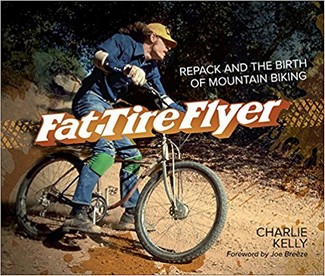
But now it’s Charlie’s turn to shine. He’s spent the last few years working on his book, the aptly named “Fat Tire Flyer: Repack and the Birth of Mountain Biking”, from Velo Press.
I knew he was working on it, and wasn’t sure what to expect, but now that I’ve seen it I am blown away . It’s bigger an fatter than I imagined, with 264 pages packed with new perspective on those early days of the sport we love. With its 11” x 9 1/2” format there’s plenty of room for some great photos, some never seen before. Each chapter is a vignette of a moment in time, but they all work together and flow rather nicely.
Every detail is here. From the first bastardized Schwinn’s, the first Repack races, Joe Breeze’s first run of bikes, Cove Bike shop, Tom Ritchey’s building, and more. It’s all there in first hand commentary, as if you were hanging out with CK at the trailhead while he regales you with his stories. I’ve been there, and I can hear Charlie talking through the pages, always humble and honest, warts and all.
There have been other books written over the years on the birth of mountain biking in Marin County (Not that there aren’t other places where MTB was born at the same time?), but this guy did coin the word “Mountain Bike” and that counts for a lot. This book stands as one of the great pieces on the subject.
Pez Bookshelf
In all honesty, readers don’t come here to PEZ to read about mountain bikes. We are all about skinny tires, classic road races, white ankle socks and total Euro-style. So when the folks at VeloPress, who put out some of our favourite road cycling biography/history/training/ books pressed one of their latest publications into our hands we were not sure what to do with it.
And that’s because “Fat Tire Flyer” by Charlie Kelly is about the birth and early years of the mountain bike. Bikes with fat tires. Bikes ridden by long-haired freaks in California in the 1970s. Bikes that–shudder–even got really dirty. And this account is one of the most entertaining books I’ve had this year.
There are very few inventions where one can say there was a clear and definite beginning. Germans will tell you Philipp Reis invented the telephone, not Alexander Graham Bell; the French will say that Clement Ader’s airplane was the first in powered flight, not the Wright Brothers’. The birth of the mountain bike (unfortunately described as “one of the most significant inventions in the 20th Century” on the book’s inside cover) brooks no such foggy origin. We have all heard about the Repack Race on Mount Tamalpais in Northern California and the names associated with the “klunker bikes” still resonate in the bicycle industry nearly four decades later. These names include Tom Ritchey, Gary Fisher, Joe Breeze and the author of “Fat Tire Flyer,” Charlie Kelly.
Charlie Kelly is a man who has worn many hats in his life and the book opens with an account of how he got into cycling. In his very amusing and wry style he recounts the junk bikes he rode as a child, moving up eventually to one of the great bike boom-era road bikes, a Peugeot U0-8, described as the kind of bike people who don’t own bikes would recommend.
Now into riding more seriously but still clearly knowing not much he upgraded to another Peugeot, a PX-10 (a very collectible bike in today’s market) before meeting up for the first time with like-minded spirits in the form of Gary Fisher and the drummer of the New Riders of the Purple Sage band. Kelly had become a roadie for a band himself and the group he associated with, musicians and cyclists, were long-haired free spirits.
Deciding that he wanted to race, he realized that it was necessary to belong to a club and since they thought of themselves as not suitable for the only bike club in the vicinity they ended up forming their own, rather anarchic group, the Velo-Club Tamalpais. To manage VTC, Kelly went to the public library and after mastering “The Clubwoman’s Handbook” was able to establish some rules of order and determine enough of a statement of purpose that VTC was accredited and on its way.
The group’s racing history did not sound particularly distinguished and Charlie Kelly’s own palmares never reached more than a second place after he blew a lead. But the story really gets interesting when he and his friends determined that riding skinny-tired 10-speeds for errands and transportation was not very practical so they picked up old heavy singlespeed bikes to ride to club meetings and for other purposes. One day they visited a friend on Mount Tamalpais in Marin County and using their heavy old bikes rode around on the local trails, discovering, to their apparent surprise, that going downhill was much easier than uphill. Soon a course was determined, the Pine Mountain Loop, and more people joined in.
A particular section of dirt fire road behind Cascade Canyon became the site of the now-legendary Repack. The bikes used were never meant to handle the kind of abuse the VTCers aimed at them and the coaster brakes would smoke as the grease burned out, necessitating frequent repacking and hence the name. Charlie Kelly took on the task of organizing the Repack races and arranging for time and record-keeping. As time passed the group made more and more modifications to their old bicycles but 40 year old bikes and parts gradually disappeared and as they become more and more modified the direction was clear. The Marin Klunker Bike, made of bits and pieces found in thrift shops and basements, metamorphosed into the first purpose-built off-road mountain bike with new parts, one of a small series constructed by Joe Breeze in 1977. The rest is history.
Charlie Kelly was not only the organizer of the Repack races but he went into a partnership with Gary Fisher to build and sell the new style bikes, with frames constructed by Tom Ritchey, and actually used the name MountainBike for the product. The growth of the racing scene, the MountainBike story, the establishment in 1983 of NORBA (National Off-Road Bicycle Association) and Charlie Kelly’s mountain bike publication, “the Fat Tire Flyer,” is covered in the book, with many period photographs and groovy counter-culture graphics.
There is much in the book that is counter-culture and one has the sense of a group of Californians who refused to grow up, semi-employed in their 30s and hanging around with bands like the Grateful Dead, having a great time crashing their bikes down Repack, while wearing what looked like construction worker gear. It was a world far distant from European-style road racing and in fact the Union Cycliste International (UCI) did not even deign to recognize the sport until 1990. In the meantime mountain biking has become a global sport, its manufacture a global industry. The bikes, with their fat tires, flat handlebars and friendly appearance, have brought many people into cycling who might never have considered it.
Charlie Kelly wrote for Bicycling magazine for a while—well, until he got fired—and other cycling pubications and the book includes some excellent samples of his writing. There is even a chapter about his trip to the 1985 Giro d’Italia, far from the fire roads of Marin County, where he saw some of the greats of European road racing, including Francesco Moser, perform before the world. And in a life characterized perhaps by the unexpected after “the Fat Tire Flyer” ceased publication he turned his hand to a completely different line of work, that of piano mover, for three decades.
Considering the makeshift nature of the original “klunker” project, VeloPress has produced a very fine volume, with good photo reproduction, worthy of any cycling library shelf. It is the first book to provide a detailed insider’s account of the birth of the mountain bike, a machine that had numerous fathers but was the product of a very particular time and place. “Fat Tire Flyer” may not be about road bikes and Euro-style but it is not just about a new technology coming to life. It is about unforgettable characters, good friends, good times and having fun on your bike. That is something all cyclists should be able to relate to and enjoy.
Want to review or comment on this book?
Need a FREE Reader Membership?
Reviews for "Fat Tire Flyer: Repack and the Birth of Mountain Biking"
"HOMEGROWN: The Making of the 1972-73 Providence College Friars" is a retrospective of that remarkable season as well as a history of the school's basketball program, which was responsible for drawing the local talent that propelled that team to succ
This book tells the story of the 1999 Providence College Friars baseball team, the last season that the sport was played at the institution. Baseball was set to be eliminated after that season in order for the school to comply with Title IX regulatio
This book tells the story of the 1999 Providence College Friars baseball team, the last season that the sport was played at the institution. Baseball was set to be eliminated after that season in order for the school to comply with Title IX regulatio