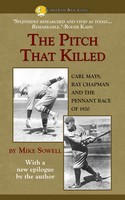
Few stories in the annals of baseball history match the irony or drama of the popular Ray Chapman’s fatal beaning by lone wolf Carl Mays. And few titles in the annals of baseball literature have received the critical acclaim of Mike Sowell’s award-winning telling of the tale. — Summer Game Books
Winner of the 1989 Casey Award for Best Baseball Book of the Year.
New York Timesnotable book of the year, 1989
Included on numerous all-time best baseball book lists.
Excerpt
Catcher Muddy Ruel followed the path of the ball. Ruel always had difficulty handling Mays's pitches, as the pitcher's underhand motion caused the ball to take unexpected twists and turns. That was especially so on days such as this when Mays was throwing with greater speed than usual.
But this pitch did not fool Ruel. It was a fastball and it took a noticeable although not extraordinary shoot as it approached the inside part of the plate. The catcher raised his glove in anticipation of catching the ball. From his vantage point, the pitch was in the strike zone.
The ball sailed directly toward Chapman's head, but he made no effort to move. He remained poised in his crouch, apparently transfixed as the ball flew in and crashed against his left temple with a resounding crack that was audible throughout the ballpark.
Mays heard the noise, then saw the ball bouncing toward him. Thinking it had struck the bat handle, he grabbed it and threw to first base. He watched as Wally Pipp made the catch and turned to toss the ball around the infield.
It was a routine Mays had seen thousands of times before. But suddenly, Pipp froze, his arm still cocked behind his ear. Mays wondered what was happening, then he saw Pipp staring toward home plate with a look of shock on his face. Only then did the pitcher realize something was wrong.
Professional Reviews
Death on the Mound
By SUSAN JACOBY; Susan Jacoby is a freelance writer and a New York Mets fan.
Published: September 17, 1989
On Aug. 16, 1920, Carl Mays, a New York Yankee pitcher, achieved an unwanted form of baseball immortality when he threw a fastball that hit and killed Ray Chapman, the Cleveland Indians' shortstop. In view of the fact that batting helmets did not become routine gear until the late 1950's, it is astonishing that Chapman is the only player in the history of the major leagues to have been killed by a pitched ball.
This tragic piece of baseball lore might strike nonfans as somewhat arcane, but Mike Sowell, the sports editor of The Tulsa Tribune, has used the incident as the focal point for an illuminating, highly entertaining exploration of a sport and a country during a pivotal period. ''The Pitch That Killed,'' the author's first book, is a gritty account that offers a much-needed curative for the current wave of nostalgic fantasy about kinder, gentler fields of dreams.
The cast of characters is a rich one that includes many of the most colorful personalities in the history of the game: Ty Cobb, Babe Ruth, Tris Speaker, Smoky Joe Wood and Jacob Ruppert, the co-owner of the Yankees.
Both Mays and Chapman had typical backgrounds for players of their era. Born poor in small towns, they developed their aptitude for baseball as the only alternative to what would otherwise have been bleak lives as miners or farm laborers. Because Mays's family was too poor to own a gun, he bagged dinner by throwing rocks at squirrels and jack rabbits. This story, which Mays often told as an adult, did him no good with those who felt he had deliberately thrown at Chapman.
The difference between Mays and Chapman was that the former was one of the most detested players in the game and the latter was apparently loved by everyone who knew him. ''You know, kid,'' a crusty minor-league manager once told Chapman, ''even if you never played a game, you'd earn your pay just by sitting on the bench and being such a cheerleader.''
Mays, in contrast, was described in terms usually reserved for serial killers. His contemporaries saw him as a sullen loner - a judgment that may have been influenced as much by his unwillingness to join in boozy bonhomie as by his give-no-quarter attitude on the field.
There is a darker undertone to Mr. Sowell's account than there is to Lawrence Ritter's splendid oral history, ''The Glory of Their Times,'' which encompasses many events of the same period. The era's popular religious prejudices, for instance, reared their heads even at the beloved Chappie's funeral - an event of major civic proportions in Cleveland. Chapman, a Protestant who grew up in the Bible Belt, had married Kathleen Daly, the daughter of a prominent Cleveland Roman Catholic.
Kathleen, claiming her husband intended to convert, wanted a Catholic service. Chapman's parents wanted a Protestant burial. (He was eventually buried in a nondenominational cemetery after a Catholic service). Several players took sides in this dispute. Tris Speaker, who had been best man at Chapman's wedding, and Jack Graney, his roommate on the team, beat each other up so badly that they were too disfigured to appear at their friend's funeral.
Not a word of this unseemly behavior reached the newspapers, since this was an era when sportswriters did nothing to tarnish the image of on-the-field heroes. One can only imagine the ensuing deluge of newsprint if, say, Darryl Strawberry and Keith Hernandez of the New York Mets had got into their 1989 spring-training fight over a teammate's last rites rather than over their own bragging rights.
Mays himself exemplified the prejudices of the era in his defense against accusations that he deliberately threw at Chapman. He declared that ''when any man, however ignorant, illiterate or malicious, even hints that a white man in his normal mind would stand out there on the field of sport and try to kill another, the man making that assertion is inhuman, uncivilized, bestial.'' The qualifying adjective ''white'' was one of the few of Mays's words that never elicited criticism.
Mays died a bitter man in 1971, because he felt the fatal pitch had denied him his rightful place in baseball's Hall of Fame. There is no question that Mays belongs in the hall of the basis of his won-lost record of 208-126 over 15 years and his lifetime earned-run average of 2.92. Rumors (never pinned down by the sportswriter who did the most to spread them) that Mays threw a game in the 1921 World Series may have had as much to do with his exclusion from Cooperstown as the fatal pitch. One suspects that Mays's fate was also influenced by the dislike he engendered in many writers, who elect the hall's members.
The beaning itself was almost certainly an accident produced by the combination of a pitch moving inside and Chapman's inability to see the ball on a gray, drizzly day. At the time, teams did not use clean, new balls. The typical pre-1921 baseball was a grimy object, covered not only with players' spit, licorice and tobacco juice but with the same ingredients from fans who returned the prized spheres to ushers in the stands.
All of that changed after Chapman's death, which the baseball analyst Bill James has cited as one of the key events that led to the modern so-called lively ball era. In 1921, the owners not only banned spitballs but agreed that new, clean, more easily seen balls should be used routinely. Pitchers were furious and batters hit more home runs as balls traveled farther and faster without their former unsavory load.
All of this would make a convincing argument for the science-fiction theory that altering one small event in time will change the universe forever. In this fascinating account, Mr. Sowell has re-created the bygone social universe surrounding that unique and fatal pitch.
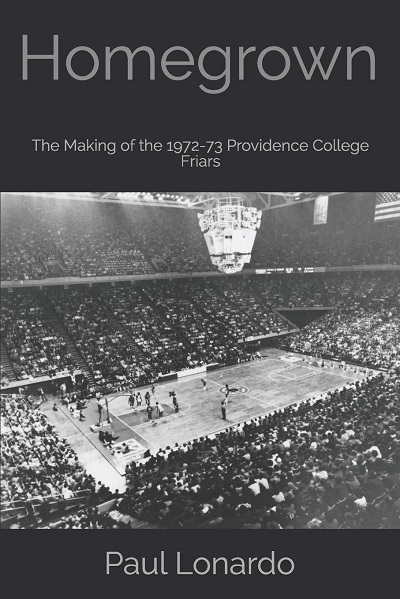
"HOMEGROWN: The Making of the 1972-73 Providence College Friars" is a retrospective of that remarkable season as well as a history of the school's basketball program, which was responsible for drawing the local talent that propelled that team to succ
"HOMEGROWN: The Making of the 1972-73 Providence College Friars" is a retrospective of that remarkable season as well as a history of the school's basketball program, which was responsible for drawing the local talent that propelled that team to succ
"HOMEGROWN: The Making of the 1972-73 Providence College Friars" is a retrospective of that remarkable season as well as a history of the school's basketball program, which was responsible for drawing the local talent that propelled that team to succ