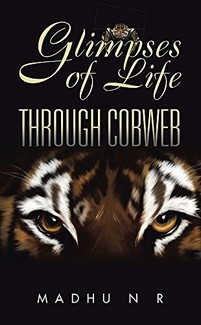
Glimpses of Life Through Cobweb
Glimpses of Life Through Cobweb
By Madhu N R
Published by Partridge India (2015)
ISBN 978-1-4828-4571-6
104 pages
Reviewed by Brian E. Wrixon
Founder of “Poets with Voices Strong”
It’s an interesting little book, one of those that leaves you scratching your head and then thumbing back through its pages. I quickly came to the conclusion that Madhu is a person with whom I would like to spend an afternoon, in the off chance that I might be successful in nailing down just who the real Madhu is.
Reading Glimpses of Life Through Cobweb is like being a spectator at a race car track. You know your favourite driver is behind the wheel of car #29, but every time it makes the circuit and roars past the starting point, a new driver is behind the wheel. As I read through the book, I am confronted by an author who is at one time a philosopher, then an artist, a lover, a patriot, a humourist, an historian, a social commentator and the list could go on and on. The question remains for me, “Just who or what is Madhu?” All I know for certain is that Madhu is a writer who keeps me engrossed throughout the entire book, and one whose brain must operate at racing speeds.
This slim volume is comprised of three parts – Poems, Stories and the Cobweb dialogues. The first two sections are self-explanatory, whereas the last one needs some description. The author tells us that Cobweb has two characters, a spider and a sloth, both of which are symbols of human beings. The deadly spider is waiting for the sloth to fall into its web but the boring and wily sloth always manages to steer clear of the trap. Their dialogue consists of a series of questions and answers or statements and counter statements. It is all highly entertaining.
My favourite poem in the book is the first one, “Ode to a Tigress from India”. It is a tribute to Jyoti Singh, the young medical intern who was the victim of that horrific attack on a bus in Delhi in 2012. More than a tribute to her and to women in general, it is also a strong social commentary on men, the police, and society itself that allows such things to happen in the first place, and then does little to keep them from happening again. One could easily just change a few words in Madhu’s poem to create a similar diatribe against gun violence in the USA, or the backlash against refugees in Europe. The author’s strong feelings and disgust with the system and its do-nothing supporters literally spits from the page. The people were outraged and protested vehemently, but the system has done nothing since that dreadful. The problem continues. I find it interesting to note Madhu’s contention that if Nirbhaya (Fearless) had died in India instead of Singapore, Delhi would have burned.
My favourite short story in Glimpses of Life Through Cobweb is “Vincent Van Gogh Meets Death”. It is the story of a conversation that Vincent has with Death while he lays there waiting the end of his life. Death is surprised that Vincent does not appear to fear him like most people do when at their final point of worldly departure. Vincent tells him that he has always had more trouble dealing with Death’s enemy. “My enemy, who is that?” Death asks him. Vincent replies, “Life.” Like all of Madhu’s short stories, this one is well-written, poignant and surprising.
The final section of the book is most entertaining. The Cobweb dialogues between the Spider and the Sloth will leave you laughing at times, shaking your head, shedding a tear, shouting “Aha!”, or sometimes “O no!” It is through the give and take of these two line conversations that we see all aspects of Madhu’s personality and sometimes his strange ways of thinking. Call them repartee, wit and quick retort, fast thinking or whatever you wish, the fact is that the dialogues are brilliant. Once more we see a writer’s brain operating at 100 miles an hour. As the author says in the Introduction to COBWEB, “This is NOT – non-political, non-philosophical, non-sexual, non-satirical, non-ironical, and non-absurd.”
The next time I am in Trivandrum Madhu, please put on the kettle for a pot of tea. I would love to spend the afternoon trying to keep up to you. On second thought, maybe you had better make it something stronger than tea!
Glimpses of Life Through Cobweb is a good read and has my full recommendation. I look for more in the future from this talented writer.
Musings of a Poet
By Express Features | Published: 04th August 2015 03:48 AM |
Last Updated: 04th August 2015 03:48 AM | A+A A- |
The collection of poems and short stories by Madhu N R, Glimpses of Life Through Cobweb, attempts to present an informed observer’s take on everyday happenings. Published by Partridge, tyhe book was recently released in the city.
The book is dedicated to the victim of the 2012 Delhi gang rape and so is the first poem, ‘Ode to a Tigress from India’. From an impassioned plea for justice, the poet moves to a scathing criticism of the apathy that plagues the Indian society when it comes to crimes against women. The enraged poet says that the country is worse off than the Nazi concentration camps. The poem ends with the hope that the young woman will acquire the status of an idol and a symbol of the insurmountable spirit of a human being.
The poet deals with an array of subjects in the collection, offering his thoughts on everything from corruption to the divinity of motherhood. The voice is often sarcastic, mocking the constructs of religion and politics. By focusing on the futility of politics as a tool to bring about positive change in the lives of human beings, the author prompts the reader to think of alternatives.
The gravity of the subject on hand is often cloaked in a deceivingly simple approach to it. As in the poem, ‘Jihad’, which is a short take on the senseless killing of people in the name of religion. The explosion of information and the lack of choice in this regard is pondered over in the poem, ‘A Day for Celebration’. The poet declares that the day after a public holiday, when the newspaper does not arrive at his doorsteps in the morning, is marked by peace and happiness. He confesses that the habit of newspaper reading gets the better of him on other days, implying that people allow themselves to be bombarded by information.
The two short stories in the collection are allegorical in nature. The stand off between Satan and God is satirised in ‘An Idle Man in the Devil’s Workshop’ and by adding on the character of ‘The Briton’, the author has weaved an allegory for the conquest made by commercialism on our sensibilities. ‘Lord Rama’s Dilemma’, a story told in five paragraphs, is a sympathetic take on Ramayana.
Space Bugs, Earth Invasion (57,000 words) is an imaginative sci-fi/fantasy novel written for children eight to thirteen that could also be read and appreciated by adults. Space Bugs completes the young adult trilogy that was begun by Enchanta and Pot