Category: Fantasy Publisher: Black Rose Writing
ISBN-10: 9781612969541
Type: Fiction
Pages: 132
Copyright: Nov. 16, 2017
ISBN-13: 9781612969541
Price: $3.99 (eBook)
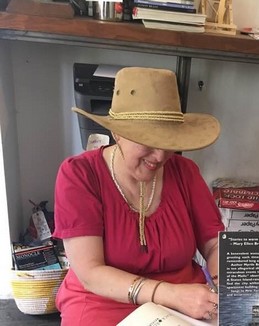
Author Myrtle Brooks’ love affair with the Big Apple served in ten allegorical slices depicting everyday people experiencing miraculous events throughout the five boroughs.
A benevolent woman of quiet mystery who smiles in welcome greeting each time one visits her; whose distinct perfume is remembered long after one’s departure:
Author Myrtle Brooks’ love affair with the Big Apple served in ten allegorical slices depicting everyday people experiencing miraculous events throughout the five boroughs. “The Sanctity of the Mails:” observed in Heaven via the Brooklyn Post Office. A Staten Island-raised engineer who escapes city living, only to find the city within himself. A mysterious floor in a Queens apartment building reachable through attainment alone.
"Songs to New York" crosses the threshold between impossible and occurrence: “Only in New York.”
Excerpt
IV. THE BAR
“Wisdom… hath mingled her wine; she hath also furnished her table.”
-Proverbs.
Our friend, Timothy Green, his wife, Sarah, and their 11-month infant, Timmy, Jr., moved out of their two-bedroom apartment in Coney Island a while back and headed upstate for Poughkeepsie. IBM had offered him a job at their immense building complex for more money than what they paid him here in New York. It was a supervisory position for which, as an engineer, he well qualified. After discussing the offer with Sarah, he accepted. “New York has gotten too dangerous, anyway. No place to bring up our son.”
IBM helped arrange for a rental with an option to buy: a three-bedroom ranch with a good-sized yard located four miles from the plant. Two elm trees, one in the back, the other in front, sheltered the house from the morning and late afternoon sunlight. Smaller trees and shrubs formed the borderlines of the property.
The Greens loved their new dwelling. In their minds, it was the ideal in every aspect: a perfect life for their son. Timothy wondered how they had survived city living for so long.
Born in St. Vincent’s Hospital in Staten Island, Timothy spent his youth in Port Richmond in a 1930s two-story cedar home with a fenced-in yard and large porch. As a child he frequented the Ferry with his parents, Lyle T. and Dorothy, who traveled often to Lyle’s widowed mother on West 99th Street in Manhattan. Both the ride and the Upper West Side appealed to Timothy. The former was due to the view of the Statue of Liberty, and to the ferryboat itself, which he scoured from bow to stern in search of hidden treasure and of pirates.
The latter held Timothy with an attraction not so easily explained. It was not just on account of such tangible things as the stately splendor of Riverside Park where he played catch with his grandmother; or the majestic antiquity of the residences overlooking a Broadway more quietly paced than Midtown, with an endless center divider filled with trees and flowers, and park benches at every corner. The Upper West Side had a spirit all her own, a benevolent, mysterious woman who spoke little, but who smiled in welcome greeting each time he visited her; whose distinct perfume lingered long after his departure.
But, as one-by-one the years advanced, and with them the unrelenting increase of crime and urban neglect, the perfume faded from Timothy’s conscious memory. The Staten Island Ferry, Coney Island (where he had met Sarah and afterwards resided for two-and-a-half years) and the city in general became routine, a habit he could rid himself of without regret.
Instead, memories surfaced of his studies at Penn State University College of Engineering in State College, Pennsylvania, a town surrounded by farmland. Over four years’ time, spending leisure hours in meadows reading books on returning to basics and humankind’s role in the natural order, he had come to believe the tranquility of his surroundings far surpassed the steel and concrete into which he had been brought forth. In fact, he began to link the inner city with the decline of man into a soulless, materialistic hell on earth of his own making.
In his boyhood, Timothy had always desired to take up engineering, and he graduated Penn State among the top five of his class. But now, he found it harder to equate an engineering career with his quest for perfect harmony with nature. He yearned for a brighter future.
Thus, it was with these thoughts, that he packed up and left New York on the day which, in his estimation, marked an upward start.
Sarah, while sharing her husband’s love of nature, expressed her continuing feelings for the city she had called her own since age three when her parents moved from Omaha. “There’ll be no beaches up here. No Astroland. No subways.”
“No hypodermic needles sticking up out of the sand,” her husband would smirk. “No muggings on the subway, no crowds, no hallways reeking of urine. And no kids puking on top of your head from the roller coasters.”
“Oh Tim, you’re so sarcastic,” Sarah would give him a playful shove. “Seriously, though, I miss New York. We’ve got to go visit. I mean it.”
Two years passed, and the Greens settled in. The baby grew big and played in the yard with the neighbors’ children, while their parents sipped drinks and spoke of past hits and misses, present pursuits and future prospects.
Timothy’s honed skills earned him a raise. With few exceptions, his colleagues and those under him admired his dedication and perseverence. But Timothy continued to take little pride in his achievements: as this was not the job to which he would devote the rest of his life.
When they did manage to get back to the city, Sarah remarked that their stay had passed too soon, that their visits were too infrequent. Timothy turned his nose up over the litter-strewn streets and looked at his watch, hoping they would reach Grand Central Station in time to catch an early train home to Poughkeepsie, the city of trees.
Then, in the middle of the third year, the dreams began.
They were barely noticeable at first. Timothy brushed them off with a: “Can you believe, last night, I actually dreamed…” Oftentimes they were fragmented; brief glimpses through a frosted pane of glass melted in one tiny place. But as they recurred in the early morning hours, their impression lingered more and more, like perfume scarcely acknowledged until compounded by the wearer’s frequency.
It was the wind rippling his shirt and tousling his hair when an approaching subway train rocketed through the tunnel. Or a hot chestnut and pretzel vendor holding out a sack of culinary treats. Or the Midtown Symphony Orchestra of honking car horns. Or the towering grace of the skyscrapers shading his head from the sun. Or the sun setting on a waterfront inhabited by sky rises beaded with jewels of light.
He awoke with a strange emptiness he could not explain.
“What’s wrong, honey?” his wife asked him one morning in bed. “You keep waking up and just lying there.”
“I… I don’t understand it, Sarah. But for… I’d say around two months now, something’s been happening inside me that seems against everything I believe in. I’m… almost afraid of it.”
“What is it? Tell me.”
“I… keep having these dreams. About New York. Always New York. Little things. Little dreams.”
“Well, perhaps deep down you miss New York.”
“No way! That’s why it bothers me that I’m even dreaming this: like the very thing I’m trying to escape is haunting me like some kind of ghost. Remember in The Bible: ‘The spirit is willing, but the flesh is weak?’ Well, it’s as if my spirit says, Go back to earth and to nature, but my flesh says, No, no, the big city’s where you belong.”
Sarah’s eyes met his straightway. “Maybe you are not aware of what your spirit truly is saying.”
Timothy stared back in silence.
The dreams increased in size and occurrence. Once, Timothy was a passenger on a New York-bound train from upstate. At the borderline of The Bronx, it screeched to an abrupt standstill, and the conductor announced: “This train can go no further than here.” Timothy looked out the window and saw iron bars stretching for miles, preventing entrance into the city.
Whenever the Greens visited their relatives and friends in New York, Timothy tried to piece together his dreams.
Professional Reviews
Beautiful, whimsical love letter to New York (Five stars)
Songs to New York, as the title suggests, is a love letter to New York. Although I have never been to this city, I feel like I know it now, because of the way these stories were written. Brooks' beautiful, gentle prose is easy to read, and it fills the reader with a sense of wonder and hopefulness, all the while making you see more of New York than meets the eye. I am a fan of Brooks' novel, The Geyser Girl of Yellowstone Park, so it is no surprise that my favorite story in this collection was the one about an anthropomorphized cat named Marco Polo who learns to ride a bicycle. This story, like the others, is whimsical and quirky, and juxtaposes the harsh realities of New York with a sort of childlike wonder that is very endearing to the reader.
This book is a quick read, and makes you think about everyday things in a new way.
-Author Jessica A. Scott
far more than a dream to me/ I love you, and that is the reality/ Which (Four Stars)
Songs to New York is a collection of stories from New York, for New York. Beginning with an inscription, “My dear, yet, far more than a dream to me/ I love you, and that is the reality/ Which, pervading your soul and breath as you do mine/ Transcends the temporal and touches the Divine,” the ten tales that follow tell of miracles connecting people to each other and their city.
Be amused by a bicycle-riding cat, take a trip to Heaven, take a celebratory ferry ride, recover a lost balloon, send a letter to God, befriend a bug, take dreams seriously, and immerse yourself in music -- these stories present a perspective on New York life that is eye opening and gracious, healing and full of wonder. In a clever twist, the last story is called “The 10th Story,” about getting to the top floor of an apartment building only by going through the other nine floors. This tenth and final chapter suggests the book is to be taken as a whole, not just as isolated stories but invitations to look for the spirit of the place in which we live.
The tone of the book is religious, although non-denominational. Multiple nationalities and generations are authentically represented. A true, light-hearted, concrete-defying, picture of New York.
-Mari Carlson, Midwest Book Reviews
This is the perfect little book to curl up with on cold winter ... (Five Stars_
As a former New Yorker and want-to-be-again New Yorker, this lovely collection of short stories about the Big Apple spoke to me on many levels. The potpourri of characters and the episodes of their lives were delightful and left me longing for the city. The flow and cadence of the language was engaging and a treat in and of itself. This is the perfect little book to curl up with on cold winter night. The stories are sure to warm your heart.
-Heather's Picks
Pot of Gold (52,000 words) is an imaginative fantasy adventure novel for children ages eight to thirteen that adults will also find interesting and funny. Janet and Larry Garrison, twelve-year-old fraternal twins are touring Limerick Caverns with the
If you enjoy being taken to the edge of your seat, yanked sideways, and left spinning through the sky on a speeding wyrm, rejoice. The gripping, white-knuckled conclusion of the Dragon Racers trilogy is here.