Kindle Edition
Amazon
Stateless
Cyberwit.net
Category:
Literary Criticism
Publisher: Cyberwit.net
ISBN-10: 938665346X
Type: Non-Fiction
Pages: 82
Copyright: December 21, 2017
ISBN-13: 9789386653468
Price: $4.99 (eBook)
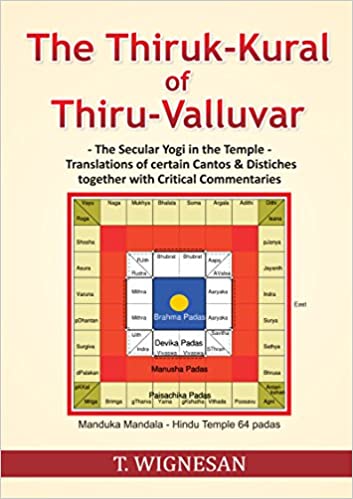
The most celebrated oeuvre in Tamil: The truth about a Tamil poet and his oeuvre constructed on the architectural plan of an extended Hindu Temple (the Manduka Mandala complex of the Gupta Period) in the Middle Ages and based on the Hindu conception of life. For over a thousand years or more, it was taken for granted that the poet who has been a household word ever since was a priest officiating in a Hindu Temple for the Dalits or Untouchable castes. In my mathematical calculation of the 1330 cantos of 10 couplets each, I give the proof of his deliberate use of the extended architectural plan of the largest type of Hindu temple to shape and create his monumental oeuvre which is an epic endeavour for any poet given the complexity of the prosodical and rhetorical features of the classic Tamil couplet known as the "kural"..cf. SAMPLE CHAPTER here: https://www.authorsden.com/visit/viewPoetry.asp?id=350885&authorid=200114
The Thirukkural of Thiruvalluvar: The Secular Yogi in the Temple by T. Wignesan
(cf. SAMPLE CHAPTER here: https://www.authorsden.com/visit/viewPoetry.asp?id=350885&authorid=200114 )
Note on the Structure and Nature of the Treatise on Ethics
For all we know, the Thiruk-Kural was composed in Tamil used over a thousand years ago in most probably Tamil-Nadu by an individual who is only remembered by his caste name, Thiru-Valluvar: “thiru” meaning “sacred”, “kural” meaning “short”, that is, the poetic form of distique or couplet with its own rigorous metre, rhyme and rhetorical features, structured according to classical Tamil “venba" pattern of prosodical rules. “Valluvar”, on the other hand, is the name of a caste of priests who served in temples reserved for the “lowest” untouchable social denomination.
The book is divided into three sections along certain Hindu traditional Purusha pursuits: araththup-paal (dharma or virtue), porud-paal (artha or the acquisition of wealth), kaamaththup- paal (love and amorous relationships, both pre-marital and connubial). Each canto is made up of ten distiches, totalling
1330.
The scant linguistic and socio-political evidence the book tosses up or lets escape make the delineation of the personality of the author extremely difficult and thus allow for much dubious conjecture about his origins and nurture. One of the earliest commentators on the treatise, Parimelalakar, lived in the 13th century C.E.
The oeuvre has come down to us as the storehouse of wisdom on all matters concerning the householder, his interpersonal relations with his beloved and social environment, his place in a society where the government by royal edict and benevolence controls and dictates his wishes and aims. The secular work has achieved the status of the ultimate voice of inner conscience in all that the householder may undertake, while informing his private, public and intimate behaviour.
As such, this classical treatise on ethics has even been claimed by most Tamils as their true testament and repository of cultural heritage, replacing even other religious compositions. That the work smacks of Jainist and/or Buddhist influences, apart from the inevitable foundations of Hindu beliefs and practices, may not however be easily contradicted.
The important thing to acknowledge is that all Tamils are familiar with its teachings be it ever so little as to be able to quote from memory some few couplets on all sorts of occasions.
The author provides - as we progress through the translations - appropriate commentaries which ultimately lead to an exegesis of the great poet’s hidden motivations: the construction of a philosophical/ethical oeuvre on the architecture of an extended Hindu Temple according to the dictates of the Hindu conception of life.
(Note: First published in www.poetrysoup.com/me/twignesan in 2017 and
in print version by www.cyberwit.net/authors/twignesan
and marketed by Amazon.com Services LLC)
(c) T. Wignesan, Paris, 2015-17
|