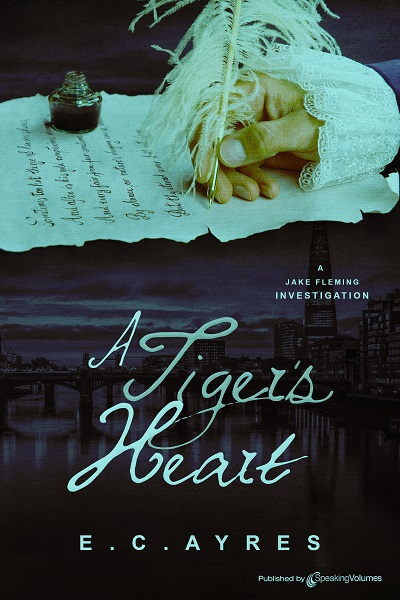

Kindle Edition
Amazon
Category:
Mystery/Suspense
Publisher: Speaking Volumes
ISBN-10: 1645403556
Type: Fiction
Pages: 445
Copyright: January 19, 2021
ISBN-13: 9781645403555
Price: $6.99 (eBook)
Investigative reporter Jake Fleming goes to London to investigate the disappearance of a good friend, who'd vanished en route to Jake's home port of Berkeley, California to give a talk at the University about a new book he was about to publish. He predicts it will be a blockbuster, but also highly controversial. He never arrives.
San Francisco based Investigative reporter Jake Fleming has a problem: Desmond Lewis, a Professor of English Literature and an old friend of his from London has vanished, en-route to a talk at the University of California in Berkeley about a new book promising shocking revelations. He never arrives. When a rented car is found parked on the Golden Gate Bridge with Lewis’s travel bag in the trunk, the police deem it a suicide. Jake doesn’t believe that for a minute, and convinces his newspaper The San Francisco Tribune, to sponsor a trip to London to investigate.
When Jake arrives, he discovers Lewis’s office and apartment have both been ransacked. Any evidence of a new book is gone: no manuscripts, no flash drives, nothing. The only remaining clue is a list of brief words or abbreviations. Their meaning escapes him, but it’s all he has.
Excerpt
Prologue
Outside London, late November,
11:51 p.m., present day
The pallid sliver of moon drooped low over the London night sky, the city’s
sullen glow giving way to the onward creep of fog rising from the river as the witching hour drew closer. Abruptly, the moon vanished as the mist closed in on the churchyard. The ancient stone edifice and dark bell tower loomed above and behind the two intruders as they dug: a black pit before them, darkness at their
backs. The man shivered, pulled the drawstring tighter on his military surplus parka, and plunged the shovel once more into the sodden, moldy earth. So far so good. They were nearly six feet down and had collected a dozen or so bones of different sizes and functions, some with ancient, dried organic matter still clinging to them. They’d even found a pale staring skull, its ancient jaw clenched in a perpetual scream as if yearning to tell a tale of horror that would
remain forever untold. The man who so frantically dug could only hope they
had gotten enough evidence to make their case.
“Oh shit. C’mon, hurry up, please!” the young woman called out anxiously
as she stopped a moment to listen. “I think someone heard us!”
The man heaved another scoop of loam from the burrow they had dug along
the wall. He could tell she was losing her resolve by the minute. “Hang on. We have to know one way or the other!” His stomach emitted a growl of displeasure. Shit, he thought. Bad time to run out of Mylanta.
As with most old English churches, the rear of the churchyard had lain in
silent vigil over the worn and weathered stones for ages, some of the crusted markers many centuries old, with names long lost or forgotten. Such was the case with the name engraved on the bronze plaque above their heads, on the vine-and moss-covered brick wall. The plaque was ancient, yet it appeared to be the newest object in the vicinity, suggesting that some lonesome devotee
somewhere had assumed responsibility for its care, perhaps not unlike the
longtime faithful nocturnal visitor to the tomb of Edgar Allen Poe.
‘Cut is the branch’ it read in letters still clearly etched in the dim night glow from the city’s distant lights. The man had seen it once before, recently, and heard the words
uttered long ago and far from here by a dying man on a theater stage: 'Cut is the branch that might have grown full straight'. And above the inscription, a name that had languished in infamy for more than four hundred years.
By this time, he was convinced that the dead poet was not buried here but
rather another man entirely. Possibly a stranger or derelict, or even a true victim of murder rested below. But not the name on the plaque. Ironically, the only way to prove that was to fail to dig him up. Yet dig he would, fully aware that he was engaging in a crime: stealing bones from a church cemetery! But it was the only way he could think of—that any of them could think of—to know the truth for certain.
They had access to forensics. They could DNA any bone marrow or tissue
they found. It would be enough, he believed, at least to eliminate the line. It would be a much harder task, he knew, to assign these bones to Penry. But that wouldn’t matter; it wasn’t whose bones they were, so much as whose they were not that counted.
A light went on upstairs in the rectory, at the far end of the church. “Damn!” he muttered, and his stomach sounded its own second warning. He dug faster.
The young woman stopped digging, more urgency in her voice than before:
“Jesus, let’s go! Someone’s coming!”
He heard the rectory door open in the distance. He heard it slam, then the
sound of footsteps approaching. The graveyard filled with shadows that came alive like creeping ghosts, swooping and weaving before the uneven gleam of a hand-held lantern as it came bobbing towards them.
“Who’s there?” a gnarled voice shouted out. “Curst be he that moves my
bones!”
“Fuck this,” declared the young woman. “I’m outta here.”
The man gave in at last. “OK, I’m coming.” Quickly, he helped her out of
the hole and scrambled up after her. By then he knew they’d been seen. His
stomach churned again in open rebellion as he grabbed the shovels, threw them over the wall, and dove after them.
But his companion’s feet slipped, and she fell back into the graveyard. That
was when he heard the scream.
|