|

Kindle Edition
Amazon
Amazon
Barnes & Noble
Category:
History
Publisher: Speaking Volumes
ISBN-10: 164540417X
Type: Non-Fiction
Pages: 226
Copyright: March 23rd, 2021
ISBN-13: 9781645404170
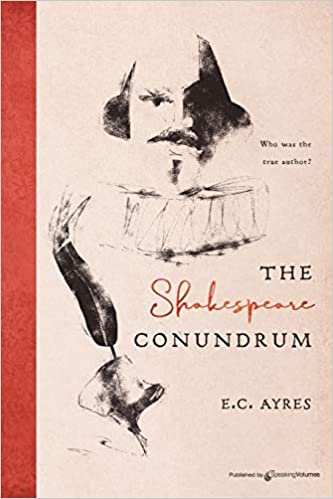
An investigation into the controversy surrounding the Shakespeare authorship.
The controversy over the authorship of Shakespeare is two centuries old, and the doubters were numerous: Mark Twain, Samuel Taylor Coleridge, Walt Whitman, Henry James, Ralph Waldo Emerson, Charles Dickens, Sigmond Freud, Charlie Chaplin, even Orson Welles questioned the veracity of Shakespeare as author. For starters, the man had no known education. He was raised by illiterate parents in a rural farm village, where the local school only had three grades. But even that much schooling is in doubt, because there is no evidence he was ever registered there (or anywhere) as a student. He signed his wedding certificate with an 'x'. His will included no books—not even a bible—and his gravestone epitaph is superstitious and illiterate.
So, who was the true author? Once again, the evidence is extensive and conclusive and points in a single direction, to a man forced to live in exile sending plays from Italy to the Globe, where Shakespeare, whose three roles in the company (actor, producer and 'author') assured that he would be first to receive anything, then he simply stamped his name on them. Four centuries of grave injustice cannot easily be overcome. But this is a start...
Excerpt
Prologue
Setting the Stage
In 1951, an obscure English author named Elizabeth MacKintosh, writing as Josephine Tey, published an extraordinary short novel (188 pages, once again proving that size isn’t everything) which legendary New York Times book critic Anthony Boucher declared to be “one of the permanent classics in the detective field.” Boucher further proclaimed Tey’s modest little novel to be “not only one of the best mysteries of the year, but of all time.” Such praise was not lightly given by the redoubtable Mr. Boucher, or for that matter, any book reviewer, just on general principles. Interestingly, Boucher’s use of the phrase “of all time” echoes Ben Jonson’s words three hundred and fifty years earlier to describe Shakespeare. In a eulogy written several years after the death of the Bard, Jonson called him “. . . a man for all time.” Of course, Jonson was just parroting Robert Whittington’s eulogy for the sainted Thomas More, “a man for all seasons.” Which like everything else we think we know, may or may not have been true. Which, when it comes to Shakespeare, is the whole point of this book.
Tey’s little novel was titled The Daughter of Time, the title originating not with Jonson, nor, for that matter Shakespeare, but from an old proverb: “Truth is the daughter of time.” And what Tey had done was, if not alter history, at least alter the public’s perception of history, and open up to legitimate question a matter that had long been thought laid to rest: the truth regarding the alleged villainy of King Richard III, and the murder of the two princes in the Tower of London. What Tey dared to suggest, through the literary device of present day detective work, was that Richard was not at all the hunchbacked demon depicted by Sir Thomas More on behalf of the Tudor dynasty that succeeded him, and that he had very likely been slandered, not to mention murdered (at Bosworth Field) by the French-born adventurer Henry Tudor (Henry VII), a distant cousin of his mother.
Tey’s book is a fascinating and entertaining page turner, in which a passive, bedridden police detective takes up the cause of the deposed king Richard, trig-gered at first purely by a casual perusal of a copy of his portrait, the original of which still hangs in the National Gallery. This portrait depicts—in the view of our querulous policeman accustomed, it seems, to making snap judgments—a thoughtful, sad, intelligent man, who has seen much travail, and had tried to do the right thing. We all know where that can get you, who live in the 21st Century (the same place it tended to get you in any other century).
|