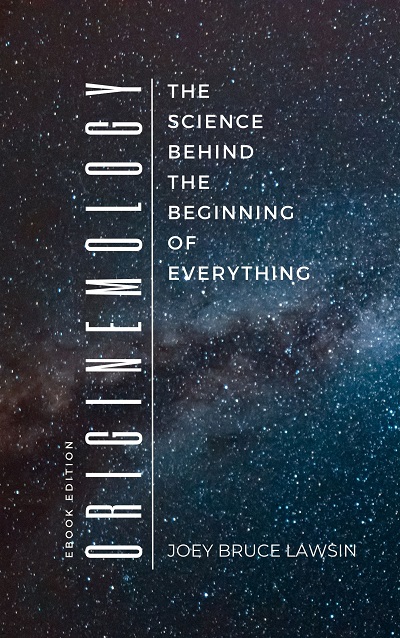
Originemology is the science behind the beginning of everything, the "study of the origin of origins". It is a pioneering discipline that examines generally the roots or origins of everything and everyone based on the natural emergence of instructions comprehensively known as Inscription by Design.
Originemology represents a novel school of thought primarily focused on unraveling the Genesis of Information—the inception, creation, and evolution of information across various epochs: from primordial times to ancient civilizations and into the modern era. This field delves into fundamental scientific inquiries:
1. Emergence of Information: How did information first manifest in the minds of our earliest human ancestors?
2. Providers of Knowledge: Who supplied our primitive forebears with this information?
3. Origins and Sources: Where did this information originate? What was its source?
4. Divine or Extraterrestrial Influence: Was the source of information a sentient being (a “who”) or an abstract force (a “what”)? Could it have been a deity, extraterrestrial beings, or something else entirely?
5. Transformation of Information: How does information evolve into inscriptions and instructions?
Key Components of Originemology:
1. Ideas and Concepts: It scrutinizes the origins of ideas, labels, and concepts created by humans—such as languages, numerical systems, behaviors, emotions, and even notions of gods and tools.
2. Natural Objects: It investigates the origins of objects created by nature—ranging from the vast universe to elements, plants, and animals.
3. Laws of Nature: Originemology explores the inherent laws of nature, aiming to synthesize a comprehensive Single Theory of Everything.
In a broader context, Originemology is a cross-disciplinary endeavor, drawing insights from fields like anthropology, archaeology, geography, history, chronology, etymology, ideology, onomatology, ontology, and epistemology. The collaborative pursuit seeks to systematically trace the primal source or origin of information—whether abstract or physical—from its elemental beginnings to its emergence as complex structures. This exploration is guided by five primary questions:
1. Emergence: How did the original idea come into existence?
2. Provider: Who first conceived the original idea?
3. Conceptualization: Where was the idea initially conceptualized?
4. Chronology: When did the idea first take shape?
5. Purpose: Why was the idea conceptualized in the first place?
Foundational Theories in Originemology:
1. The Caveman in the Box Trilogy: This trilogy unravels the enigma of our earliest ancestors—the cavemen—within the context of their environment. It examines their cognitive leaps, the birth of ideas, and the emergence of rudimentary knowledge.
2. Codexation Dilemma: At the heart of Originemology lies the question of how information transforms into inscriptions and instructions. The Codexation Dilemma claims that no human can think of something without associating his thought with something physical.
3. Intuitive Objects: This theory explores the origins of objects created by nature. From celestial bodies to earthly elements, plants, and animals, each object carries embedded inscriptions of its own.
4. Inscription by Design: Inscription by Design asserts that everything can store information on its own without the aid of a brain or neurons, and through its embedded inscription one can be alive, living, and with life.
5. Generated Interim Emergence: Also known as the Single Theory of Everything, it asserts that everything only exists because other things cause it to exist, otherwise, it actually exists and doesn't not exist at all.
Ancient Questions Revisited:
1. Who or What Created the Universe?: Originemology prompts us to revisit our origins. Was it a cosmic architect, a primordial singularity, or an intricate interplay of inscription and materials?
2. How Is All Creation Created?: Here, we delve into the mechanics of existence. From subatomic particles to galaxies, each creation follows a pattern—an intricate dance of space and shape, materials and instructions.
3. Where Did We Come From?: Our origins trace back to the single theory of everything: generated interim emergence and inscription by design.
4. Why Are We Here?: Purpose echoes through the ages. Whether driven by curiosity, survival, or cosmic design, our existence carries a profound quest for meaning.
In this dance of beginnings and endings, Originemology invites us to decode the symphony of existence—one inscription, one idea, and one primal spark at a time.
The symbiotic pattern of evolution is everywhere and allows us a very different and fascinating window into the way symbiotic viruses work, since all viruses are symbiotic, including those involved in our human reproduction.
Our human genome is full of viruses similar to HIV-1. These have played an important role in human evolution and still play an important role in human embryology and day-to-day chemistry. Just how important are they to our evolution past and future?