Category: History Publisher: Greenleaf Book Group Press
ISBN-10: 1934572691
Type: Non-Fiction
Pages: 216
Copyright: Jan 30, 2012
ISBN-13: 9781934572696
The authors of Savannah: Brokers, Bankers and Bay Lane: Inside the Slave Trade (Civil War Savannah), received the 2012 Award for Excellence in Research from the Georgia Historical Records Advisory Board. The Award was issued by then Georgia Secretary of State, and now Governor of Georgia Brian P. Kemp.
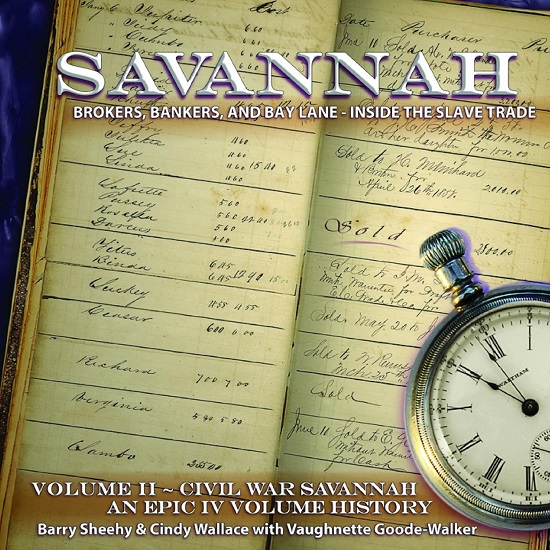
This second book of the Civil War Savannah series, Brokers, Bankers, and Bay Lane: Inside the Slave Trade, journeys even deeper into Savannah's slave-trading past to examine the business of slavery in the late antebellum period. With the simple premise that slavery could not have operated for so long without a viable business model, the authors examine the social, economic, and political factors that made the institution so remarkably resilient. In addition to serving as editor for the series, Aberjhani also recounted his experience of working on it in the book Dreams of the Immortal City Savannah.
Who was making a profit for the institution, and how much did they make? What did they think about their work and what did the community think? Who, besides the slave traders and masters, benefited? The authors also tell the stories of the slaves themselves, the human beings swept up and processed through this terrible machinery. What were their names and their stories?
Answering these and other questions, the authors demonstrate how the institution of slavery in no way operated in a vacuum, but rather thrived on the support of local government, banks, church and community organizations, and established social networks. With stunning black and white photographs of physical structures and artifacts tied to the slave trade, this rich and compelling volume will give readers valuable insight into the unique and powerful role that Savannah played in the expansion of slavery in Georgia.
Excerpt
“Our original goal in writing this book was modest. We wanted to document the important military sites associated with the Civil War in and around the city—many of these sites are threatened by development. This includes the inner line of defenses around the city, the river line laid out by Confederate General Robert E. Lee, the western line of 1864, and the rear guard and defensive sites in surrounding counties. Our goal was to photograph these sites in black-and-white and knit them together with text to support a series of “staff drives” for historians, military personnel, and anyone interested in the subject. We looked upon this mission with urgency as urban developers are now plowing under and building over significant historic sites in Chatham and Effingham Preface xi counties faster than we can document them, never mind attempts to preserve them. For some of these sites, the photographs we have taken may be all that’s left for historians in a few years.
“When I saw the first haunting black-and-white photographs taken by my gifted colleague Cindy Wallace, I knew we could not restrict our project to earthworks and battlefields. Armed with her talent, we could do much more. Perhaps, just perhaps, we might be able to photograph and document all of the important Civil War sites in and around the city. Each address has a story to tell and while some are mute, many more are rich with information about the people who lived there in the tumultuous years leading up to and during the Civil War. Although other works—more scholarly than ours—have documented the history and architecture of the city, our goal was different. We sought to document the role these sites played in the years before and during America’s bloodiest conflict: a titanic clash of arms still carefully and reverently referred to in Savannah as the “War Between the States.” We sought to visit for a time with the generation that fought this war, a generation that, in the words of Oliver Wendell Holmes, was ‘touched with fire.’
“Since a third of Savannah’s antebellum population was African American, we felt it important to also tell their story in text and photos as best we could. This meant delving into the intricacies of Savannah’s local slave trade—always a painful subject—while exploring the experience of Savannah’s free persons of color and, especially, the city’s vibrant black churches. Here we have been assisted and guided by our knowledgeable and capable colleague Vaughnette Goode-Walker.
“In all, we labored mightily to exercise objectivity and accuracy. Looking back, this was both a wonderful opportunity and a towering challenge. When researching and cross-referencing several hundred sites against hundreds of individuals, the potential for error is high. We have worked hard to minimize the possibility of errors but accept responsibility for any mistakes or misjudgments in the text. Only time will tell how well we have succeeded in our task—but we put down our work contented with the knowledge that we have done our best with the time and resources at hand. Where our conclusions may turn out to be inadequate, we look to others to build upon or correct our work. For now, this is our contribution.
—Barry Sheehy
Savannah, Georgia
150th Anniversary of the American Civil War
Professional Reviews Very Informative
This book was mentioned by one of the tour guides (who happened to be one of the authors) while in Savannah. Book very informative regarding slavery in Savannah before and during the Civil War and how it affected and was affected by the war.
Verified 5-star review on Amazon
Poignant and Compelling Docu-story
This is the most thorough analysis of Savannah's late antebellum slave trade that I've encountered. The photographs, maps, lists and diagrams are themselves extraordinarily valuable to anyone interested in this subject. The book reads like a novel with the reader being carried along by the characters who were apparently all real people. Here we meet the brokers who sold slaves at their offices and homes in Savannah, Georgia--many of which are still standing. We also meet the bankers who financed the trade and a host of lawyers, accountants and doctors who benefited from the South's "peculiar institution." Even the role of Savannah's white churches in rationalizing and supporting the institution of slavery is exposed. Most of these churches still serve the community today. The narrative style is riveting and the photographs fascinating.
--Verified 5-star review on Amazon
Another Great Installment in the Savannah Sago
For several years I have been researching the Confederacy, the origins of the Civil War, and the history of slavery in the South, particularly Savannah, Georgia. Not only is this a fantastic, thorough, well-illustrated volume about one of the vital trade centers of the South but also maybe the most detailed investigation of the slave trade in any city. Street by street, building by building, it provides all known information about the business of buying and selling human beings and also provides illustrations of similar markets from other southern cities. Savannah is a magical place, but behind the moss curtain was money, BIG money, for cotton, rice, and the horrors of the slave trade. This is an objective history volume of immense value.
--Verified 5-star Amazon review
The history of four terrorist organizations in the Balkan and a general introduction to terrorism and freedom fighting. Also includes essays about religious co-existence in the Balkan and about pathological narcissism as a precursor to terrorism.