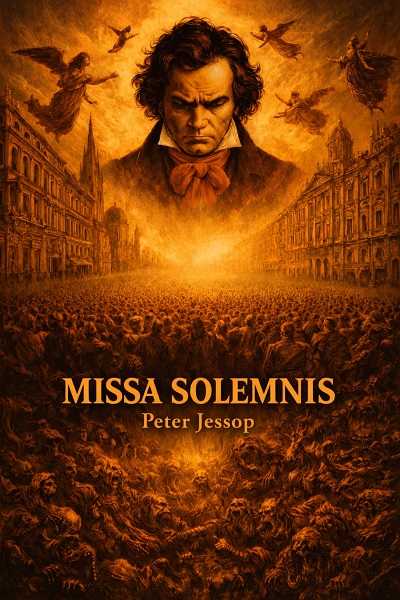
As deafness, illness, and demonic forces close in around him, Ludwig van Beethoven must summon his faith and genius to complete the Missa Solemnis—a sacred masterpiece he believes could bring divine light into a darkening world.
Set against the evocative backdrop of 19th-century Vienna, Missa Solemnis is a gripping and deeply spiritual exploration of genius, faith, and the eternal struggle between light and darkness. At the heart of the story is Ludwig van Beethoven, a tormented yet brilliant composer racing against time to complete his magnum opus, the Missa Solemnis. As his health deteriorates and his hearing fades completely, Beethoven battles not only his physical limitations but also the haunting spectres of his past, the weight of his failures, and the sinister evil forces that seek to derail his divine purpose.
Guided by his unwavering faith and the support of his loyal confidant Anton Schindler, Beethoven navigates a world of personal demons, familial tensions, and fleeting moments of inspiration. His relationship with his troubled nephew Karl and a mysterious young admirer, Ember, adds layers of complexity to his journey, forcing him to confront his humanity and the sacrifices demanded by his art.
As Beethoven delves deeper into his work, the lines between reality and the spiritual realm blur. He is drawn into vivid dreamscapes of apocalyptic battles and celestial visions, mirroring his inner turmoil and the cosmic stakes of his mission. With time slipping away, Beethoven must summon every ounce of his faith and resilience to complete the Missa Solemnis, a work he believes to be a conduit to the divine.
Rich with historical detail, haunting imagery, and the transcendent power of music, Missa Solemnis is a poignant and inspiring tale of redemption, perseverance, and the eternal quest for grace. It is a celebration of the human spirit’s ability to rise above darkness and create something timeless and heavenly.
Peter, Striking the divine chord brings down the wrath of the collective. This is a repeated theme that has existed without quantification. How have you quantified it in your particular book? Kindly reply so I can assess where you are at in terms of it.
"All-as-one we are the beast of our own discontent."
Kind regards, Tom Kitt
In this eccentric tale set in a small town in northern India, Pawan Mishra masterfully weaves ingenuity and sarcasm in a manner that’s simultaneously hilarious and tragic.





"All-as-one we are the beast of our own discontent."
Kind regards, Tom Kitt