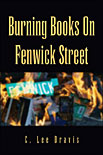
Released in September, 2003, "Burning Books on Fenwick Street" takes a look at an America where we have surrendered our freedoms in the name of homeland security. Inspired by the infamous "Turner Diaries", John Kolzig must cross an America of AIDS camps, forced segregation and mutual suspicion before he can reach a place of freedom with the woman he loves.
In the early 21st century, John Kolzig and his neighbors on Fenwick Street attempt to adjust to the changes wrought by the recent presidential election which has elevated a conservative Christian to the White House. Books are burned in the church parking lot and foreign residents are deported as the Bill of Rights is replaced by the 10 Commandments as the law of the land. Alcohol, tobacco and guns are outlawed and John finds himself under the scrutiny of the local block deacon. Life goes on, but John has fallen in love with the wrong woman and they find themselves on the run with the help of a wily dwarf, their guide on a modern Underground Railroad to freedom.
Excerpt
CHAPTER ONE
The Southside of Chicago burned for much of the searing summer that damnable year. So did parts of Newark, Atlanta, St. Louis and L.A. Just blocks from the White House, the flames of black and Latino outrage swept down the H Street corridor for the second time in half a century. People, mainly poor, cursed and wept and died through the torpid months of July and August. The fires of hate, frustration and vengeance in neighborhoods of rat-infested tenements and decaying high-rise projects cast their sparks into the hot summer winds, igniting new conflagrations as the embers of violence fell in Detroit, Bridgeport, Seattle and dozens of other cities across the continent. The shooting death of a six-year-old black child by the Gary, Indiana police during a crack-house raid provoked the final, fatal shove over the precipice upon which America had teetered. Something snapped in the collective psyche of that once-enslaved race, and no plea for calm could stop the inevitable reaction.
On the family farms of the Midwest, in small New England towns and in well-manicured suburbs, white Americans watched the distant riots on cable and dish-TVs, but were more concerned with news of the economy, which was sliding from recession into depression. They tried to hold on to jobs and homes and thanked the Lord for the peace and security of their own communities, far away from the turmoil of the cities. They proposed among themselves both high-minded and low-minded solutions to this awful urban crisis. Well-meaning but naďve liberals flocked to the cities with food, medicine and sympathy for their urban brothers and sisters; deeply disturbed conservatives re-stocked their ammo and bought bigger dogs; and the vast majority, the sheep, did nothing at all, watching the dreadful news from the cities, trusting that the government would take care of everything.
Fulfilling their own prophesies of a race war, Aryan-Americans, primarily in the Pacific Northwest and Central Plains, went to arms, filling the ranks of the right-wing militias. Seeing an opportunity, the militias bent to their dark work in the heartland, fighting for a purer, Christian America. A string of lynchings in Grand Rapids, a raid on a National Guard armory in Billings, and the bombing of a black congregation in Tupelo shocked the country. But back in the top-10 TV markets, where the rioting went on, where there was always the threat of stray Asian terrorists gassing the subway or crashing a bridge, fear was the rule. As the summer wore on, suburban commuters stopped commuting. Some people kept their jobs by telecommuting from deeply suburban homes, while others quit and moved their families to safer, whiter communities.
Pre-occupied with the more heavily media-covered bloodshed within the urban cores, the federal government failed to attend to the blossoming rural disturbances. When five networks are offering live firefights from downtown Los Angeles, the White House doesn’t pay any attention to eight dead Mexicans in Utah. One awful night, on September 26th, an estimated two hundred armed members of the Church of the Apocalypse attacked and held a police station for three days in Spokane, Washington. The Churchmen demanded the deportation of all illegal aliens and the restoration of the gold standard. Eighteen policemen and fourteen civilians were killed. The survivalists lost nine dead and made off with a roomful of weapons, the police computers, several hostages and an armored vehicle. Into the winter, the Churchmen, and allied groups, staged raids and robberies across rural America, making their racist demands and gathering more supporters and arms.
The President had to act, but made the calamitous error of delegating to the Bureau of Alcohol, Tobacco and Firearms the task of investigating and subduing the rampaging militiamen. Federal police forces, coordinated and controlled by the BATF, made abortive raids on militia strongholds in Arkansas, Montana and Idaho. The very sight the of blue-helmeted, flak-jacketed ATF agents only enraged the extremists further and spurred them on to more violent, and ultimately more successful, endeavors.
In the ghettos and barrios of the crumbling cities, the National Guard was pressed into service, but this only heightened the violence. Guardsmen cordoned off whole neighborhoods with razor wire. Well-armed patrols roamed city streets in Humvees, and still the looting, burning and killing went on, feeding off itself, building to some rending climax. It was as if Somalia had been transplanted to St. Paul, or Bosnia had traded places with Boston. But this time it was happening here, on our own sacred shores.
To the north, our Canadian brothers and sisters stood by, aghast as their neighbor tore herself apart. That Canada was spared the same fate was a credit to her leaders who rallied the populace and forged new bonds of national unity. Even the historically separatist Quebecois were stunned into sensibility by the violent aspect of America's turmoil and sought rapprochement with their Anglo countrymen. But it was by then far too late for we Americans to do the same. For too many years had a multitude of wedges been driven into the foundations of society by groups and individuals with their own segregationist ideologies and theologies for any mason to make whole again. Black versus white; Democrat versus Republican; pro-choice versus pro-life; the religious right versus the secular left; and on and on. The American leadership argued and postured while the final hammer-blow was poised to strike, the blow that might shatter the nation completely.
By the following summer, with the militias effectively controlling great swaths of the countryside, agricultural products barely trickled into the cities. The right-wing forces consolidated their power in the west where unsympathetic county sheriffs were co-opted, coerced or killed. Meanwhile, in the eastern cities, downtowns became far too dangerous to conduct normal business, even with the protection of Guard troops. Snipers were everywhere and anywhere. Random trashcan bombs ripped up sidewalks and passersby. Spontaneous mass disturbances could occur at any moment, on any street corner. Great corporations closed their downtown doors and re-located to the suburbs. But these American companies, with their foreign factories, were hard-pressed to import our own "domestic" products. Years before, most industrial production had been farmed-
out to plants in Asia and Latin America. America still produced some of the best software products in the world
but couldn't manufacture a shoe, a shirt, or a lousy piece of steel.
In Manhattan, on a snowy January day, an empowerment rally turned violent. In the melee, the New York Stock Exchange was torched. Fortunes were lost. The middle-class fled, barricading their families within guarded,
gated Xanadus far beyond any beltway. Telecommuting was largely a failure: the simple exchange of digital information was not the fuel that drove American industry. The country was becoming a nation of managers with no one to manage, no facilities of production and no products to retail. The national economy spiraled downward amidst rancorous debate in Washington about price controls and devaluing the dollar.
To cope with these problems at home, America turned in upon itself, withdrawing from its traditional place on center stage in the affairs of the wider world. The war against foreign terrorism continued in a quieter form with fewer troops and a smaller budget. Marginalized in the United Nations, unneeded by the European Union, we withdrew our armed forces from Iraq, Pakistan and Korea, leaving the planet unguarded and mostly free of our influence. The world was happy to see us depart. Nationalists nodded knowingly and pointed to America as an example of the folly of a multi-cultural nation. Allies offered condolences and plotted their position in the new world order. The remaining Islamic terrorists declared victory as they witnessed America stumbling.
US troops returned from around the globe to deal with the homeland crisis. Wherever there was a military installation, all personnel turned out to build emergency resettlement camps for the inner cities refugees fleeing to the countrysides. Commandeering any convenient piece of empty land, camps sprang up in Barstow, Mountain Home, Dayton, and countless other towns. Unemployed, dispossessed citizens loaded their belongings into battered Nissans, or climbed aboard packed Amtrak trains and Peter Pan buses, making their journeys to the resettlement camps sprouting in the countrysides. Remote towns that had previously held so few minorities that everyone knew who was meant when one referred to "the colored family" or "that Mexican couple" became the scenes, that winter, of a sudden ethnic influx theretofore unimaginable to their homogenous residents.
In the suburbs and towns that hosted these sprawling camps, the brief initial compassion for the refugees swung toward resentment as cultures clashed and resources and nerves grew taut. At first, these descendents of Irish, Italian, Swedish and German forefathers opened their hearts and made room, welcoming the newcomers as less-fortunate fellow Americans, at least as long as there weren't too many of them coming to their particular town. But the flow of urban refugees only increased over the ensuing months and the complexion of rural America was changed forever.
Eager to carry on with life as best they could, DPs (displaced persons) who had owned retail businesses in the cities cooperated to rent vacant storefronts in the towns adjoining the camps, plying their traditional trades. Hamlets, which prior to the upheaval might have had only a general store, cafe and post office, now sprouted Korean groceries, tandoori restaurants and hosts of other new minority-owned businesses. Along with these enterprises came Gospel churches, Cinco de Mayo festivals, and Sudanese cabbies. Any American farming town with a grain silo was now just as likely to have a Pakistani restaurant or an annual celebration of Tet.
The influx of the "coloreds" drove up rents, added to the competition for scarce jobs, and caused local taxes to rise to meet the demand for social services and education. Resentments flared. Suspicious stares, hushed epithets under the breath, and isolated assaults occurred with growing regularity. And, with the doubling and trebling of local populations, unemployment became a serious problem. Desperate refugees, working dirt-cheap, and under the counter, displaced the townies in the stores, farms and offices.
Some peaceable and despairing white citizens, unable to find work themselves, and seeing their hometowns forever changed, began their own migration. For the most part they trekked north to Canada, which over the next few years saw her population rise by some four million and who finally, in the crush of the tide, closed her borders to any more. Hundreds of thousands of others emigrated to Australia and New Zealand. A sizable colony of wealthy Anglo-Americans put down new roots on the shores of Jamaica and Bermuda, where they could pretend that they were superior to the darker locals simply by dint of being white Americans. A million more returned to ancestral European father- and motherlands.
As the economy of America foundered, many Hispanic Americans returned to Mexico and Central America, an incredible reverse-migration. Israel became a favored destination for American Jews, shrugging and moving on once again, hardly surprised. A Palestinian zealot succeeded in convincing a hundred thousand Arab-American families to re-populate the holy lands, and re-ignited an ancient war along the way. Never before had the United States, the destination of immigrants the world over, seen such a loss of population. In Washington, the government seemed stricken, unable to deal with such vast movements of people and the questions of how to house, feed and employ them.
Into this vacuum swept darker forces. A revived Ku Klux Klan wielded terror throughout the south and mountain-west. Outside of some of the resettlement camps, DPs dared not walk the streets after dark, and lynchings were not uncommon. The infamous South African practice of necklacing, wherein the bound victim has a gasoline-filled tire placed around his neck, which is then set aflame, made its first appearance in North America during those black days. It was as if the country had returned to the time of Reconstruction. A few black activists pleaded for sanity and peace, but soon the pastoral call of Martin Luther King was out-shouted by the fiery rhetoric of Malcolm X and Louis Farrakhan. The level of anger was again rising and threatening to finish the job which had been started over a
century before.
*****
Injected into this volatile mix occurred a series of random events that, taken individually over time, would have had no bearing upon the course of the Nation. Unfortunately for America, these disasters struck the country as relentlessly as waves. At the apex of America's grief, California finally experienced "the big one". At 8.3 on the Richter scale, San Francisco very nearly did fall into the Pacific. The federal government, already stretched to the breaking point, did what it could, but the loss of life was terrible, uncounted. Billions and billions of dollars were needed and the treasury no longer had the resources. Token help came from the booming manufacturing economies of the EU and Asia, but little was accomplished with their meager foreign aid. And America seemed to have lost its will to heal itself.
Over the ensuing summer, during the second year of the Disturbances, the coastlines of the southeastern states were lashed by no fewer than four major hurricanes, sweeping away both Charleston and Pensacola. That same summer, the upper Midwest was devastated by a relentless series of particularly destructive tornadoes, and one not-to-be-forgotten drought scorched the corn belt. These disasters, in conjunction with the confusion in the cities and the unrest in the heartland, awakened the fear of God in millions of people. Indeed, a fair number of fundamentalist Christians rejoiced in these catastrophes, secure in their belief that this was the Lord's retribution visited upon the American Gomorrah. Some of them even served in Congress.
This unprecedented rash of natural disasters was as a trumpet call to a nation desperate for answers. Though the prophesied Rapture had eluded them at the turn of the millennium, the truly faithful were a determined lot, willing to bring on Judgment Day whether God was ready or not. A sweeping religious-revival was re-born, with churches filled beyond capacity, spurred in part by the myriad books, articles and television specials focusing upon the Book of Revelations. This final chapter of the Bible speaks of the last days of mankind, a period of prolonged turmoil, when Christ will return to rule while the wicked are destroyed and the true believers ascend to Heaven. From pulpits and street corners across America, ministers and preachers warned that the end was at hand, the signs were perfectly clear and all should prepare for the coming of the King. And this mass-revival soon exerted a peculiar hold upon the politics of the nation.
Both major political parties had been locked in a death-grip in Washington, accomplishing absolutely nothing even as the country balanced on the edge of calamity; indeed, entire states had already begun the plunge into hopelessness as emigration, unemployment, double-digit inflation and civil strife took their toll. All seemed lost, the great American experiment ending in failure.
And then, from a small parish in St. Joseph, Missouri, came an answer to our desperate prayers.
Reverend Matthew Winslow Dobbs was an intense man, sure in the way of the Lord, yet able to impart the message of Christ in a manner that was totally calm and rational. He was a preacher for the everyman, tending to his Pentecostal congregation for thirty-some years, possessing a smile that sparkled, uttering never a rough word, and always quick with the perfect verse with which to comfort a member of his flock. A talented and persuasive orator, Dobbs became nationally known through his daily television programs, beamed by satellite from coast to coast. His weekly newspaper column was read by millions and his website reached millions more. A confidant of the President, he opened sessions of Congress and consulted with the Pope. His ministry sent relief workers and missionaries into the camps, and his charitable fund endowed scholarships to minority Christian youths. Matthew Dobbs became one of the most trusted and respected religious leaders in America in the years just after the millennium, and it took only a modicum of prompting by his closest disciples and handlers to convince him to take a leave-of-absence from his ecclesiastical duties and to devote himself to politics in the name of Jesus Christ.
From every corner of the nation, ordinary white folks responded to his message of patriotism and salvation. The Churchmen and the other militias rallied behind the banner of the Missouri Messiah, as People magazine dubbed him, and pledged their support to his crusade, which made Dobbs’ people a little nervous until they learned how to control these armed marauders. Dobbs employed his satellite television network and on-line ministry to outline his vision of an America resurrected, one trusting in God and repenting the mistakes of her recent past. His personal appearances packed stadiums and hockey arenas across the country. A so-called grassroots movement (actually orchestrated by a handful of the Reverend's most trusted aides) sprang up almost overnight, laying the groundwork for a new political paradigm.
Seeing the handwriting on the wall, desperate for re-election themselves and smart enough to follow the votes, an astonishing number of congressmen, senators and governors jumped from the sinking ships of their Tweedledum-Tweedledee parties and signed on with Dobbs' new organization, the American Christian Conservative Party.
In the following mid-term elections, Christian Conservative candidates rode into office on a wave, and state and local contests turned the wave into a flood. The new party geared up for a run for the presidency itself, espousing a platform of Judeo-Christian values (a Dobbsian concession to the remnant Jewish populace in order to engage a financially valuable ally), a moratorium on immigration, personal responsibility, patriotism, fiscal conservatism, high tariffs, low taxes, sacrifice for the greater good and, above all else, a personal devotion to God. The incumbent president, a liberal Hollywood actor who was politically under-equipped and trapped by a suddenly opposition-controlled Congress, very nearly forfeited the election two years later in the face of the Christian Conservative tsunami. Matthew W. Dobbs was sworn into office on a crisp January day.
*****
It was President Dobbs' good fortune that he was able to appoint two new Justices to the Supreme Court during his first summer in the Oval Office. He also named 72 new District Court judges before September. Congress anointed each and every one. The end result was a decidedly conservative judiciary. Over time, it became common, if unprovable, knowledge that Dobbs himself was directing the votes of both the Court and the Congress. Yet there was hardly a ripple of public opposition as the country struggled to recover.
During Dobbs' first year in office, the Supreme Court ruled on a dozen landmark cases, frequently astounding legal scholars with examples of the most convoluted logic. At their first opportunity the Justices struck down the right to privacy in the case of abortion, and overturned Roe v Wade. Only tiny Vermont refused to impose any restriction upon the procedure whatsoever. On a stern Dobbs' instruction, Congress immediately ended all federal funding of transportation and education in that state. The Green Mountaineers responded with taciturn indifference and Dobbs took note of their intransigence.
In other decisions, the Court ruled in favor of organized prayer in the schools, and the posting of the Ten Commandments on public buildings, an event received by much of the citizenry with an enthusiasm not displayed since V-E Day. Police powers were extended by the Court to bolster the wars on crime and terrorism, with profiling of suspects, unfettered surveillance and warrentless searches now permitted. The hated Brady Handgun Bill was tossed aside, allowing Joe Six-Pack to pack heat (though this liberty was soon to vanish also). And the first AIDS camps were set up, segregating the unclean.
The minority of whites who opposed these Court rulings, those who called themselves liberals, came to refer to members of the Christian Conservatives as the "Radical Conservatives”. But their objections were lost in the rush toward a better nation, one adhering to Dobbs’, and presumably God’s, interpretation of the Constitution. One by one, our rights and liberties were curbed, and we willingly gave up those rights and liberties in the name of prosperity and homeland security. America lumbered on under the leadership of President Dobbs and the stewardship of his loyal militias.
Thirty-six months after Dobbs' sweeping victory, an unprecedented assembly took place at an exclusive resort in the autumnal mountains of West Virginia. The conclave encompassed the President, his Cabinet, the entire membership of the Supreme Court, and 397 members of Congress. There was practically no one left in Washington to run the country. In the Grand Ballroom, over dinners of steak and lobster, and in liquor-soaked hospitality suites, backs were slapped, deals were cut, toasts were made and instructions were issued. The walls between the three branches of government were coming down, the checks and balances of the Constitution unconstitutionally nullified. The great gathering of power took on the air of a coronation, the crowning of President Reverend Matthew Winslow Dobbs.
*****
In the next few, brief years, America, under the political and spiritual guidance of President Dobbs, crawled its way into the sunlight of fiscal solvency. To accomplish this, the federal tax code was completely revised, tossing out the old system of a progressive income tax and replacing it with a flat tax on personal income at a rate of 23 percent. Still, not enough money was raised, so a national sales tax of five percent was also instituted, as was a new federal personal property tax. To placate the traditional supply-side conservatives, Dobbs abolished corporate taxes, as well as the Departments of Energy, Education, Health and Human Services, NASA, and a dozen smaller agencies. With an executive order, he enriched the budget for the Department of Homeland Security, folding Customs, the FBI, INS, DEA, and BATF into a single monolithic police force, answerable only to the White House.
The major political parties of the last two centuries, the Democrats and the Republicans, were by then mere ghosts of their former selves, electing a mayor here, a councilwoman there. The Christian Conservatives came to wield total power, and Dobbs expected no trouble in capturing a second term in the election of 2020.
By campaign season, an edgy peace reigned throughout the country, enforced by loose bands of white militia. With welfare programs abolished, private charities and churches struggled to provide the basics to that significant part of the minority population still living hand to mouth. Draconian immigration laws slammed shut the golden door, allowing America to digest or expel the multitude that had landed upon her shores over the past five decades. The notion of diversity came to be scorned by the barely majority white population, and thousands of "undesirables" were deported to Africa, Asia and Latin America. Hundreds of other people of color just disappeared. Those few immigrants accepted for citizenship invariably hailed from Western Europe, the possession of Anglo-Saxon roots serving as the deciding factor. English was finally legislated as the official language of the nation, and the notion of a multicultural society strangled and died.
Russia fought a bloody civil war. The Balkan states flared up, cooled off and then exploded again. India exchanged nukes with Pakistan, Arabs battled Jews, and terrorists planted bombs across the globe in support of one cause or another.
Few of these conflicts were of any consequence to the United States. By no means would Dobbs allow the country to be drawn into any fray, and without the world's policeman on the scene, there was no one left to extinguish the various brushfire wars around the planet. Kicked out of their New York headquarters, the United Nations retreated to Geneva, hemorrhaging member states along the way.
By the third summer, with the emptying of the old burned-out city cores, much of the urban populace spread to newly emerging edge cities, mega-suburbs that sprouted along the interstate corridors. The population came to be far more evenly distributed about the countryside, often growing up outside the sprawling old camps, now deserted as the “coloreds” were resettled as part of the government's new Homelands policy. No longer would the races mingle. Where once black fought yellow, and brown fought white, all now lived in rigid, if separate, harmony.
Politically, the nation carried on. Most of the citizenry were content to place their trust in the hands of the president, who after all, had led them out of the darkness of the post-millennium. Though no great trumpet call had sounded, no bolt of lightning from above had smitten them dead, no second coming of the Savior had occurred, the people kept faith with the word of their leader, President Reverend Dobbs.
And it was this blind faith in Dobbs, and in God, that made it so simple for so many to accept with open hearts and minds the exacting vision, the bold new direction for America, which the president revealed to the nation upon the occasion of his second inaugural address, on January 20, in the Year of our Lord, 2021.
Professional Reviews
Voice of America,
http://www.manythings.org/voa/01/010831am_t.htm
VOA Asian Service Interview
http://www.geocities.co.jp/SilkRoad-Desert/7667/42/a42.html
Hearts of Gold
Synopsis
by
Frank P. Whyte
Portland, Oregon is known as the City of Roses. Of course that’s an odd name for a city whose mere mention conjures images of driving winds and torrential ra
Deputy Dave Jenkins investigates the murder of local high school principal, Jerry Egge, but this is a multi-faceted novel that deals with spiritualism, romance, friendship, and children who fall through the cracks.
"Murder isn't usually this