|
|
|  | | Above an Angry Sea: United States B-24 Liberator and PB4Y-2 Privateer Operations in the Pacific (October 1944 to August 1945)
This is the story of the men who served and sometimes died while flying with United States Liberator and Privateer squadrons during World War II.
Above an Angry Sea chronicles USN B-24 Liberator (PB4Y-1) and PB4Y-2 Privateer operations in the Pacific. The author's previous book, We Flew Alone, discussed the Navy's use of the B-24 Liberator from February 1943 to September 1944. He now examines in dramatic detail the use of the B-24 and PB4Y-2 during the last eleven months of the war against Japan. The author has collected personal stories, over 200 photographs, a tabulation of all aerial kills credited to PB4Y patrol plane commanders, a roster of all personnel killed in action or in the line of duty, individual squadron records, and a li | |  | | Consolidated-Vultee PB4Y-2 Privateer
Consolidated-Vultee PB4Y-2 Privateer: The Operational History Of The U.S. Navy's World War II Patrol/Bomber Aircraft
Consolidated-Vultee Aircraft Corporations (Convair) attempt to make a few design changes to its famous B-24 Liberator for the U.S. Navy in 1942 eventually evolved into the PB4Y-2 Privateer, a 70,000-pound patrol bomber equipped with state-of-the-art electronics gear, armed with twelve .50-caliber machine guns, and the capability to deliver bombs, depth charges, and guided missiles. Beginning with the development and production of the aircraft, this book presents an in-depth examination of the patrol bombers entire operational history from 1942 to the present. Containing over 260 photographs an | |  | | Galloping Ghosts of the Brazilian Coast
Anti-submarine operations conducted by U.S.N aircraft.
Galloping Ghosts of the Brazilian Coast: United States Naval Air Operations in the South Atlantic During World War II is the story of United States Navy combat aircrews, their counterparts in the Brazilian Air Force, and those who served aboard German U-boats in the South Atlantic during World War II. It covers efforts by the United States Navy to protect the flow of strategic materials, men, and military equipment from ports in South America to points around the Western Hemisphere and Europe. | |  | | Leatherneck Bombers
Leatherneck Bombers: Marine Corps B-25/PBJ Mitchell Squadrons in World War II, is a powerful story of an elite group of men chosen to form the U.S. Marine Corps only medium bomber group to serve in World War II.
Leatherneck Bombers: Marine Corps B-25/PBJ Mitchell Squadrons in World War II, is a powerful story of an elite group of men chosen to form the U.S. Marine Corps only medium bomber group to serve in World War II.
Through information obtained from veterans, squadron historians, and official government sources, Alan C. Carey, the author of three previous Schiffer books on U.S. Navy PB4Y operations, now documents the history of Marine Corps B-25/PBJ squadrons. Veterans, in their own words, recall the missions they flew and the friends that were lost fighting Japanese forces in the South | | 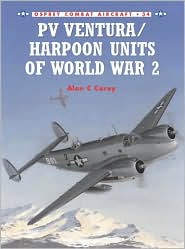 | | PV Ventura and Harpoon Squadrons of World War II
This book covers the history of the Lockheed PV-1 Ventura and PV-2 Harpoon
A development of the successful Lockheed ‘medium twins’ of the late 1930s, the PV Ventura/Harpoon family of patrol bombers saw widespread service with both the US Navy/Marine Corps and the TAF and Commonwealth from October 1942 onwards. The USAAF also used surplus Venturas originally ordered by the RAF, designated B-34 Lexingtons, in the bomber training and coastal patrol roles. The final variant in this family was the larger PV-2 Harpoon, which was built to a US Navy requirement from March 1944 onwards. Used primarily in the Pacific, 470 Harpoons saw frontline service on anti-shipping and sub | |  | | The Reluctant Raiders
The most documented book written on a Navy Heavy Bomber Squadron.
The book traces the history of Navy Bombing Squadron VB/VPB-109 from 1943 to 1945. Over 90 photographs and line art. | |  | | U.S. Navy PB4Y-1 (B-24) Liberator Squadrons in Great Britain
This is the story of U.S. Navy Fleet Air Wing Seven (FAW-7) and the men who flew the Navy version of the Consolidated B-24 Liberator bomber out of Dunkeswell and Upottery, England during World War II.
This is the story of U.S. Navy Fleet Air Wing Seven (FAW-7) and the men who flew the Navy version of the Consolidated B-24 Liberator bomber out of Dunkeswell and Upottery, England during World War II. Navy PB4Y-1 Liberator squadrons were unlike their counterparts in the U.S. Armys 8th Air Force, who battled their way through thick flak and swarms of German fighters while flying to and from targets in continental Europe. The job of U.S. Navy PB4Y-1 Liberator aircrews was to keep German U-boats from successfully operating in the Bay of Biscay and the English Channel by going out day after day, o | |  | | We Flew Alone: United States Navy B-24 Squadrons in the Pacific (February 1943-September 1944)
This book examines the use of the B-24 Liberator by the U.S. Navy during World War II.
The book traces the formation of the first Navy B-24 Liberator squadron in 1943 and its deployment on Guadalacanal to the squadrons that served in the Central Pacific in 1944. It includes first hand accounts and photographs of the men and the planes they flew. |
|
|
|