|
|
| 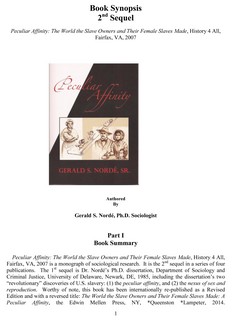 | | Peculiar Affinity: The World the Slave Owners and Their Female Slaves Made,
Peculiar Affinity: The World the Slave Owners and Their Female Slaves Made, History 4 All, Fairfax, VA, 2007 is a monograph of sociological research. It is the 2nd sequel in a series of four publications. The 1st Sequel stands as Dr. Nordé’s Ph.D. Dissertation, Department of Sociology and Criminal Justice, College of Arts and Sciences, University of Delaware, Newark, DE, 1985, including the Dissertation’s two “revolutionary” and “game-changing” discoveries of U.S. slavery: (1) the peculiar affinity, and (2) the nexus of sex and reproduction. Worthy of note, this book has been internationally re-published as a Revised Edition and with a reversed title: The World the Slave Owners and Their Female Slaves Made: A Peculiar Affinity, the Edwin Mellen Press, NY, *Queenston *Lampeter, 2014. http://www.mellenpress.com/mellenpress.cfm?bookid=8855&pc=9 and the two editions’ Foreword is written by the late and renowned Professor William Chambliss, Department of Sociology and Criminal Justice, George Washington University, Washington, DC. In addition, this book and its Revised Edition have the endorsement by Professor Cornel West, Harvard University, MA.
The subject matter of this 2nd Sequel is twofold. First, the subject matter includes the intended consequences, children, of the sexual and reproductive relations between the South’s White American slave owners and their two and more sets of American Negro female slaves and Colored American slave girls at any one time. Second and most importantly, the subject matter includes the breeding and selective breeding of the South’s American Negro female slaves and American Colored girls by their White American slave owners. Those sexual and reproductive relations between the White American slave o | |  | | The Sociological Theory of the Skin-color-syndrome Together with Explaining
The Sociological Theory of the Skin-color-syndrome Together with Explaining the Origin of White Racism in the American South is a monograph in sociology, in general, and a monograph southern slavery in the United States of American (U.S.A.), in particular. The monograph contains one hundred-twenty nine (129) pages. In support of the monograph, the monograph’s science, and in support of the theories put forward in this monograph, there are the Table of Contents, Tables of Charts, The Preface, The Introduction, Five Chapters, and the Author’s Notes, Appendices, Select Bibliography, Author’s Index, and all subsumed by thirty-one years of sociological research, analyses, along with national, and award and prize winning international publications. Please follow the link(s) below for more information regarding prior and related publications http://www.mellenpress.com/mellenpress.cfm?bookid=8855&pc=9.
Chapter 5 provides a theory of the white racism’s and the skin-color syndrome’s love-hate relations and relationships among White American men and directed at Black, Negro, and Colored American men and boys in the U.S.
Chapter 5 puts forward a theory of the origin of those love-hate relations being the South’s White American slave owners’ sensing of their American Negro and Colored American sons’ skin colors which indicated they were born from the slave owners’ American Negro female slaves and American Colored girls, their sons’ mothers. Chapter 6 is the concluding chapter and it offers | |  | | What Black People Are Afraid to Tell Themselves about Themselves...........
This book is the 4th and final sequel in a series of four published scientific studies of United States of America (U.S.A.) southern slavery, monographs, exclusive to the U.S.A. domestic slave era, 1807-1865. The subject matter of this book is the magnitude of the cultural and social impact of the South’s White American slave owners’ exclusive two and more sets of children from their American Negro female slaves and their American Colored girls exclusively during the U.S.A. domestic slave era. At the same time, the research confirms with scientific certainty the South’s White American slave owners were also having two and more sets of children with their American White women, American White concubines, American White mistresses, American White girls, and their American White wives. With all certainty, the 28 years of research, the quantitative and qualitative data, the appropriate quantitative and qualitative data analyses, and other original documentary materials supporting this book and its research all confirm that, biologically and genealogically, all of the White American slave owners’ children from all of their White American women, their American Negro female slaves, and all their American Colored girls were all exactly brothers and sisters to each other. The cultural, social and, even, the historical impact of those children on the United States of America is, simply, how to reconcile with justice the fact none of the South’s White American slave owners and none of their children was an African or a descendant of African slaves. Reconciliation with “Justice or else”!
The book’s cover represents the contemporary peculiar affinity, the first “revolutionary” discovery of slavery in the U.S.A. and re-introduced in the 2nd Sequel. Upon the initial appearance of the book’s cover, the skin color of the woman and the man matters, controversy, and it should not; they are both of the same species, Homo sapiens. During the U.S.A. domestic slave era, skin color was the sin qua none definition of the “self” and the “other”. That is, the Black, Negro, or Colored American woman on the cover represents all contemporary American women in the U.S.A. The White man on the | | 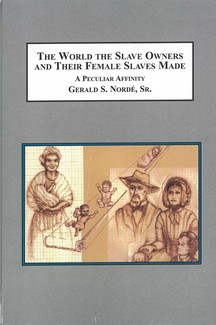 | | White Slave Owners Breeding and Selectively Breeding Themselves............
This book is the 3rd Sequel is a series of four publications on slavery in the United States (U.S.) during the U.S. domestic slave era. This 3rd Sequel has the revealing title: White Slave Owners Breeding and Selectively Breeding Themselves with Their Black Female Slaves and Girls: Why Black Americans Are Not Descendants of Africans or African Slaves. “We are not African Americans!”, Edwin Mellen Press, Lewiston, NY, *Queenston*Lampeter*, The book also has a highly commendable Foreword written by Arthur E. Thomas, Ed.D, President Emeritus, of Central State University, Ohio. Most importantly, this 3rd sequel has been awarded the international book prize: The Adèlé Mellen Prize for its Distinguished Contribution to Scholarship, 2014. http://www.mellenpress.com/mellenpress.cfm?bookid=8855&pc=9.
Most importantly, the book’s 28 years of sociological research have also provided the scientific certainty the South’s White American slave owners were breeding and selectively breeding only themselves with their Negro American female slaves and Colored American girls. The children who were born from the breeding and selective breeding were bought and sold as U.S. domestic commodities. The essence of these children was strictly American. However, those children appeared as American “domestic” commodities, “domestic” slaves, and not African slaves. Those children were advertised in newspaper |
|
|
|
I, Father
by Paul Lonardo
|
 Is Assisted Reproduction Technology pushing modern biological science to the legal and ethical limit?
This case examines the story of one man caught in the middle of custody battle that became a landmark surrogacy case involving one child and fiv Is Assisted Reproduction Technology pushing modern biological science to the legal and ethical limit?
This case examines the story of one man caught in the middle of custody battle that became a landmark surrogacy case involving one child and fiv |
Member BookAds
|
|
|
|