|
|
| 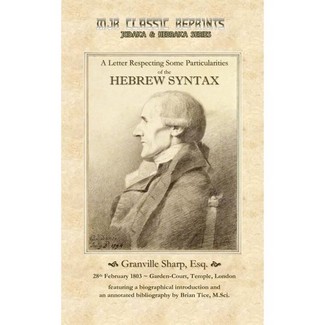 | | A Letter respecting some Particuliarities of the Hebrew Syntax
The 19-century British abolitionist Granville Sharp was self-taught in Hebrew and Koine Greek and considered a preeminent scholar in both languages. This treatment on the function of the Hebrew waw-hahipuch was groundbreaking.
This is an MJR Classic Reprint of a work originally published in 1803. A new introduction (biographical sketch) and an annotated bibliography have been appended by Rabbi Brian Tice. | | 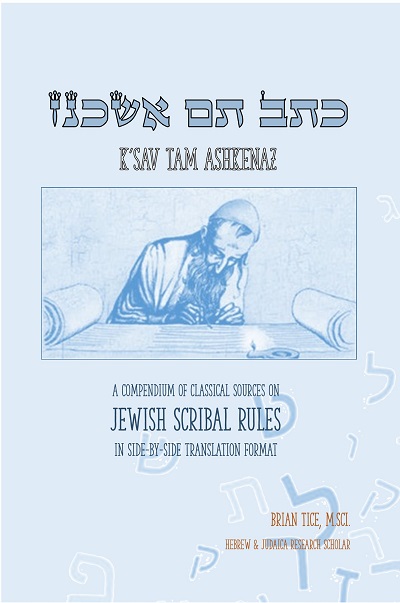 | | K'sav Tam Ashkenaz: A Compendium of Classic Sources on Jewish Scribal Rules
The Ashkenaz edition of the texts instructing on the rules pertaining to Jewish scribes for Sifrei Torah, Tefillin, and Mezuzos. The texts are included both in their original language and in English translation.
K'sav Tam is a Jewish expression which translates "flawless writing." In the case of the scribal arts, it refers to the diligent effort an Ashkenaz sofer (scribe) puts into the task of preparing a letter-perfect duplicate of the tikkun (correct parent copy) text being copied from when writing a scroll or codex transmitting the Hebrew Scriptures. Approximately 4000 rules come into play for the writing of a Torah scroll. This volume is a compendium of the chief halakhic codes containing them, specific to the Ashkenaz tradition, in both the original language (Hebrew or Aramaic) and English, begin | |  | | Kosher Ketosis: A Treif-Less Approach to Keto Living
Kosher Ketosis presents 88 Keto-adapted recipes for traditional Jewish dishes from around the globe.
Keto living is not just for bacon lovers anymore! Jewish comfort foods just got healthier... and keto-friendly! This recipe collection is packed with keto-adapted versions of Jewish staples like challah, matzo, and charoset as well as foods that almost define the Jewish experience... such as bagels, blintzes, chocolate babka, and kreplach... all keto-adapted! Rabbi Tice includes a section addressing keto-adjustments to holiday traditions as well, and every one of the 88 recipes — representing Ashkenaz, Sephardic, Mizrahi, Beta Israel, Kaifeng, and Kochi Judaisms — is gluten-free, diabetic-frie | |  | | Reflecting on the Rabbis: Sage Insight into First-Century Jewish Thought
Reflecting on the Rabbis presents the lives and teachings of the most influential rabbis of the First Century CE.
We used to know a lot about First-Century Judaism... until we realized we didn't. The First Century CE was what is known as Judaism's "creative phase." There were Sadducees, Pharisees, Zealots, Essenes, Therapeutae... just to name a few of the Jewish sects and movements. And, most of these had sub-sects or sub-movements of their own as well. The Pharisaic sect was certainly no exception. In this volume, Jewish Studies professor Brian Tice presents the six most prominent and influential Sages of this period, drawing from the Bible, both Talmuds, the Midrashic literature, the Targums, and other | | 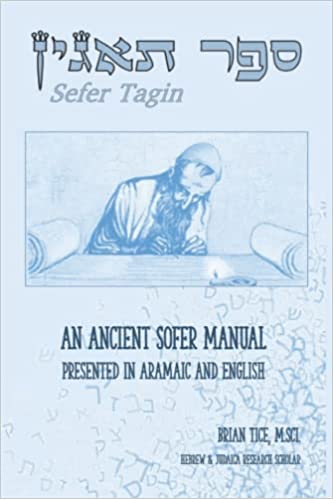 | | Sefer Tagin: An Ancient Sofer Manual
Sefer Tagin most likely dates to the 2nd century, and all scholars date it certainly to no later than the early 7th century. There are external references to it at least as far back as Rav Sa'adia Gaon, and possibly even as far back as Hillel haZaqen.
Sefer Tagin, the oldest known Jewish sofer manual, has never been available in English until now. This work presents an English translation alongside the original Aramaic in a side-by-side format. Includes an introduction and a bibliography of all known manuscripts (full and fragmentary) of Sefer Tagin. The work was written before versification, but the present author has identified the majority of the intended verses and indicated them parenthetically in the English. | | 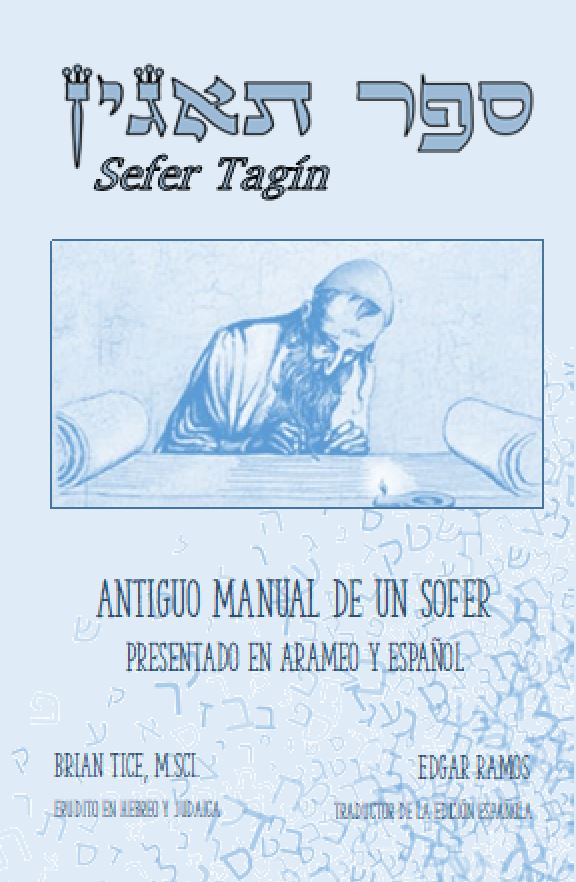 | | Sefer Tagín: Antiguo Manual de un Sofer
Un antiguo manual de un Sofer presentado en arameo y español.
La costumbre común de coronar las letras del Sefer Torá es adornar las letras “Sha’atnez Gatz” (shin, ayin, tet, nun, zayin, gimel, y tzade) con tres tagín y las letras "Bedek Jaya" (beit, dalet kuf, jet, yod y hei) con una sola taga.
En tiempos antiguos, la practica era mucho mas compleja. Existía un sistema que contenia 1960 especialmente adornadas letras en un Sefer Torá. Este manual, muestra tanto en el arameo original como en español, las reglas tanto para el lugar como la vestimenta propia de cada letra.
| |  | | The Other Cassius Clay: An Original Stageplay
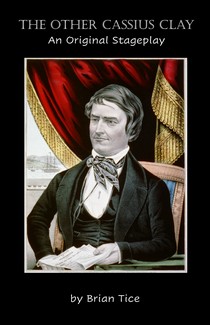
The Other Cassius Clay chronicles the political life of Kentucky Emancipationist Cassius Marcellus Clay (1810-1903). Cassius Clay was the son of the wealthiest slave-owner in the state of Kentucky, inheriting many slaves from his father's estate and subsequently freeing them all, including an ancestor of American professional boxer Muhammad Ali (orig. Cassius Clay).
The life of controversial Emancipationist Cassius Marcellus Clay, son of the wealthiest slave-owner in 19th-century Kentucky and founder of the nation's first integrated college (Berea College, Kentucky), who granted freedom to his inherited slaves and to many others and spoke out openly against the "evil institution of slavery," making him countless enemies throughout the slave-owning South. The play was originally performed in Kalamazoo, Michigan by the Rockhill Free Theatre Players in February 2003. |
|
|
|