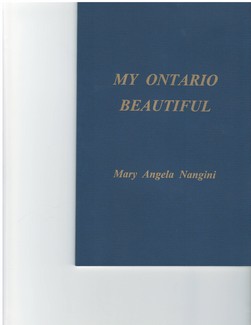
Mary Angela Nangini's poems celebrate the richness of life and love. From the city to cottage-country and the roads in between, Nangini explores the changing seasons of her varied region. (This book will soon be reprinted in hard cover.)
Heavily percussive, my jazz poetry does not resonate silently from printed page—these cries need hearing. Stop. Look. Listen.
Background
Information
My poetry springs from an oral and spiritual tradition with similarity to jazz/ blues music development. My early influences were recordings where poets join jazz ensembles, e.g., Langston Hughes or Kenneth Patchen reading with Charles Mingus’s Jazz Workshop, or Jack Kerouac’s work with a pianist and sax players. The late Ted Joans, one 1950s originator of Beat poetry, trained me in 1986-87 to improve my interactivity with musicians.
My practice is neither standard songwriting, nor “vocalese,” recreating virtuosic instrumental solos using words. Mine goes beyond the two common music/poetry collaborative styles: floating words above musician-initiated rhythmic patterns, or reciting to elicit response by improvising musician(s).
I intentionally fit my words—loosely as a jazz drummer might insert unanticipated beats—into the structure of a tune, while musicians play that form. The song may have other lyrics, or a well-known title. Just as jazz soloists express ideas to hipsters by “quoting” phrases from other compositions, I choose to associate songs with my poems that deliberately—but subtly—embellish my message with allusions to implied words or concepts.
I thrill to live in a virtual world where sounds can be associated with text. I invite you to visit my VIMEO and SoundCloud sites to see/hear/experience how print poetry comes alive.



 Share
Share Save
Save [
[