“It’s getting to be a problem of such magnitude,
That it is starting to affect the resources
That we pull out of the sea, to feed ourselves.
We could end up with no crabs, no shrimp, no fish.”
Professor Robert J. Diaz,
The Virginia Institute of Marine Science
There are now more than 400 oceanic Dead Zones around the world, twice the number the United Nations reported just two years ago.
Earth’s oceans are being starved of oxygen at such an alarming rate today, researchers are now reporting, that vast stretches of water along Earth’s seafloors are already to the point that they can barely sustain life.
And the main culprits, these scientists say, are nitrogen-rich nutrients from our crop fertilizers and our human sewage that spills into Earth’s coastal waters by way of our rivers and streams.
In a new study to be published today in the Journal Science, researchers say that the number of oceanic Dead Zones around the world has doubled about every 10 years, since the 1960s. At the same time, deadly Dead Zones along our coastlines have also been growing in size and intensity.
But the good old U.S.A. still holds the record for the largest oceanic Dead Zone in the world.
This summer, because of severe flooding in the Midwest, the Dead Zone in the Gulf of Mexico got even larger, and it now covers a swath of ocean the size of Massachusetts. This Dead Zone has horrifically more than doubled in size in the last 20 years.
“What’s happened in the last 40 to 50 years is that human activity has made our water quality conditions much worse,” says Robert J. Diaz, the study’s lead author and a professor at the Virginia Institute of Marine Science at the College of William and Mary.
“Dead Zones tend to occur in areas that are historically our prime fishing grounds.”
And these horrific Dead Zones now represent a significant portion of the ocean waters that support our many commercial fish and shellfish species.
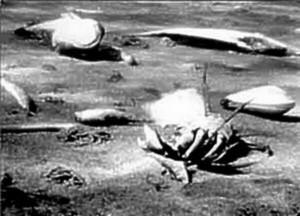
Extremely low oxygen levels are now wiping out fish and crustaceans from bottom waters in places like the Gulf of Mexico, Chesapeake Bay, and the Baltic Sea, leaving little life left other than microbes.
“There are extremely large areas in the Gulf of Mexico where you can’t catch a single shrimp today,” says Nancy Rabalais, executive director of the Louisiana Universities Marine Consortium. Dr. Rabalais has studied the gigantic Dead Zone there for more than two decades. “It’s sort of a losing battle.”
In recent years, Earth’s oceanic Dead Zones have also increased in places like coastal China and the Kattegat Sea, where the Norway lobster fishery has already collapsed. Dead Zones have also cropped up off the coast of South Carolina and in the Pacific Northwest.
Nitrogen from agricultural runoff and human sewage stimulates the growth of photosynthetic plankton on the surface of our coastal waters, and as these organisms decay and sink to the bottom, they are decomposed by microbes that consume large amounts of dissolved oxygen.
And marine life that lives at the bottom of Earth’s coastal oceans will not survive, if these oxygen levels continue to drop.
“The overwhelming response of these organisms in our coastal areas is to migrate, or to die,” Dr. Diaz said. “To adapt to low oxygen water, it has to be a part of your evolutionary history — it’s not something that you can develop in a 40 or 50 year time period.”
And over time, these Dead Zones can permanently kill off entire marine species.
They have already prevented the re-bound of species under protection after over-fishing, like in the Baltic Sea. Cod eggs rely on a delicate balance of oxygen content, salinity, water density, and temperature, to survive.
Many now believe that we’re already experiencing a similar problem with our Pacific salmon.
Low oxygen levels also kill off annelids and other sources of food for Earth’s fish and crustaceans. In Chesapeake Bay, Dr. Diaz estimates that Dead Zones already prevent the production of 75,000 metric tons of fish food.
The marine life lost each year to our enormous Dead Zone in the Gulf of Mexico would supply about 75 percent of the brown shrimp catch with food for a year. In the Baltic Sea, the Dead Zones lead to the loss of about 1.3 million metric tons of fish food each year.
“Once they occur, they are very hard to reverse,” says Donald F. Boesch, President of the University of Maryland’s Center for Environmental Science. “They have major consequences for the ability of fish populations to renew themselves.”
Dr. Boesch, who was not affiliated with this particular study, says that “the global proliferation” of oceanic Dead Zones, once mainly a problem of only the developed world, has been fueled by modern day industrialization, by our changing eating habits, and by human population growth, which has led to more and more fertilizer usage, and much more waste being dumped into the world’s oceanic watersheds.
I truly wonder what the skeptics and the nay-sayers think our very own grandchildren are going to have left to eat one day, when all of the ocean waters on this planet that we call home - are Dead.
And if you still think this is all just science fiction, talk to some folks who are still trying to make a living from fishing these days.


















Good write.
Edwin
Remember the story of Noah, nobody listened their either, this time it'll be fire instead of flood, there will be one big thunder bolt coming from the sky, I hope my little critters will survive, like the marmot did the last time, and only a handful of our type, It will take them another million or so years to screw everthing up again. Blessings! Jasmin Horst