This article tells about those who took it upon themselves to alter parts of the Old Testament long before the books of the Old Testament were brought together in one place. Their alterations, of course, were to make the scriptures agree with their own points of view.
The Deuteronomists
by Val Greenwood
One problem that comes up in connection with in our study of the Old Testament is the problem of the Deuteronomists. Webster defines the word “Deuteronomist” as follows: “Any of the writers or editors of a Deuteronomic body of source material often distinguished in the earlier books of the Old Testament.” If that definition leaves you knowing no more than you did before you read it, you are not alone.
First, note that the word comes from the book of Deuteronomy, the fifth book of the Pentateuch in the Old Testament. The word Deuteronomy actually means “Repetition of the Law.”
The book of Deuteronomy primarily comprises three discourses supposedly given by Moses. The second discourse is in chapters 5 through 26. Chapters 5 through 11 contain the Ten Commandments and a practical explanation of them. Chapters 12 through 26 contain what is referred to at the Deuteronomic Code―a code of laws forming the basis of the entire book. It represents the law as interpreted by the 7th Century B.C.E historians, the Deuteronomists.
When the temple was being renovated for reopening under the direction of King Josiah of Judah, about 621 B.C., a book of the law was discovered by the workers that became the basis of a great spiritual reawakening. Most scholars believe that the book found was likely the book of Deuteronomy and that the Deuteronomic Code now in that book was either revised extensively, or was actually written, by the historians of the time (those who are now called Deuteronomists) to suit their own interpretation of the law.
Many people also believe that these Deuteronomists revised other parts of what is now our Old Testament. The popular theory is that what exists today in the books of Joshua through 2 Kings is mostly the result of Deuteronomic revisions.
When you look carefully at the situation, it seems curious that the Old Testament contains no writings of some of the greatest prophets―prophets such as Samuel, Elijah, and Elisha. Many believe that the writings of these prophets were revised by the Deuteronomists to give us writings about them.
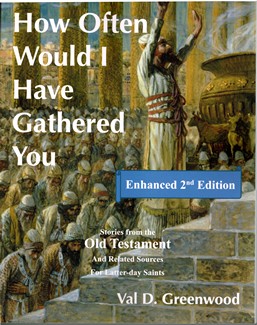
There is also another Deuteronomic issue that relates to me and to my Old Testament stories in the book How Often Would I Have Gathered You. The issue is this: It is believed that in the original Old Testament writings, both Elohim and Jehovah were separately and distinctly identified. That being true , it is believed that the Deuteronomists obscured the distinction between the two in order to support their own beliefs. If this is true , the Deuteronomic revisions have a significant effect on my Old Testament stories. As I wrote my stories, I changed the Old Testament term “the LORD” (with "Lord" in small caps), as used by the King James translators to identify “Jehovah,” back to Jehovah in an attempt to clarify. Some of these changes, however, may in fact be―and likely are―incorrect. If the Deuteronomists are right, some should probably have been changed to Elohim, but it is impossible to tell.
The scope of the work of the Deuteronomists, if in fact there really were Deuteronomists, is hard to discern, though scholars have studied it extensively. The scholarly study of the issue is intricate and complicated. It is not something that most of us who read the Old Testament for spiritual uplift want to worry about or get involved with. Considering all that the Old Testament has been through in the process of getting it to us, most of us are content to have it as it is, as good as it is. If we can get a little help with comprehension without becoming overly concerned about what the Deuteronomists changed and how they changed it, we still have a priceless treasure.
For those interested in pursuing the study of the Deuteronomists further, I recommend a book by Thomas Römer entitled The So-Called Deuteronomistic History: A Sociological, Historical and Literary Introduction (London: T&T Clark), 2007 [ISBN 9780567032126].
One problem we deal with in our study of the Old Testament is the problem of the Deuteronomists. Webster defines Deuteronomist as follows: “Any of the writers or editors of aDeuteronomic body of source material often distinguished in the earlier books of the Old Testament.”
If that definition leaves you knowing no more than you did before you read it, you are not alone. First, note that the word comes from the book of Deuteronomy, the fifth book of the Pentateuch in the Old Testament. The word Deuteronomy actually means “Repetition of the Law.”
The book of Deuteronomy primarily comprises three discourses supposedly given by Moses. The second discourse is in chapters 5 through 26. Chapters 5 through 11 contain the Ten Commandments and a practical explanation of them. Chapters 12 through 26 contain what is referred to at the Deuteronomic Code―a code of laws forming the basis of the entire book. It represents the law as interpreted by the 7th-Century-B.C.E historians, the Deuteronomists. When the temple was being renovated for reopening under the direction of King Josiah of Judah, about 621 B.C.E., a book of the law was discovered by the workers that became the basis of a great reawakening. It is believed that the book found was likely the book of Deuteronomy and that the Deuteronomic Code now in that book was either revised extensively or actually written by the historians of the time (those whom we call Deuteronomists)to suit their own interpretation of the law.
It is also believed by many that these Deuteronomists revised other parts of what is now our Old Testament. (The popular theory is that what exists today in the books of Joshua through 2 Kings is mostly the result of Deuteronomic revisions.)
When you look carefully at the situation, it seems curious that the Old Testament contains no writings of some of the greatest prophets―such as Samuel, Elijah, and Elisha. Many believe that the writings of these prophets were revised to give us writings about them.
In the Old Testament writings, both Elohim and Jehovah were clearly and distinctly identified. But it is believed that the Deuteronomists obscured the distinction between them to satisfy their own beliefs. These revisions have an effect on my Old Testament stories. As I wrote the stories, I changed the Old Testament term “the Lord” (with "Lord" in small caps), as used by the King James translators, to “Jehovah” in an attempt to clarify. Some of my changes, however, may in fact be―and most likely are―incorrect. Some of them should probably have been changed to Elohim, but because of the work of Deuteronomists, it is virtually impossible to tell.
The scholarly study of the work of the Deuteronomists is intricate and complicated. It is not something that most people who read the Old Testament for spiritual uplift want to get involved with. Most of us are happy to have the Old Testament as it is―with perhaps a little help in the comprehension area―without becoming overly concerned about what the Deuteronomists changed and how they changed it. For those interested in pursuing such a study, I recommend a book by Thomas Römer entitled The So-Called Deuteronomistic History: A Sociological, Historical and Literary Introduction (London: T&T Clark), 2007 [ISBN 9780567032126].
Titus and Philemon: The Easy Study Bible Commentary
Completely Revised and Greatly Enhanced!
Not for scholars but for anyone who struggles to understand the New Testament!
The Easy Study Bible Commentary take
Revelation: The Easy Study Bible Commentary
Not for scholars but for anyone who struggles to understand the New Testament!
The Easy Study Bible Commentary takes The Easy Study Bible Diagramed and examines, describes and expounds upo
Finally! Understand and learn from the New Testament Book of John.
Try James first for free
Now there is a Bible translation that is easy to read, understand, and study.
This translation is unique in that it is arranged