Richard Brautigan: The Tokyo-Montana Express Redux
For most of my adult life I have been a big fan of 70s-era writer Richard Brautigan, who was a hugely quirky eclectivist personality in American literature of that period.
[Brautigan was, of course, a complexly neurotic individual in his own way, suffering to a large extent from a miserable childhood (like so many others whose miserable early years have permanently altered or adversely affected their subsequent adult lives). Nevertheless, and despite all that, there is something singularly attractive about Brautigan’s existentially fraught plight as a misunderstood artiste that has always attracted me. Perhaps we also shared a subliminal death-wish, for I have myself throughout my life contemplated death (at 49, he took his life with a gunshot late in the 1984, you’ll recall, at his moody old mansion at Bolinas, California) as an unwelcome but unavoidable aspect of the human condition. At any rate, Brautigan remains a fascination for me, hence the following story.]
Like that stodgy, self-important and grossly condescending publication ‘The New Yorker’, which disdained to even mention the Beat poets and writers in that magazine’s otherwise prodigious compendium of a book of 50s cultural events and literature (‘The 50s: The Story of a Decade’, 2015), far too many people in the past decades took Richard Brautigan ‘lightly’ or regarded him as little more than an ‘odd’ countercultural anomaly who didn’t quite fit into either the Beat generation or the subsequent Hippie movement. While New Yorker (the magazine) may be forgiven for its overly hyped and also overly narcissistic opinion of itself (they are, after all, ‘New Yorkers’…despite considering themselves and their ubiquitous literary rag archetypical ‘American’ institutions), mainstream literature in general may never be absolved for its failure to give full credit to Brautigan’s singular literary excursions of the early 60s/70s!
For myself, as someone just released from the service and living my ‘trip’ in Berkeley (CA) in the 70s, Brautigan’s uniquely whimsical outlook on the human zoo had me (as the popular phrase puts it) with his first words in ‘A Confederate General in Big Sur’ (an early and somewhat successful book of his).
From that point on, I made it a point to collect as much of Brautigan’s written output as possible and enjoyed every bizarrely idiosyncratic take that appeared in his books and poems. I even have a rare copy (only 250 were printed) of the tiny, 14-page chapbook (‘Desire in a Bowl of Potatoes’) that contains the essence of one of his previously unpublished manuscripts, written in the mid-1950s. And naturally, in addition to all his available works, I also have several copies of his ubiquitous, definitive, posthumous biography ‘Jubilee Hitchhiker: The Life & Times of Richard Brautigan’, by William Hjortsberg.
Musing upon all this, I think that I valued Brautigan’s stylistic wanderings to a great extent because we share a great many perceptions and outlooks on the whimsical tragedy of all human affairs. The principal difference between us is that I utterly lack his talent to interpret life’s foibles to any degree approximate to his own writings. In other words, we’re talking ‘genius’ versus ‘hack’, if you’ll permit the ambitious allusion.
But this is all contextual backstory, setting the stage for my chief intent here: to delve into a special aspect of one of his specific books: ‘The Tokyo-Montana Express’.
The ‘Tokyo-Montana Express’ was written back in the late 70s and consists of a collection of 130 of his (typically) short anecdotes, all written down in various places and brought together in the book, but a goodly number of them written at his spread in Livingston, Montana, and an equal number jotted down while traveling in Japan. By 1980, Brautigan's popularity had began to wear somewhat thin and his formerly enthusiastic youthful audience began to shrink appreciably.
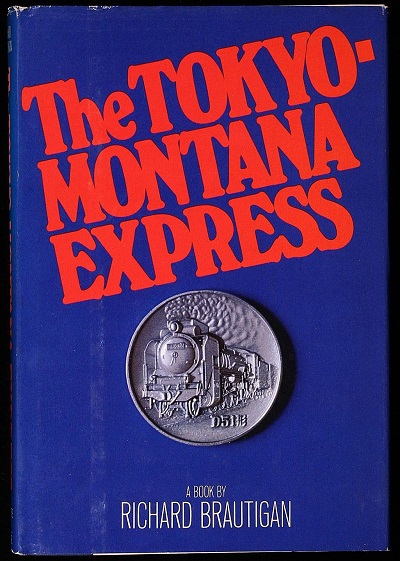
In 1980, Delacorte Press/Seymour Lawrence printed a paperback edition of The Tokyo-Montana Express (258 pages in length). On its back cover is a color photograph of Tokyo bar and literary hangout (‘The Cradle’) owner, Shiina Takako with Brautigan, sitting placidly in a small boat off the coast of Japan in a moment of existential languor. On the front cover is an object that has, ever since I first saw it, perched on a small shelf inside my mind for several decades, stored away, unclassified, unknown and unexamined. It appears to be either a coin (numismatic currency) or a small silver-colored medal on which is a relief engraving of what is quite obviously an old steam locomotive of some sort.
Most people reading this particular 1980 Delacorte-printed edition of The Tokyo-Montana Express would glance briefly, perhaps with a slight bit of perplexity, at the coin-like object and wonder briefly what the connection was between the title of the book and it, but then quickly forget about it as they began to read the book’s contents.
Not I, of course. But it took the previously referenced several decades for my restless, ever-wandering curiosity to finally get around to puzzling that book’s cover out! In fact, it required a shift of preoccupations brought about by the 2020 SARS-CoV-2/COVID-19 pandemic to actualize itself. Having been considerably involved over many years with aviation, aerospace and aircraft, in 2020 I found myself forced to withdraw from my local air museum (where I’ve been a volunteer, former board member, historian and consultant) due to the social constraints pertinent to the pandemic and develop other amusements and preoccupations.
This, in turn, stimulated several other semi-dormant interests that I’ve had simmering on the mental back burner for a long, long time. One of them is railroads and train technology.
Having spent a number of years abroad (Saudi Arabia, China, Europe) as an America expatriate involved with various medical projects and contracts, I found myself reading several accounts (again) of legendary eccentric T.E. Lawrence (otherwise known as ‘Lawrence of Arabia’ to most), several of which related to his 1918 guerilla warfare raids against the Ottoman Turks and their Arabian Peninsula railway that extended down the Red Sea border of the Kingdom from Damascus to Medina.
That, in turn, drew me into a much fuller immersion in the whole fascinating story of that singularly unique and historic railway that runs through the coastal ‘Tihama’ desert portion separating the Red Sea from the prominent elevations of the Hejaz Escarpment. The story of how that railway came to be conceived, funded and constructed is an involved one and it was at that time fraught with geo-political significance, since its construction would enable the Ottoman Turks to extend their tenuous hold over the Arab tribes of the region and simultaneously provide a much quicker access for the Islamic faithful to make the annual religious ‘Haj’ (the journey required of all faithful who are able, to visit the twin Islamic Holy Cities of Medina and Makkah). Formerly, the only means of reaching Makkah had been via an arduous and exhausting journey through the bandit-infested Bedouin desert via camel caravan, lasting several weeks. A train, operating from Damascus all the way to Makkah would allow pilgrims to shorten their journey and reduce all its deprivations considerably, achieving in mere hours what had previously taken many days. It would also enable the Turks to move their troops in and out of those areas, thereby extending and securing the Ottoman possession of both Arabia Felix itself and its ancient Holy sites.
Lawrence, as many of you may know, was sent by the British government to side with the Arab rebels (who were of the Hashemite tribe), in cooperation with Prince Faisal, who in resisting the Ottoman Turks wished not only to dislodge the Ottomans but to claim hegemony over the whole of the Arabian Peninsula. The Ottoman Turks, you’ll remember from your history lessons, had allied themselves with Germany and the Hapsburg’s Austro-Hungarian Empire in WW1 and therefore Britain was motivated to support the whatever rebellion to dislodge the Ottomans from Arabia was afoot.
Unfortunately for Britain, they picked the wrong Arabs to support and in the end it was not the Hashemite Arabs who came out on top but the rival Arab tribes who unified under Wahabist Ibn Abdulaziz. Thus, poor Lawrence found himself uncomfortably involved in the unscrupulous and complicated political imbroglio and associated machinations (by the French and English) that resulted in that part of the Southwest Asian landmass being divided, at war’s end, into the countries that now exist there.
When I was working as an expat in Saudi Arabia, my work found me in Taif for two years, the so-called ‘summer Capitol’ of Saudi Arabia, which is perched high up on the Hejazi Escarpment (that rises to an eventual 11,000+ feet on the south end of the Arab Peninsula). Taif was an important Ottoman Turk stronghold back then and its fort was quite formidably constructed. At any rate, since we were relatively close to Medina and Makkah (just ‘down the hill’ from Taif, so to speak), we had the opportunity to actually visit some of the sites along that Hejazi Railway that Lawrence had operated against. This is normally done by either camel-back or 4WD and although today much of the old track and railbed has been torn up or removed, there are still several old engine wrecks (steam locomotives & cars) to be seen, peacefully rusting away under the hot Saudi sun, out there in the coastal Tihama desert.
If you’re asking yourself at this point what prompted all of this backstory, the short answer is that although I’ve always had a fondness for trains and steam-engines in particular, that interest remained relatively dormant until this past year during the social isolation of which I whiled much of my time away reading and pursuing a number of odd and eclectic interests (including trains!). After I had read several excellent and authoritative works on the Ottoman’s Hejaz Railway, I stumbled quite by accident across my copy of Brautigan’s ‘Tokyo-Montana Express’ one morning (quite literally, since it was perched on a stack of poetry books that lined the wall leading from my mancave to its adjacent bathroom!).
Despite my still-blurry, just-out-of-bed stupor, I distractedly scooped up the book where it had tumbled down in front of me and gazed bemusedly at its cover: there was that strange, silver coin-like medal with a steam-engine roaring towards me on its blue field. And then…a Eureka moment! It was a steam locomotive of some sort! I could hardly wait until the moment when my soon-to-be-consumed AM cuppa Joe had shaken up my cerebral neurons enough to start processing data!
A certain number of glugg-glugg-gluggs later, comfortably ensconced in my reading room’s Eames Chair clone, I picked the book up again and looked at the coin (or whatever it was) in some detail through a magnifying glass.
The coin had, as previously mentioned, a steam-locomotive in three-quarters frontal profile chugging up a track under a full head of coal-fired smoke. At the bottom of the coin was a short inscription that read ‘D51’ (followed by two Japanese Kanji characters).
Logically, there had to be some sort of connection between the book's cover illustration (of the the coin) and its title (‘Tokyo-Montana Express’), I surmised. Based on what I could determine from recent researches into steam locomotives, I also noted that it was what railroad buffs call a ‘2-8-2’ engine fitted with bilateral smoke deflectors (these deflector plates help keep the stack’s smoke effluent from blowing directly back to the engineer’s cab and also help disperse it). A Japanese train? Probably? A real ‘Tokyo Express’? Possibly!
How intriguing! And so, armed with this basic information (but not wearing a 'deerslayer' cap, nor carrying my magnifying glass in best Sherlockian fashion), I next turned to that marvelous research tool we all have come to know and love: GOOGLE Images. Typing ‘Japanese steam engine on coin or medallion’ into the search line, I punched the return button on my keyboard and waited to see what GOOGLE would make of that! Nothing smoking-gun’ish, it seemed, so I experimented with a few variations on search line and finally there appeared a silver medal with a train in a similar profile and the description: “Japanese medal commemorating 10,000 km accident-free operation”. Close, but still no see-gar!
Still, nothing fully congruent emerged until after a further bit of searching, when finally, a silver medallion popped up on the other stalwart search device (eBay) that had ‘C-23’ at its bottom (followed by the two Japanese Kanji characters!). Bingo! That led to the discovery that the silver medal object on Brautigan’s Tokyo-Montana Express printing (by Delacorte Press/Lawrence) was one of a series of commemorative Japanese National Railway medallions struck back in 1972 to commemorate one century of train travel in Japan!
The medal series memorialised a number of different steam locomotives that had been used on the Japanese National Railway system over the past decades, from 1872 onwards, and it appeared that “D51” was a particularly well-known and somewhat famous Japanese locomotive type.
In fact, there were over 1115 of the D51 class 2-8-2 locomotives built, amazingly. 1-202 standard type D51 was developed as an improved version of the large cargo steam locomotive D50 for main lines in 1936 (1936), and not only for the Kai line (main Japanese rail line) but also for use on the Japanese shore line (a quasi trunk-line). The most advanced technologies of those days were introduced on the D51 Class, such as using a lot of welding to reduce the weight of the car body and adopting the first box-shaped ring core (box motor ring) in Japan. The locomotive came to be known commonly in Japan as Degoichi and was a superb example of Japan’s emerging railway technology of the 1930s. Of the total number built, 30 of the locomotives ended up in Soviet hands at war’s end, while 32 were used on Formosa (Taiwan) during the Japanese occupation of that island; 10 were used in the Philippines and 2 remained in Korea.
Thus, Brautigan’s book front cover consisted of a photograph of one of the commemorative medals honoring the D51 locomotive (taken by one Walter Harper, a photographer) and its use on Brautigan’s cover was probably coincidental, combining the Japanese element of the book with an actual artifact of Japan’s railways system (the D51 steam locomotive). In this context, it is therefore still entirely possible that there was a real ‘Tokyo Express’ pulled by a Class D51 engine…a rather amusing possibility to contemplate, despite Harper’s seemingly arbitrary selection of the medal to adorn the book’s cover merely because it was Japanese.
The story doesn’t, however, end there, since if one examines that cover photograph of the medal closely, one can just make out the steam engine’s numerical designator plate affixed to the front of the boiler’s steambox. That number is ‘D51-266’. Another clue!
As it turns out, a number of Class D51 steam engines ended up being preserved, after the last of them in Japanese service was retired in the 1970s. No less than an amazing 187 of the Class D51 locomotives have since been preserved…a not-small measure of the respect they generated. This does not include an additional 9 of the D51 engines in Russia and 4 in Taiwan. After the type was retired in the Philippines in 1951 (due to ‘Dieselisation’) none of them were preserved by that nation.
It is of additional interest to note that the specific D51 engine (‘D51-266’) on the commemorative medal Harper used for Brautigan’s book’s front cover turned out to be one of those preserved (inoperative, but in excellent display condition) examples of the D51 steam locomotive the Japanese have kept. It is situated in a public park in Nakatsugawa, Gifu Province, where it remains on 360-day-a-year display (although it is shielded by a somewhat unaesthetic but suitably protective link-chain fence enclosure, making good photographs of it a bit challenging).
The illustration that appears at the head of this article is of Japan National Railways engine D51-266’s commemorative medal and thus the story of the train linked to Richard Brautigan’s ‘Tokyo-Montana Express’ (as its ‘cover-object’) comes full circle and the relevance of that steam engine may at last be understood by everyone, train buffs and/or the casual Brautigan reader alike.
It is poignant to reflect upon the fact that just as Japan's 'era of steam railways' was coming to a close, Brautigan's popularity as a writer was also declining noticably, a fact that undoubtedly exacerbated his preexisting problem with acute alcoholism and mental depression. Critics have since noted that his last works were not in the same class as his earlier, original writings and Brautigan undoubtedly recognised this fact with intense regret. In this sense, the symbolism of that 'Tokyo Express' is almost palpable in considering all of the foregoing.
I have no doubt that while a few of you are fascinated by this discovery and silently mouthing the words “Whodda thunk it?!”, most of you are probably a lot less bemused by my sleuthing here, in this regard. Ah well!
For an eclectic soul like myself, this story marks the completion of yet another perhaps odd but also fascinating desire to more fully understand somewhat arcane, hidden details that may expand our awarenesses of the writer’s art and add a bit to our appreciation of…in this case, Richard Brautigan’s mindfulness (or lack of it, if you’ll permit me a sick joke, since he blew his brains out in September of 1984 with a .44 Magnum revolver, borrowed from a San Francisco Japanese friend, somewhat ironically).
----------------------------------
Note: for more historical context on the JNR Class D51 Japanese steam locomotive, see here. Several excellent and useful articles on Richard Brautigan may be found here, here and here. The first is a review that is somewhat critical of Brautigan’s art, while the third was published in Rolling Stone Magazine in 1985, immediately following his suicide. For those who may not be aware of William Hjortsberg’s excellent biography of Brautigan, it is ‘Jubilee Hitchhiker: The Life & Times of Richard Brautigan’, which is quite authoritative and perhaps one of the ultimate accounts of Brautigan’s convoluted life. I highly recommend it to anyone with an interest in Richard Brautigan, the man and the writer.
---------------------------------------
Postscript: Given my interest in the 'D51' commemorative train medalion appearing on Brautigan's 'Tokyo-Montana Express' book cover, I thought it would be neat to find a larger-scale, operating model of that engine type to put on my shelf. Searching about the internet, I was vaguely disconfuddelated to find that, aside from some teeny-tiny 'N-Guage' train D51 models, there were hardly any larger scale versions of that steam locomotive produced!
One of the few appeared to be the ATOMIC (a Japanese toy company) 1/40 RC controlled engine and tender set, produced some years ago as a 'beginner' set for small children. Although the items are quite authentically made, with all the details modeled quite well on them, the train set seems to have gained almost cult status with train collectors throughout Japan. Consequently, all stocks have long since been depleted and if one becomes available, the asking price is near-astronomical.
Finally, my search produced a used (but well preserved) specimen offered for sale at about US$200 or so. The only kicker was that it came w/out tracks and the ATOMIC train set uses a singular, proprietary track guage that is unique ONLY to ATOMIC. That is to say, there are no 'spare tracks' available anywhere, for any price! Reluctantly, I purchased it from its Japanese owner, anyway.
Then, even later still, more diligent searching revealed a still new-in-the-box ATOMIC 1/40 RC Controlled train set for 65,000 Yen! Yes, 65,000 Yen, which is approximately US$ 600 or so! By this time, so thoroughly flummoxed by my lack of success in finding a new example of this amazingly popular engine, I rashly plopped down the money and am presently waiting for it to arrive (this time, with tracks!).
In retrospect, I have this unsettling vision of someone over here in the USA trying to estimate the relative 'value' of such a God-awfully expensive 'toy' after I am gone and all of my small museum full of curiosities has been handed over to an 'estate sale' person to dispose of! The average potential buyer would probably consider US$50 WAY too much for it! Sigh!
Thanks a heap, Richard!