INTRODUCTION
(to pre-1957 poems by T. Wignesan)
Wignesan s/o Thuraiappah
by
The late Professor Eric N. W. MOTTRAM,
Chair Professor - Emeritus - of English and American Literature,
King’s College,
University of London
© T. Wignesan – Paris – 1948 - 2014
INTRODUCTION
(to pre-1957 poems by T. Wignesan)
Wignesan s/o Thuraiappah
by
The late Professor Eric N. W. MOTTRAM,
Chair Professor - Emeritus - of English and American Literature,
King’s College,
University of London
These poems come from a man who spent his first twenty years in Malaya, an Indian, a Malayan, ‘citizen’ of a country recently achieving independence from colonial rule. These are independent poems. A Malayan poet either drifts into or chooses to write in Chinese, Malay, one of the Indian languages, or English. I have never read English poetry by a Malayan which sounded like English poetry, and I did not expect to. In West Africa and the Caribbean Federation, as in Malaya, new forms of English confront the local writer: the other culture produces its own rhythms, colloquialisms, significant vocabulary, and probably its particular religious and philosophical variations. Wignesan writes in English learned in Malaya.
A Malayan Indian inherits in some way some kind of Indian culture. His people are mainly immigrants and their descendants from probably the Tamil areas of Southern India, from Bengal, or from Ceylon. Until the nineteenth century Malaya owed practically all its culture to Indian commercial and religious penetration – alphabets, religion, political systems, law, astrology, medicine, literature, sculpture, metal crafts and weaving. Hindu, Muslim and Buddhist culture continue to effect [sic] Malaya, especially at the level of local folk life, in the villages and country towns, in birth and death ceremonies, in the village wise woman, the local prophetic astrologer, the style of carving and pots. All this is embedded in the exciting cultural heterogeneity of Malaya today. But there is no strong national Malayan cultural tradition; it is a melting pot for a future nation.
At a local dramatic performance or a puppet play the audience will most likely be Chinese, Malays and Indian, whatever the drama’s origins. The Malay plays are mainly drawn, in any case, from the ancient Indian Ramayana literature, and this would not necessarily mean more for an Indian. In Indian community schools, the teaching is mainly in Tamil; the Indian majority today is from Tamil-speaking Indian and Ceylonese regions. Many of these people return home after three years money-making in Malaya. The second and third generations, to which Wignesan belongs, constitute an important part of the Malayan middle-class, the white-collared workers, overseers, schoolmasters, and professional men – lawyers, doctors, railway engineers, merchants. This represents an intelligent minority in the whole mixed community.
But Wignesan learned English at his school. The British, semi-Christian type of European culture would be one of the choices opened to him, or something alien to refuse, during his most impressionable years, totally unlike his local Indian culture, remote from ancient Indian tradition. At some point in his maturity he would have to choose or at least accept one line if he was to write at all. His situation is shared by nearly all intellectuals in Malaya. In fact he left that situation and has been making his way about England and Germany as a student of Indian and European philosophy, as well as English Law, and definitely writes poems in what is now an English enriched with English idioms, but poems which are not, I think, in the English tradition.
Wignesan’s poems have no European mythical allusions, no European cultural backing to their words, none of the characteristic ambiguities of English poetry. His metrical and rhythmical forms are freer and more direct, less organized even, than English free verse. His words may have a Malayan inference, or even an Indian one. His knowledge of English poetry is in fact not great and he has not suffered academic literary inoculation. Such an English poetry has its own fate. It is the poetry of an English-writing Malayan attempting to use the ancient Indian idea of poetry. Instead of writing a debased Tamil or Malay – the country’s official language – or Sanskrit, the dead language of ancient Indian literature, Wignesan uses English to write a philosophical poetry which aims towards a non-English tradition. His images may be drawn sometimes from Malayan landscape and life, and he may use local words, the mixed vocabulary of colloquial Malaya; but we have mainly to understand the kind of poetry he writes.
Vedic poetry is prophecy or revelation or, in a very general sense, philosophy. Its common mode is incantation, a special and increasingly rare form in English. Rhythm and metre are invocatory. Punctuation is reduced to exclamation and termination. It is a spoken rather than a written art, a rhetorical celebration of how the mind moves out of the senses and objects of experience into the experience of beatitude. They claim “the flower and fruit of Speech is Truth”, and this is the philosophical aim of Wignesan’s verse, its particular direction. He does not imitate Vedic traditions; he aims at something more personal. Vedic rhetoric is as formal as European medieval rhetoric and just as subject to arid elaboration. The Rigveda is a pattern of traditional lines and tags, rule-bound stanzas, quantitative metrics, and the free word order of ancient Sanscrit.
Certainly very little of the myths and dogmas of Hinduism that make up the material of the Ramayana appear in Wignesan’s poems, or the surface artificiality of the later forms of kavya which are really embellished exercises in rhetoric. I think Wignesan draws from his Hindu interests his philosophic aims, his quantitative lines and his incantatory modes. But I would go only as far as saying that this line appeals to him more than the English tradition at the moment.
Does he write Malayan poetry? Malayan poetry does not exist yet because a truly national culture has yet to appear. Wignesan is very much himself, his own dogma, his own ebullient, intensely self-reliant self. I really do not think mentioning his cultural origins does any more than merely state the situation he is in, his language position, and the kind of choices he might make. These poems show he can make his own way.
July 1958
Eric Mottram,
Professor of English Literature,
University of Gröningen,
Holland
( This essay, written in English by Eric Mottram, then Professor of English at Gröningen University, first appeared in German in Forum Academicum, N° 4, July 1958 (Heidelberg University), p. 13. Cf. “Appendix” for the German translation by Horst Taubmann.)
|

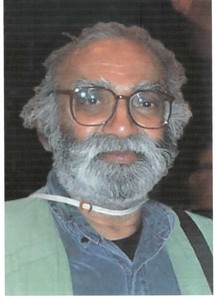


In 1955, I had to go to London to keep my "dining terms" at Lincoln's Inn, and I sat for the Bar Finals in 1956 (though I was cheated of my diploma from practising Law). It was then that the famous sinologist and ex-Vice-Chancellor of the University of Hong Kong: Wang Gung-wu - handed him a copy of my poems and our first meeting took place. Since then, Eric and I became very good friends and our correspondance lasting right up to his passing in January 16, 1995 makes up a véritable book of literary production. Excerpts were published in the festscrift for Eric in December 1994: "Alive in Parts of this Century: Eric Mottram at 70" by North & South Publishers, U.K. (ANY PUBLISHER INTERESTED IN BRINGING OUR CORRESPONDANCE OUT, PLEASE GET IN TOUCH SOON ?)
Eric wrote the article in English and it was translated into German by Horst Taubmann (later a famous theatre producer and critic).
Thanks a million, Ron. TW
Ron