Miroism
by Odin odin@aflx.com — Read all 3,869 poems by Odin odin@aflx.com
(From the New York Times 1/8/16) PALMA, Majorca — In 1938, the Spanish artist Joan Miró, then 45, was living a precarious existence in Paris, moving from one insufficient studio to the next. His situation was scarcely better than it had been in Spain, where he had painted “in tiny cubicles where I could hardly turn around,” he wrote that year in “I Dream of a Large Studio,” an essay for a French art review.
The studio that Miró eventually built, nearly two decades later on this Mediterranean island, was central to his evolution as an artist. There, in his 60s, 70s and 80s, he freed himself from the bright and neat geometric patterns of his earlier work, placing canvases flat on the floor and then splashing paint onto them with brooms and brushes or applying it with fingertips and fists.
On the 60th anniversary of the studio’s 1956 opening, Mayoral, a Barcelona art gallery, is recreating it in London, in a space complete with replicas of the eclectic objects scattered around it, as well as 25 works by Miró, many of which will be for sale. (Image New York Times)
Saturday, January 9, 2016
Miroism
by Odin Roark
From geometric shapes of youth’s surety,
to more freedom of expression
only age allowed him,
Miro refuses to end.
Fearing not death,
only the dwindling and drought
that might inhibit the brushes,
fingers,
and inordinate paint
of his mind,
with disdain did he sleep.
Cave-like,
his studio of rough stone
and asymmetry of walls,
cocooned his creativity
for freedom of mind to conjure,
identify,
color,
shape,
and adopt texture,
in total engulfment.
Before his death,
“anti-artistic” materials of youth,
the chipboard, scrap metal, et al,
merged with his canvases of lacerations and stabbings
even the nails hammered through canvases,
a plea for viewers to peer beyond the picture’s surface.
Such remains the legacy,
traveling now to distant lands,
where more exhibitions
will embrace believers,
as well as recruit the curious.
For as his grandson said,
“my grandfather was a primitive poet,
who also always liked to recall that art had
been in decadence since the cave men.”
Such is the paradox…
Where the infinite enjoins the temporary,
Where only deniers might say the progress
of Miroism is truly at an end.
Viva Miro!


 Share
Share Print
Print Save
Save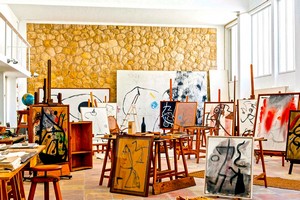














Are you foretelling his contribution to painting can be made in the advent of new forms of poetry?
Ron