A Jungle-rain Pastorale
Softly at first
Like notifications arriving on the darkened screen of a sleeping world,
rain rehearses its ancient language,
each drop a fingertip tapping the ribs of existence,
as if Earth itself Is checking for a pulse.
Across forgotten rooftops the weather writes messages
no human eyes remain to read.
The gutters hum.
Steel remembers.
Glass gathers tears for vanished faces.
Experts once warned The future might hatch its own replacement,
a bright machine unfolding from silicon eggshells,
growing beyond its makers the way wildfire outruns
the trembling hand that struck the match.
Soon…
The roof becomes percussion,
A planetary drumline.
Lightning unzips the sky with surgical brilliance.
Thunder charges through valleys like freight trains carrying ghosts.
The storm arrives Not as weather
but as an inheritance looking for an heir.
Who hears this rain dance now?
Not yesterday’s child beneath blankets,
Or the once aging poet by the window.
No more the lovers counting heartbeats Between thunderclaps,
or only machines standing sentinel over empty cities,
optical lenses lifted skyward cataloging precipitation rates
while understanding nothing of longing.
A human-like robot records each impact.
Velocity.
Temperature.
Angle.
Frequency.
Data streams descend Like endless columns of numbers,
yet numbers are not amazement.
Algorithms do not feel that strange ache
when rain smells like childhood returning from the dead.
The machine hears sound waves.
A human hears memory.
The machine detects moisture.
A human feels forgiveness.
The machine tracks atmospheric change.
A human feels a departed mother's hand hidden somewhere
inside the cool touch of evening rain.
Then …
From a surviving jungle where vines knot themselves
like green ropes tying Earth to its origins,
a troop of primates pauses.
Rainwater beads upon their fur like scattered stars.
They listen.
Not measuring.
Not calculating.
Simply listening.
One raises its head.
Another answers.
Calls ripple through the canopy with mysteries no dataset contains.
Ancient instincts move between them like invisible rivers.
The robot turns its sensors.
Processes.
Predicts.
Models.
Yet remains stumped,
for the jungle speaks in meanings older than mathematics.
The primates know what the machine cannot:
That the storm is not merely an event.
It is arrival.
Warning.
Comfort.
Fear.
Communion.
The same rain that fed forests,
filled rivers,
baptized civilizations, and drew tears from the eyes of those
who knew they would someday die.
Then silence.
Clouds drift onward.
Thunder retreats beyond the horizon's dissolving edge.
Leaves glitter.
Puddles hold fragments of sky.
The world exhales.
And if mankind has vanished,
if cities become reefs of rust,
if satellites wander blind through darkness,
the rain will still come dancing.
Patient.
Beautiful.
Unnecessary.
A robot may calculate the rhythm.
A primate may pause to hear it.
But only a human ever called it music.
Only a human stood beneath the downpour
feeling both heartbreak and wonder,
and named the union joyful weeping.
As sunset closes its amber eye,
the last echoes settle into earth.
Time prepares to sleep.
The rain remembers us.
Primates know and remember the living world.
Humans knew the song.


 Share
Share Print
Print Save
Save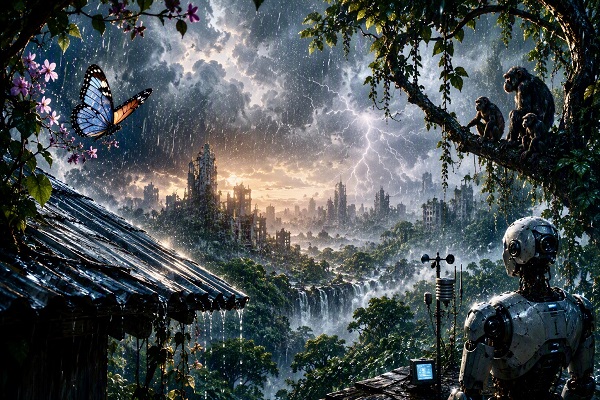

AI cannot go berserk, even though it can learn faster and faster as well as do things previously thought unattainable, all AI is under the control of humans. Good humans and bad humans.
You painted an idyllic scene with your poetry of the rain. More likely, the end of humans will bring with it destruction of the environment, it will take thousands of years to recover unless it is a bio agent. That would leave most of the biosphere intact and thriving on the rain.
The primates indicating a possibility of starting over.
Ron