Alone and on foot in a medieval land in the heart of ancient Greece.
This is an excerpt from Chapter 1 in my book of travel essays entitled "Journeys With Soul".
In the Shadow of Mount Athos
Alone and on Foot in an Ancient Medieval Land
By John Herlihy
Nearly 40 years have now passed since one sunny summer morning in Northern Greece when I eagerly climbed into a small fishing boat on my way to visit the sacred enclave of Mount Athos. As I trace my own footprints back into the ever receding and distant past before they completely disappear, I recall that the sunlight passed through the dry clarity of the air with a knife-like sharpness unique to the Mediterranean area. The sea was wild in the wind; the light reflected off the water with an insistence that was blinding. Some unknown impulse from deep within me had brought me to that point, in spite of myself. Perhaps it was the same force that brought color to the sky, reflected in the water, and entered my mind through the sensors of your youthful vision.
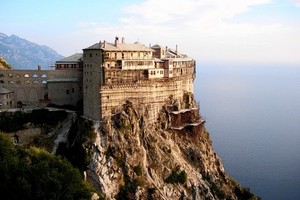
The rugged peninsula is celebrated as a monastic enclosure with twenty ancient monasteries tucked into the cliffs on the coast of the Aegean or perched like soaring eagles on top of a rocky promontory overlooking the landscape below. These monastic sanctuaries of meditation and spiritual rigor date back a thousand years where history and arcane accounts of the area have receded into the darkness of the past and can no longer be reclaimed. I cannot hide the fact that I was forty years younger in my early 20s back in the late 60s when the youth of the time were called “flower children” and the era itself was called the “beat generation” who seemed to follow some inner drum that not everyone was privy to. What I was looking for then was what I am still looking for now, still searching, still seeking for the “eye of certainty” that leaves no doubt and that makes no mistakes, the eye of wisdom and enlightenment that leads like a torch along the way to one’s chosen destination. Over the years, I have noticed that I sometimes hear an inner voice that makes no audible sound but that tells me what I need to know. If fact, we all have such a voice; whether we listen to it and trust its inner guidance is another question. Fortunately, I have had the good sense to listen to what my intuitions tell me, a tendency that I attribute to the no-nonsense attitude my mother had toward life and its mysteries.
I had been living in Europe for a year and had the summer free to explore places of my own choosing. A chance encounter with a fellow traveler the summer of ‘68 brought the alluring name of Athos to my ears. I soon found out that Athos was none other than the holy mountain of Athos, a lonely and secluded wilderness that still existed in the upper reaches of Northern Greece with the great mountain chain of Athos running down the length of the peninsula like the spine of the land’s rugged body. It is in fact a well preserved holy monastic enclosure that dates back beyond the Middle Ages into the Dark Ages of Europe, a peninsula in Northern Greece that has survived the onslaught of natural storms, the ravages of war and the turmoil of political conflict down through the ages. The Holy Mountain has been the center of Orthodox Christian monasticism for the past millennium. Its recorded history spans the millennium, while apocryphal legend introduces Mary, the mother of Jesus, to the area much earlier than that. In engravings of the Mount, the monks display the image of the Holy Virgin high above the crest of Athos as its celestial patroness and protectress.
According to the apocryphal account, the ship she was traveling on with St. John the Evangelist was blown off course arriving in sight of the wooded mountain ridge. The Virgin gazed at the high peak, saying: “This mountain is holy ground. Let it now be my portion. Here let me remain.” The first clear account of the beginnings of monastic life on Athos commences with the story of the 8/9th-century monk, St. Peter the Athonite, who spent fifty years in a cave which still exists at the edge of the cliff near the Great Lavra monastery. St. Peter is a prime example of a solitary monk in combat against hostile forces. The next step was the development of a lavra or colony of hermits, founded by St. Euthymios of Salonica, a spiritual guide born in 823 who attracted others by his personality and the force of his ascetic reputation resulting in a small colony of ascetics.
My pilgrim experience found its flowering in a visit in this wonderful monastery at the end of the Athos peninsula, the prototype of all the monasteries in these medieval environs. As I approach its impressive gate giving entrance to the grand monastery that resembles to my inexperienced eye a monolithic Turkish structure, I take note of the towering peak of Athos in the distance, as though the 1,000 year monastery still stands under the patronage of its watchful gaze throughout a long and varied history. The gate upon closer inspection is actually a four-pillared portico that covers a domed verandah where I image the monks sitting in the early evening watching the creeping shadows descend in a darkness that matches the silence of the night, the passage of day to night being an event worthy of notice in places such as this, out in the wild natural order with no sign of civilization creeping around the edges of the mind and heart. I also sit down, fairly exhausted after my day long trek through the forest and over the jagged foothills of the area surrounding the Mount, wondering what will happen next as I take note of a couple of stately cypresses bending slightly in a gentle wind amid a sea of rugged olive trees, but feeling confident that I will soon be in good hands. It is still hot and on the waves of heat float the intoxicating scent of crimson oleanders that spill down from the roof of the verandah.
No doubt, the porter, who resides in a kind of lodge abreast of the double doors, framed with plates of iron, has heard the rustle of my sandals and my weary sighs, or perhaps he is on the lookout for wayward travelers who come knocking expectantly at these massive iron-clad doors. Whatever the case may be, he greets me with a nod of the head and the hint of a smile through a small aperture in his flowing, white, patriarchal beard. It’s the eyes that are penetrating and clear. After uttering a somber greeting in Greek from beneath his bowed head, he leads me affectionately by the arm with one hand, while the click of his beads make their way through the fingers of his other hand. We pass down through the narrow passage of this ancient gateway, up a small slope until we pass through another smaller door that gives issue beyond the inner wall into the courtyard of the monastery, a narrow rectangle that I later learned was about 400 feet long and 150 feet wide. Around the courtyard and rising heavenward run the rows of cells making up the honeycomb of the old wooden-galleried buildings. The porter leads me with some determination into one of these buildings and shows me into a sparsely furnished guest room where he indicates that I should leave my backpack. He then takes me to a main reception room where he gestures graciously for me to sit and wait. After a few minutes, he returns and there is a solemn kindness in his offer of the traditional tray of refreshment, including the well known Greek ouzo, Turkish delight with its distinctive taste of pistachio nut sprinkled with powered sugar, and black Greek coffee in a miniature cup, followed by a glass of fresh cool water that I imagine has made its joyous way down from the holy mountain into the well of the age-old monastery. I drank down the draft like the waters of the first primordial spring, its sparkling freshness enervating me anew with its untouched pristine energy.
All is quiet now. The grand silence of the evening is interrupted by the murmur of the Aegean surf whispering its perennial secrets into the nooks and crannies of the rugged shore. The harmonious echoes of the monks chanting the sacred psalms of Vespers in the nearby chapel recalls to me a far distant memory of a time in primary school when I too sang the mesmerizing verses of Gregorian chant as a member of the boy’s choir. Even at that young age, I was taken in by its sobering melodies and mellifluous rhythms, reflecting a more traditional era in time when such sacred music could be composed and chanted as though by heavenly choirs. In this setting, these simple, haunting melodies reach deep down into some inner well to draw, like fresh mountain water, the sweet memory of some long forgotten dream or deeper presence that lies within us, a witness if you will, of all that is sacred and dear to our conscious selves. Finally, it is the responsibility of a punctual monk to intone the evening bell that makes its way through the corridors of rooms and cells announcing the evening meal and summoning the monks to table.
In the center of the rectangular courtyard I find everyone making their way to the refectory for their evening meal. As I follow and mingle with them, in my naïve youth discreetly trying to blend in, I am politely ushered inside by a charitable monk and guided to a place to sit down at a long table made of marble slabs on seats of solid stone covered with a piece of wood. This monastic eatery is cruciform in shape and as I gaze about waiting for the food to be brought, I notice that the walls are covered with wall paintings, with scenes of the last Judgment, the terrestrial paradise, the Last Supper, together with portraitures of Athonite monks. At the end of the transept, I see the Tree of Jesse and the death of Athanasios, the founder of the monastery. The walls and ceiling, which is arched and painted with colored baskets of fruit, are darkened by the smoke left behind by candles burning down through the centuries. The food that I was served along with the other monks was simple and honest fare, a thick, homemade soup with soft noodles and a piece of farmer’s bread hard enough to crack a tooth, but temptingly softened in the thick broth. The meal itself had a ritualistic quality about it. A reader stood solemnly at a lectern and read psalms from some leather-bound manuscript like a grand patriarch, the words tripping off his tongue with sober resonance. At certain moments during the reading, the monks sipped at their soup, while at other times they drank red wine from small metal goblets.
That evening, before returning to my allotted guestroom, I step out onto a nearby corner balcony to rest my weary bones and attempt to absorb something of the mysterious and serene ambiance that hovered about the place, half expecting the ethereal spirits of monks past to float by on the way to some netherworld. I had noticed that balconies are common enough in many of the monasteries, hanging from the heights of the outer walls like damsels in distress, and commanded magnificent views across the waters clinging as they were to the sheer walls of the towering structures. I noted they are often used by the monks who sit quietly together and talk with one another. As I sit there alone on a wooden bench surrounding the porch, fenced in by a rot-iron grill on all sides, through which I can see the gentle movement of the dark, night-time waters of the Aegean far below the cliff, I begin to reflect on this amazing experience. This is a night touched by the late summer moon climbing out of the sea with its fiery orange light, glistening in triumph in its agelessness and spreading across the earth its wild freedom to inspire the mind and set the heart aglow. Now that night has fallen and silence reigns, the soul of the monastery seems to hover in the air like a spectral ghost as it wafts its way through the open places of the buildings like a gentle probing mist. The light of the moon cuts across the expanse of sea like a scimitar cutting its way through black velvet, creating a laser beam of light from the horizon to my slippered feet as I sit there gazing reflectively beyond the horizon of my own imagination.
There hovers in the backcloth of my mind an unexpected awakening that may never fully see the light of day unless I help it nurture and grow. I think of what I have seen since my arrival, including a variety of somber, indrawn monks with their beards and rounded caps and flowing black cassocks, the medieval monastic stone citadels still surviving like crowns of glory from another era, the natural beauties that provide the setting for these ancient buildings and enhance the spirit of the monks and recluses, all artifacts of another time and place that are still here to inspire people who live within this environment with a spiritual message that transcends time and the passing of generations. There is a spark in every one of us that needs only to ignite the flint of some inspiration within nature to awaken the dormant witness within us of something greater than ourselves, to feel the sudden inrush of some experience vaster than ourselves coming as though through a crack from another world and another self, an experience that echoes the natural cadences of rhythm and nature whose harmonies trace their origin back to God. Why shouldn’t thoughts and impressions that are strange and beautiful and true resonate their harmonies within the firmament of the human soul so that we can participate in the sublime messages of nature when they shine their wonder down upon us? As I sat on the balcony absorbing the subtle ambiance of the night, I was beginning to realize that nature’s beauty and peace will shine its mercy down upon those who are receptive to its natural call and will flow into their aspiring soul just as naturally as sunshine flows into trees.
That evening, I laid down to rest in the austere guestroom, painted stark white and furnished with a broad divan and an iron bedstead with a pillow and clean, white sheet. Along the wall opposite the bed was an olive wood writing table and chair standing on a flagstone floor. It has been a dry, hot day with an intense sun; but now a cool breeze wafted through the open window and spread its benevolence upon the bed and tabletop as I drifted away into the well earned treasure of untroubled slumber. But before I do, I think how little in our routine day do we sufficiently address ourselves to the clues and signals that life has to offer us in terms not only of life’s implicit mystery, but also in terms of its hidden disclosure of what God wants us to know. Our intentions and meagre efforts, our shallow imagination and our empty satisfactions, our hollow words and our feeble aspirations will all go unsung across the generations because they are unworthy of our true attentions and unfit as the stuff of our heart’s desires. Few men and women ever perceive the great mysteries of life on their own; they need to rely on the largeness of their mind and wisdom of their senses to perceive the archetypes of a grander order fall down into the symbolic images of nature and humankind, filling the everyday forms of life with otherworldly, spiritual meaning. We cannot escape the world, except occasionally, as I have done on this monastic pilgrimage; not many people even want to these days and prefer to live our their time benumbed by the attractions of this world bereft of their inner meaning. In this rarefied environment, however, I was able to take leave of the mundane world, to receive the wondrous perceptions and noble dignity conveyed through a hole in the fabric of our experience that leads us on an inward journey made complete by its wisdom and blessing, in order to balance the outward one we make through life with its insistent quality and its implicit mystery. That evening in the shadow of Mount Athos was such a moment that summarized the entire pilgrimage, matching the sublime beauty of nature, the traditional history of the area, and the spirit of the surroundings with the awakening of my own consciousness to achieve possibilities of a higher order of magnitude and to touch a greater truth that lies beyond my own limited horizon.
While I was transitioning into boring quality control engineering in the San Francisco Bay area admiring the hippie lifestyle, you were out there experiencing what few ever have. I envy these beautifully written descriptions of your constant seeking out the out-of-the-way, most interesting, places on earth. If only I had read this before writing about a monastery in one of my novels.
Two notes: it looks like you are pasting in work that has hyphens at the end of the lines. They end up being hyphenated words. I think you meant wrought iron instead of iron that was rotting. ;-)
Though you traveled to Mount Athos in your youth, you reaped the intangible riches of "witnessing something greater than yourself" in your journey to discover greater truths not ordinarily visible at a hectic pace.
At the heart of the eight compelling nonfiction stories and five-article appendix which make up Dreams of the Immortal City Savannah is this interesting question: What would your life mean if you were living someone else's dream of what it should be?








 In the Shadow of Mount Athos