In 2006, the Myanmar government established the modern capital of Naypyitaw, north of the former capital Yangon, formerly more commonly known as Rangoon. We reluctantly left the peace and serenity of the Lake Inle and Kalaw for the airport for a short flight down to Yangon for the final several days of our trip. In the heart of downtown Yangon lay the remnants and reminders of the old 19th century colonial style city that has come to be known in the former British colonies. The British seized Rangoon and all of Lower Burma in 1857 during the Second Anglo-Burmese War. On the afternoon of our arrival, after checking into our hotel, Peter and I were able to take advantage of enjoying the look and feel of colonial Rangoon as we walked through the spacious parks and lakes, the old colonial buildings, the Parliament and the old Railway Station. The city name, meaning “the end of strife” was once called “The garden city of the East.”
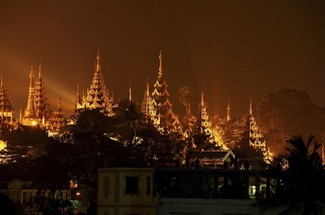
On our last full day in Yangon, we took the opportunity of visiting the famed Shwedagon Pagoda, the Golden Dagon Pagoda, a gilded golden stupa that dominates the skyline in downtown Yangon. Built upon a hill in the center of the town, the golden umbrella dome atop the stunning pagoda shone brilliantly in the crisp winter sunlight. Conveniently, we rode multiple escalators up to the citadel at the Eastern Gate to the enclosure. The most sacred Buddhist Pagoda in Myanmar, it is believed to contain relics of the four previous Buddhas of the present kalpa (an extended cycle of time). Not surprisingly, the extended area in the shadow of the golden dome was crowded with people, tourists mostly from Asia, especially China, and locals from other parts of Myanmar who come to visit as a pilgrimage. The place was also crowded with head-shaved monks draped in their signature orange monastic robes. I enjoyed how much they seemed to like taking group photos of each other, pushing and shoving each other just as all young people do everywhere in the world.
At this point, I was perhaps suffering from pagoda-fatigue, sitting image and reclining Buddha fatigue, and yet one cannot help but be caught up in the drama, the sacrality and the mystery of the moment, walking through these sacred grounds that have survived wars and pestilence across the millennia. Historians and archeologists suggest that the pagoda was built by the Mon people between the 6th and the 10th centuries. However, according to legend the Shwedagon Pagoda was built more than 2,600 years ago, making it the oldest pagoda in the world. The stupa’s pedestal is made of bricks covered with gold plates. Above the base are terraces that only monks and other males can access. Next is the bell-shaped part of the stupa, followed by what is called the turban, then the inverted alms bowl, the inverted lotus petals, the banana bud and finally the umbrella crown. The brown is tipped with 5,448 diamonds and 2,317 rubies. Immediately before the diamond bud is a flag-shaped vane. The very top – the diamond bud – is tipped with a 76 carat (15 g) diamond!
After strolling around soaking in the exotic ambiance that has endured for centuries across the ages under the light of the sun and moon, we finally made our way over to an elaborate enclosure that housed a monumental bell, many times the size of Peter even whose story is worth telling just as it is a bell worth seeing, reminding me of my own cracked Liberty Bell on view in Philadelphia! The Maha Gandha (lit. great sweet sound) Bell, a 23-ton bronze bell cast in 1779, was carried off by the British with the intention of shipping it to Kolkata, but because of its abundant size, it fell into the river instead. When the British failed in their attempts to recover it, the local people offered to help provided it would be restored to the stupa. Divers sent down and tied hundreds of bamboo poles underneath the bell and floated it to the surface where the massive ornate bell was safely return to the stupa and now sits in all its glory in a pavilion in the northwest side of the pagoda platform.
On the final night of our stay, in search of our last dinner in Yangon before leaving Myanmar the next morning, Peter and I ambled down a side street in back of our hotel in Chinatown wondering where to eat. At first, the street was quiet and subdued, with little coffee shops and quiet bars invitingly bedecked with red Chinese lanterns to give exotic, colorful light to the murky shadows. We saw in the distance the street illuminated by overhead fluorescent lighting and larger crowds of people. We soon arrived to see little open-air restaurants spilling out onto the porch, sidewalk and street, with plastic tables and little stools filled with all sorts of people eating dumplings, noodles and fried rice expertly with their chopsticks. It all looked so inviting, I motioned for Peter to stop. After all, so many people couldn’t be so wrong about their choice of where to dine, especially these locals. Peter moved on, undoubtedly thinking of the days at the beginning of the trip and the nights spent going to the bathroom. But his appetite had returned “with a vengeance”!
Then I saw it, at the edge of the curb, tucked in amid the seemingly ravenous diners and pedestrians: a make-shift steel barbeque grill with six sizzling fish spread forth in abandon upon the flaming hot coals whose smoke wafted into the air as well as into my nostrils. I looked down to get a closer look, only to be met by the restaurant’s owner, making gestures of invitation to come inside and sit. I looked inside and saw an empty table amid the crowds. “Is this river fish,” I asked, thinking of the river we had walked alongside earlier in the afternoon. “Yes, yes, li-li-liver fish,” he replied eagerly, having characteristic trouble pronouncing the Western R. “How much,” I growled, deadpan, not wishing to appear the green-eyed tourist. “Six thousand kyat,” he said and smiled. You may recalled what I wrote at the beginning of this tale, that one dollar represented 1,500 kyat. A quick mental calculation told me that this glorious jumbo fish, bursting out of its skin, sizzling in its own juices and cooked to perfection, the fish skin singed to a crisp golden-honeyed brown, cost a measly $4, a bargain, a steal, by anyone’s reckoning. “Peter,” I cried, pointing to the inviting delicacy, “could anyone ask for better than this. Peter turned up his nose, sniffing: “Will it make me sick?” ‘How,” I cried, no herbs or spices, just the freshest possible fish ever,” I told him. Against his better judgement, Peter was sorely tempted I could see, and finally agreed with a resigned shrug. “Trust me, Peter, nothing will happen and you will love this.”
We had drinks and finger snacks until our two fish finally arrived sizzling and steaming in their own juices, “Let’s take a picture,” I suggested, but Peter looked down at my fish more closely with a frown. “Your fish is bigger than my fish,” he said in earnest. “You can have my fish, Peter, no problem, be my guest. You can have the bigger fish and some of mine as well. After all, I could never eat all of this.” And that was our final night, there in Chinatown, in the backstreets of 19th century Rangoon, where people eat fresh fish to their heart’s content as pigeons sit patiently in rows on electric wires overhead as the street cats of Yangon made ready for their own feast.
Leave-taking comes far too soon. As the great leviathan of the plane responded to the lift of the wind, I looked down one last time at the countryside below. I was remembering the great rivers that I had ridden upon, that wound like snakes through the forested landscape speckled with stupas and pagodas, golden domes shining in sun-glow, the majestic lakes where people lived over the placid waters on stilts that rose their wooden houses with walls of woven bamboo into the blue of the sky, the black wasteland of mountains that huddled like sleeping animals wishing to be aroused into wakefulness, exuding a peacefulness to accompany the surrounding silence of the emerald forests, where only the wind could stir its silent heart with its whispers. I was remembering the people, the stoic, rounded faces, the street-smart, good-humored guides who took care of us as they would take care of their brothers. They too still whisper their greetings and their farewells in thankful gratitude that we had come to visit and they had had the honor to lead us through the heart of their homeland.
The journey may be at an end, but the adventure of travel is never finished. It lies there within the mind and heart as a desire to escape from oneself, to let the world reveal itself, to go to places people have never gone before, from the edge of the mind to far beyond the horizon of the world. The pagodas, stupas and temples of ancient lore now a living part of a shared experience, where distant cultures come together in the same way that strangers come together to become friends. Farewell, Mandalay, once the mirage of dreams, now the very stuff of a never-ending journey leading to new destinations and new climes, where the sun shines and eagles roam under ancient blue skies, where travelers like me roam across the earth under Heaven’s infinite dome.