Excerpted from my upcoming collection of travel essays, entitled DISTANT ISLANDS AND SEA LIGHT.
ERZURUM: TRAVELS IN EASTERN TURKEY
The penultimate stop of the journey brings us to Erzurum, a city in the highlands of Eastern Anatolia. We visited the two minaret madrasah, a fascinating Seljuk-era Quranic school of learning that now virtually serves as a symbol for the city and its traditional Islamic history. Once again, we roamed through the arcane building with varied expressions of interest, the dark presence of ancient Quranic recitation still lingers amid the blackened walls and crumbling stone. In one shadowy corner, I noticed a watchman sitting cross-legged in front of his chambers with an open Quran on his lap. I couldn’t resist the temptation to sit by his side and pick up an additional copy of the holy book on a shelf nearby. “Salam aleykum,” I intoned with grandeur in the Islamic style of greeting that Muslims of every language and country would understand, “Aleykum as-salaam,” he re-plied in the traditional response that is actually required by mandate in the Quran. I didn’t look, sound, or dress like a Muslim with my blue eyes and cotton slacks, judging from the shock and curiosity that initially registered on his face, although the white beard that covered my jaw like a snug muff might have raised some suspicions. But there was something in my manner, call it confidence, an ease in handling the book, or the familiarity I exhibited in the traditional Islamic greeting that held him in reserve, not knowing what to make of this rarefied being who now sat next to him. In order to quickly satisfy his curiosity, I leaned over towards him with a knowing smile and whispered into his ear the testimony of faith in Arabic (the well known shahadah) that there is “no god but the one God”, the supreme Islamic epithet that not only summarizes the essence of the religion, but that also immediately identifies the faith and allegiance of the Muslim in the public domain. No stranger to the mystery of the sacred epithet, a beatific smile immediately spread across the face of this man and he whispered “ma sha’a Llah” in return. We sat for a while together as members of the brotherhood of man that can be found anywhere within the Islamic crescent, where the Islamic profession of faith is not only whispered in the ear, but held firm in the heart.
I was also most interested in visiting this town because I had once had a job offer here to teach English at the local university, an offer that I declined at the time for some long forgotten reason. I had often wondered how my destiny might have unfolded if I had accepted the offer and come to live here. It was a city I felt at home in now that I had a chance to visit it, and spent the afternoon roaming around the inner bazaars. I took afternoon coffee on a rooftop café that had views into the hills and grasslands beyond the town. In the end, it wasn’t much of a town in terms of size and I was surprised to see the encroaching mountains and their graceful green folds within the undulating landscape create a charming background for reverie and dreams as I sipped my Turkish latte and munched on a shortbread biscuit. The waiter obliging brought me a woolen shawl to wrap myself in once the sun set and an evening chill began to invade the surrounding air. I could have gotten accustomed to this town, I thought with wryness.
The next morning we vacated the hotel in the usual manner, shoving our assorted luggage into the small van and tipping the eager and expectant baggage handlers with their pillbox caps secured neatly under their chins; but there was a mood of melancholy in the air among the five of us. Journey’s end, which once seemed far be-hind in the wake of our travels, or perhaps far ahead in their far distant future, had finally caught up with us. As in the experience of nearing the end of a long and beautiful book, the final page was about to be turned and all eyes were set inward at departure and leave-taking. We were on our way to the final destination of the tour in Trabzon, a city on the north-east coast of the Black Sea. Located on the Silk Road, Trabzon was a melting pot of languages, religions and cultures, a trade gateway to Iran in the southeast and the Caucasus in the northeast. Venetian tradesmen and Genovese merchants paid visit to the medieval city and sold their linens, woolens, and silks. Trabzon formed the basis of several states in its long history and was the capital of the Empire of Trebizond between 1204 and 1461.
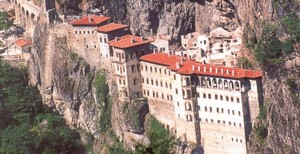
Along the way, we skirted Lake Uzungol with charming villages and trademark Turkish mosques complete with their one-armed minarets reaching for heaven along the shores of its sparkling blue waters. We made a scheduled stop at the Sumela Monastery, hanging precariously and like a maiden in distress on the Pontic Mountains near Trabzon. Lying at an altitude of approximately 1,200 meters halfway up the hanging cliffs of a beauteous mountain range, the monastery was built during the 20-year reign of the Emperor Theodosius (375 – 395 AD). According to legend, two priests undertook the founding of the monastery when they discovered a miraculous icon of the Virgin Mary in one of the caves in the mountain. The monastery reached its present form during the 40-year reign (1349 – 1390 AD) of Alexios III and during the political era known as the Empire of Trebizond.
We made the final climb to the inner portico, my fellow Marco Polos in tandem with me as the ibn Battuta of our journey, into the inner sanctum of the monastery, set within this glorious forested mountain chain in the middle of nowhere. The entire area was enveloped in a gentle mist and it was threatening to rain, not an un-welcome event in my book, coming as I did from the parched deserts of Arabia. The crevices and rocks of the mountainside were slippery and dangerous, not to mention steep and jagged. Poor Evelyn had reached her limit at one point in the unforgiving ascent, slipping and sliding along the jagged wet rocks. Seventy years of erudition and culture, not to mention her rarefied style of communication, was reduced to a single grimace and a horrified shriek. However, she didn’t slip into oblivion on the rocks of time, but rather fell into the startled embrace of the shy Turkish guide, cast fortuitously at her side to save her from the brink of disaster. Even the intrepid and stylish Christina graciously accepted the supportive hand of the stout Turkish women in front of her, dressed in a peasant’s blouse and skirt with her gray hair wrapped tight in a bun, who came to her aid as we all gingerly descended the steep stone stairway of over a hundred steps, “without a handrail,” to quote the poker-faced Christina, that gave entrance and exit to the main monastery gate along the outer fortress wall.
We had clearly left the luxurious, expansive and sometimes dry landscape of the great Anatolian Plain, with its sweeping vistas and gently sloping mountains, and entered the dramatic, tree-covered cliffs that mark the entrance into the province of Trabzon. The cli-mate changed as well. Thick, dark clouds were a welcome sight after the relentless sun of the dusty southern plains and heavy mists hovered low or entered the valleys like ethereal beings in flowing garments from another world. There was a wild beauty to this rough and ragged scenery, punctuated in its remotest corners with a mosque here, a residence there, to give credence to the need for human habitation in this forested region. Individual houses clung to the side of the mountains rather than being tucked into the more secure valleys. As we rode through the forest wonderland, we all marveled at the precarious nature of the houses and wondered aloud how the residents came and went from them and how they were built, since there didn’t seem to be any side roads or access points that we could make sense of. Indeed some of the houses were still half built; but the when and how of it remained a mystery.
Want to review or comment on this short story?
Need a FREE Reader Membership?
Reviewed by Sarah Sadat Kameli
1/28/2019
I went to Erzurum last year, its the coldest city in Turkey. Its legit amazing!!
KIND OF FELT FOR ONE OF YOUR COMPANIONS THERE ON THAT PRECARIOUS CLIMB BUT, I GUESS THAT GOES ALONG WITH EXPLORING, '...A WHOLE NEW WORLD...'!! THANKS FOR SHARING, JOHN - I ENJOY YOUR WRITING. LOVE, BLESSINGS AND FAITH...JOYCE * HIS INSPIRATIONS
Your travels to these little, out-of-the-way places are very intriguing and interesting to read about. The history of the survival of some of them is amazing given the propensity of that region for war.
Once again, I believe that the reason that those dwellings were built in such precarious places was to prevent those that came in the night. Whenever I traveled in the Middle East, I found that wealthy people used walls with sharp broken glass on top to keep intruders out. And there is also the possibility of war or siege coming. Like castles in Europe, those homes probably had a store of food and a way to get water from springs naturally forming in the cliffs.
Since you are teaching English, I thought I might comment on a couple of things. Sometimes, in an effort to make the mundane seem interesting, I believe you overuse adjectives and "gild the lily" a bit with some of your descriptions. If I were editing your work I might change some of the words. Something that struck me as strange is why you described your thoughts by saying, "I thought with wryness."? Something like something less "wry" like--came to mind--seem to be much better and less off-the-wall.
I always liked travel books as a kid, notably Lowell Thomas. Later I thought Sir Richard Burton topped the list and perhaps he still does, but your chronicles are top-notch, John. I especially like, in another posting, your description of the peace and calm you found in a mosque, quite as profound as in any cathedral or forest or lagoon ...
You have a way of writing that makes the reader feel "at home" right along with you as you go from place to place in this mysterious land! Thanks for the trip, hon!
I enjoyed reading another segment of your Eastern travels for the history you interweave throughout the landscape of your journey. Having to overcome dangerous passageways to some of your destinations makes the visions committed to memory well-deserved.
First Kindle eBook edition of the literary memoir Greeting Flannery O'Connor at the Back Door of My Mind. Explores a certain author's "Adventures and Misadventure of Literary Savannah" upon encountering, in one form or another, authors Flannery O'Con





 ERZURUM: TRAVELS IN EASTERN TURKEY