A teacher of sixth graders faces more responsibilities than she'd imagined.
Submitted to Writer's Digest short story competition June, 2005
Type or Paste you
A Teacher’s Mirage
For a month the sixth grade math, science, social studies, reading, and English teachers devised lesson plans around coastal ecosystems. The sea green bulletin board area served as a learning station. Students handled starfish, seahorses, a variety of seashells, a sea bean, and a coconut, all collected by a beachcomber, their teacher, Ms. Carpenter. The ninety students in the academic team studied many aspects of marine life, reading about adventures on the high seas, finding out about the land and life below sea level, and presenting oral reports on unique sea life.
Their studies were to culminate in a field trip to Port Aransas, Texas, to visit the UT Marine Science Institute, to journey through the back bays on a tour boat, and to scavenge the shoreline for finds washed in from the Gulf of Mexico. Susan Carpenter loved the beach and immersed herself enthusiastically in teaching and organizing details for the field trip.
On a sunny Friday in April, before the first bell of the school day, students, teachers, and brave parents who had volunteered to chaperone, gathered by the two yellow school busses in the faculty parking lot. Teachers collected permission slips, verified signatures and phone numbers, and finally the ninety-odd sleepy but excited adolescents boarded the busses and stowed their gear for the day. On the 45-minute ride from Corpus Christi, some students slept, some ate taquitos from home, while others chatted and laughed. Ms. Carpenter finally relaxed into a seat at the rear of the bus.
Susan felt confident that the day would go well. Students with a history of behavior problems, excessive demerits, and office referrals were relinquished to a stern substitute teacher with plenty of written assignments. Those students attending the field trip had signed behavior contracts acknowledging their understanding of rules for the field trip. Good behavior and following directions were imperative.
Mrs. Carpenter calmed down some during the bumpy bus ride, with the pressure of planning now behind her. Students would be shuttled between activities. The day would be full of hands on learning. Soon the caravan arrived at the piers where the guide boat was docked.
Susan’s bus arrived at the pier first, so she scouted the situation, not yet releasing the students. Walking toward the guide boat, she waved and shouted “Ms. Carpenter and her students are here for the tour.” She stepped on board the boat where the captain and two other bronzed men hovered over a large piece of machinery in the middle of the deck.
“Ma’am, I’m afraid there ain’t gonna be any back bay tours today. We have engine trouble, and it’ll take a few days before we’re able to get her up and running again. We got to get new parts for the engine.” The captain pointed toward the problem area, and squinted his eyes in the bright sun, his voice as weathered as his sea-faring vessel.
Susan stood, feeling the rock of the boat moored to the dock, her mouth agape. This wasn’t supposed to happen. She looked back at the busses of students, feet and elbows visible in blast off mode, like a rocket ready to launch into the upper atmosphere. The captain had his hands and full attention on the greasy machinery, and Susan, leaving the boat and docks, realized she’d better come up with a "Plan B” fast. Her brain raced as she walked slowly, focused in concentration, back to the yellow school bus.
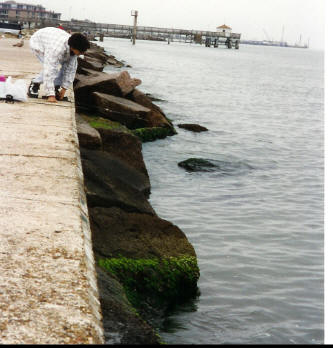
Susan took the initiative to direct the drivers of the school busses to pull around to the beach, close to the jetties. The teachers gathered in discussion while the students, anxious to escape the confinement of the busses, gathered their belongings in anticipation. In rapid brainstorming, the plan was changed so that half of the students would first tour the Marine Institute while the other half would be released for beachcombing.
Susan and Mrs. Vargas each boarded a bus and explained the change in plans to the students. Each bus heaved a groan of disappointment at the cancellation of the boat ride, but the students were too excited to be daunted from impending freedom. Before the students were released from the busses, they were again reminded of rules, and cautioned about behavior.
As the students emptied from the busses, each was numbered as a one or a two. The “ones” would follow Mr. Hinojosa, the science teacher, and his group of chaperones to the Marine Institute for the one-hour tour. The “twos” were given plastic grocery bags and instructed to walk the shoreline and collect interesting beach finds. The majority of parent chaperones and teachers stayed at the beach, supervising the group that rapidly disseminated down the shoreline and into the surf.
After observing the gleeful students to see that directions were being followed and that no obvious problems were about to erupt, Susan grabbed a plastic bag for her own collection and headed south down the beach, toward Horace Caldwell Pier. One of the parents joined her, and soon she was flanked by a number of students wanting to join in the teacher’s beachcombing.
The group strolled down the beach, continuing past the pier, collecting and discussing finds as they walked. Susan was familiar with the beach, and the group soon reached an especially green slimy barnacled large rusty iron thing that was partially covered by the incoming waves.
Susan had always thought it had washed in as a part of a shipwreck, and she asked the students for their opinions of what this thing was, where it came from, and how such a heavy object had come to rest where the surf met the sand. The group was in deep discussion when Susan glanced in the direction of the jetties to see a student running rapidly in a beeline towards them.
The sound of the wind and waves drowned out the boy’s shouts until he was within a few yards of the group.
“Ms. Carpenter! Ms. Carpenter!” The boy had done a good sprint, and was out of breath.
“Mrs. Vargas said you have to come back right now. She’s really mad.” His chest was heaving for air.
“What’s wrong? What happened?” Susan’s level of concern escalated as she tried to focus in the distance. The boy had run a long distance. Though the day was sunny and clear, She could only discern a vague scattered group in the distance.
“A bunch of kids went out in the deep water.” His words came with huge gulps for air. “Mrs. Vargas told them to come back, and they told Mrs. Vargas you said it was okay. Mrs. Vargas is really mad.” With his message delivered, the boy calmed somewhat and focused on catching his breath.
“They went out too far in the water! God! If they didn’t hear anything else I told them . . ..”
Susan wasn’t a runner, but with a burst of adrenalin she bolted more than a half-mile back to the area in which the busses were parked and the majority of the group had gathered. Rules about how far students were allowed to venture into the surf had been plainly stated and understood long before the field trip began. Of course, that was the teacher’s point of view.
No one was to go into the water further than knee deep. Susan had even stood on top of her teacher’s desk, had raised her skirt just above her knees, certain that such dramatics would leave a lasting impression, and had asked all her classes “How deep are you allowed to go into the water?”
The classes had all replied in unison, “knee deep”. Susan drilled them so often in the weeks preceding the field trip that students’ eyes’ rolled at the very question. They all knew the answer, and they had discussed the reasons why in class.
Susan counted more than a dozen heads and shoulders visible above the choppy waves. Mrs. Vargas was knee deep in the surf, arms waving, shouting into the wind and waves that muffled the sound of her voice and blew it back to shore. A few of the wayward had turned and were slowly tromping through the water, back to the area in which they belonged.
Susan slowed her pace, and she and her group, as out of breath as the messenger, merged into the massive group of students watching the antics of their cohorts returning to shore at a snail’s pace. Some were dripping wet from head to toe.
Mrs. Vargas had directed everyone to board the busses. Skeptical of the safety of such a field trip from the plan’s inception, she decided the field trip was over. Once the words were out of Mrs. Vargas’ mouth, the parents and other teachers had begun herding the sandy, wet students toward the busses. The daylong field trip was finished before it was well underway. Lunch wasn’t even over at school yet.
Susan thought Mrs. Vargas too harsh in her independent decision to call an end to the day. She thought the field trip could have been salvaged since the beach group was within minutes of being the Institute tour group. However, this was no time for adult dissention. The busses paused at the Marine Institute and Mrs. Vargas collected the remaining, disbelieving students. “We didn’t even do anything wrong! We didn’t even get to walk on the beach or get in the water at all!” Their pleas to stay fell on deaf ears as the bus doors whished shut.
The ride back to school was long, hot, and itchy. Those who didn’t have sand in their pants wriggled from the antics of those who did. However, there was no laughter. The only sounds on the bus were the crunch of potato chips and low murmurs of discontent.
Before the closing bell rang on the day, 23 students had been suspended and sent home through the principal’s office. Susan had seen her coworker angry before, but not with the furious vengeance that she flailed that day.
Feelings among the group of sixth grade teachers were never the same. The “team” of teachers decided to work independently for the rest of the school year. Susan attempted to get along with everyone as before, but for the remaining two months of school Gracie Vargas dogged every suggestion or comment she made. It was the longest eight weeks Susan ever experienced—trying to keep her students from realizing middle school teacher behaviors and attitudes can be as irrationally adolescent, and petty, as the students whom they teach.
Mrs. Vargas didn’t pass Susan in the hall without saying “Someone could have drowned because of you! We should never have taken that field trip.” It cut Susan to the core.
She called in sick many days the remaining part of April and May. At night, to relax from the pressures of the day, she drank whiskey instead of wine. She thought May 29 would never come. Mrs. Vargas, tenured educator and chairperson of the math department, had a reputation for keeping a pleasant countenance while being pushy and headstrong. Somehow she always turned situations to her advantage. She would stick a knife in your back, while smiling, keep turning the knife, and keep smiling, as if the world could not be more pleasant.
Ms. Carpenter was tired of smiling in reply, and biting her tongue. There had always been an undercurrent of tension between the two women. Each was well liked by their students. There was no popularity contest, but Mrs. Vargas seemed to resent the relationship Ms. Carpenter had with their mutual students. She had previously undermined Susan’s attempts to coordinate after school tutoring and detention among the team’s sixth graders.
Susan thought Mrs. Vargas held herself above reproach and put her own interests ahead of the group’s. It became increasingly difficult for Susan to maintain an objective attitude about the daily grind with what she considered a tirade of verbal abuse. Nevertheless, she held her tongue and maintained a positive attitude, as well as she could. She could think of no words to fix the situation. The field trip was history, and it was time to move on—despite the nightmares that haunted her sleep.
Susan had told her students when she first presented the idea of a field trip to Port Aransas that a young boy had drowned while fishing with his father in the area they planned to visit. Currents were dangerous and unpredictable.
In class, the students had studied the Gulf Stream, tides, currents and the effect of riptides and undertow. In math they had calculated the weight of water and the force of water pressure.
The students had produced group essays with poster illustrations. Theory says that when students work together they teach and learn from each other. The student group leaders had presented their reports to the class. Everyone knew not to go any deeper than “knee high”, and why. They could be knocked off their feet by a wave, and be pulled out to even deeper water by strong riptides.
As well as currents, the students had studied various types of marine life. Sharks were reported to seldom venture close to shore, but a small shark doesn’t need much water in which to swim. Students had also presented information on jellyfish, and other dangers to be found along the shore. Susan felt confidant that the dangers had been discussed and that her students would show their maturity when the day of the field trip arrived.
She could still hear the reverberations of a classroom full of students . . . “knee high. . . .”
The thought of how close some of her students had ventured to danger gave Susan goose bumps. When her mind wandered back to that day. She shuddered. She just couldn’t think about it. It wasn’t her fault.
No matter how hard a teacher tries, she can’t see everything, hear everything, and be psychically aware of what’s going on in her students’ heads. Ms. Carpenter, like other teachers, didn’t really have eyes in the back of her head. And she had no idea the effect five words from a twelve-year-old special education student would have on her life.
“Ms. Carpenter said it’s okay!”
Susan Carpenter had a different feeling about taking the Lord’s name in vain after that. It wasn’t exactly the same thing, but her name had been used by another, for purposes that weren’t her own.
His friends, in the waves, surrounded Benito that day. He was swept up in the excitement. He knew what he said was right, and what was wrong. However, when you’re 12 year old with a learning disability, you may act with no thought of consequences. Benito thought, but not of consequences--selective remembering, perhaps.
Since Ms. Carpenter was the team leader for this group of sixth grade students and teachers, and since she had been the most emphatic about not going further than knee deep in the water, he figured out if he said Ms. Carpenter said it was okay—then that made it okay.
The sun was shining, the temperature warming with the first hint of spring, and the breeze constantly refreshing. The students were dressed in bathing suits with shorts and tennis shoes. Each had brought their own sack lunch, and the teachers had iced down cases of soft drinks and water.
Some students had brought cameras and walkmans, understanding that there would be no one to “guard their stuff” for them. After six weeks of study and anticipation, the day had come. The students, and four teachers too, had looked forward to a day of fun, and all were having fun. All the permission slips had been collected when boarding the busses, and had been checked for an actual parent signature and phone number. The trip was well planned, and the students well prepared. Those whose who had a questionable behavior record had been left at school with a substitute and enough work for a week. No step of preparation had been neglected.
Benito’s friends were swept up in the excitement of the day too. They fell for Benito’s ploy for company in the danger zone. Only two boys followed him at first, but the battle cry of “Ms. Carpenter said it’s okay”, and the sight of classmates past the knee-high zone, lured other students to follow like a herd of cattle. With no visible danger--previous warnings be damned. Susan understood the psychology of what happened, but it gave her little consolation.
During the 23 student-parent-teacher conferences, held before the students were allowed back in the classroom, the students admitted they had broken an important rule. More than breaking a rule, Ms. Carpenter felt they had broken a personal trust. She had no words to explain her feelings to her students. After all, they were only children.
Susan questioned the sagacity of including the mainstreamed special education students in the field trip. If the resource students had been left behind, Benito wouldn’t have been there that day. Nine others would have been left behind with him. However, that defeated the purpose of mainstreaming special education students. They needed the experience of fitting in with everyone else, not being identified as different or dumb. They had the need, as others their age, for successful social interaction.
Many of the teachers complained about having extra documentation paperwork, and modifying lessons, to suit individual students. Ms. Carpenter didn’t particularly label these students in her head, though the office required the student’s name be highlighted in the grade book.
When paperwork for these students was required, it appeared in her office mailbox. She simply placed checks in boxes on a preprinted form, looked for any new information or instructions, and then returned the folder to the mailbox of the resource coordinator. She had never taken any Special Education courses in college. She had not anticipated the need. It seemed to her that the school district, perhaps, slighted the students’ needs by mainstreaming them. She had no easy solution to the dilemma.
The principal strongly encouraged every teacher to do everything possible to keep from failing a student, especially a special education student. All Ms. Carpenter’s students were given every opportunity to pass. She often stayed after school to help someone who didn’t understand the lesson because he, or she, had been playing around in class. Her co-workers chided her when she gave up her Saturday afternoons to meet students at the public library in order to help the participants in the school’s History Fair competition.
“Don’t you have anything better to do? Get a life!” they chided. Susan knew teachers who never took any work home. She wasn’t organized that way. She was a workaholic. Her world revolved around the activities at the school. It was more than just a job. It was her life. However, she was miserable, and her life had to change. For starters, she wanted to get away from Mrs. Vargas, though she’d made many other friends while at the school. She thought teaching a different age of students, older and more responsible, might be the change she needed. The beginning of May, Ms. Carpenter submitted a transfer request. The assistant principal, Mr. Davidson, acknowledged the difficulties Mrs. Vargas continued to throw her way.
“Everybody knows about Vargas and her attitude”, Mr. Davison assured her. “The incident on the field trip wasn’t your fault. You’re a good teacher, and I don’t want to lose you, but I understand.”
“I’ll miss this school. I’ve made a lot of good friends here. I have a lot of memories. But now, the bad memories outweigh the good,” Susan replied.
Somehow, she got through the school year. When she went to the beach, she tried not to think about the field trip, and what might have happened. Teachers need summer vacations too.
Mrs. Gomez, Susan’s former principal who had been promoted to Director of Secondary Personnel, called Susan at home in early June. “I just ran across an opening for a high school English position, and I thought of you,” said Mrs. Gomez.
“It’s good to hear your voice again”, Susan smiled, remembering all the activities they had shared between students and other teachers for two years. Mrs. Gomez had hired Susan when she had first moved to Corpus Christi. Knowing few people in town, she took every opportunity to attend football games, carnivals, and gladly accepted the position of Student Council sponsor. Soon everyone in the school knew who Ms. Carpenter was—the tall skinny teacher with the curly hair. Students often greeted her in the hallway. In November of her first year at the school, she was voted “Teacher of the Month” by her peers. Susan Carpenter put her all into school.
Susan learned how differently students behave outside a classroom setting. The candy drives, carwashes, and middle school dances, left her feeling as if she had been given an extra special gift of students, in addition to those in her classroom. Susan was happy then, and Mrs. Gomez remembered an enthusiasm that had drastically paled with the passage of time.
“Susan, you were so wonderfully involved with the students at RandallMiddle School, I think this position would be just perfect for you. HamlinHigh School needs a sophomore English teacher who will sponsor the Trojanette Drill team,” Mrs. Gomez stated cheerfully.
Susan had always dreamed of such a job. The school had a good reputation. The position would include teaching Shakespeare. She would be teaching classic literature, instead of drilling spelling words. She was surprised at the words that came to her so quickly. She spoke the words so easily.
“Mrs. Gomez, I really appreciate you considering me for the position. During our time together at Randall, I would’ve jumped at the opportunity to teach high school and sponsor the drill team. I had so much fun co-sponsoring the cheerleaders when I lived in Houston.”
“But, honestly, I don’t have the energy a position like that requires. I’m at a point in my life that I’d prefer a purely academic position. My boyfriend and I are talking about marriage, and I want to keep my after class hours for myself.” She lied herself out of the situation, as she had just started planning to move out of her boyfriend’s house.
“Well, congratulations Susan. We have been out of touch awhile. I understand. The drill team requires many extra hours, but it does have a stipend attached. However, there are times in your life when money isn’t the primary consideration. I’ll keep your transfer file on my desk, and call you when another position comes open. You let me know if the wedding date comes before I call you, okay?” Mrs. Gomez was out of the middle school gossip circle. She was always so upbeat in her attitude about everything.
The words Susan spoke were true . The meaning behind the words was a total falsehood. Susan, and the man she had lived with since the preceding November, had talked about marriage. She had taken off-white, chiffon, semiformal, handkerchief-tired evening gown to Las Vegas, when the two of them had vacationed together over spring break. She had asked him if he wanted to visit a wedding chapel for a quickie, since they were there. He said no. She left the evening gown to wrinkle in her suitcase. He must’ve thought she was joking, because the subject never came up again.
Although she was hurt, she was grateful to find out at that point in their relationship that it had no future. What she regretted most was that she had confided in Mrs. Vargas upon her return from spring break. It was just another subject Mrs. Vargas used to explain to others about what was wrong with the way Ms. Carpenter ran things—even her own personal life.
After hanging up the phone, Susan pondered upon the teaching position she had just declined. Mrs. Gomez must not have heard about the field trip fiasco, or wc she didn’t care. Either way, it didn’t really matter.
While this is interesting, I find that the story does need a bit of polish. I, too, felt confused as I read several "repeated" paragraphs. I wasn't sure if that was about a separate trip or what was going on. So, I'd suggest some clarificaton there.
I also agree... the last quarter of this really seems to digress from the actual story or from the initial intent - at least in my mind. As I continued reading, I found myself wondering what this story was really about. Was it about the trip? Was it about dissention amongst teachers? Students who aren't able to be responsible on field trips?
I would suggest tightening up the story a bit by clearing out some of the extraneous stuff and pulling the story full-circle.
This gives interesting insight on a teacher's life. Actually, to me it seems like a personal essay or autobiography.
Suggestions: The ending leaves things hanging a bit. Maybe work on resolving some of the questions--you could do this with fiction, even if the rest is fact.
In the last third of the essay, some of the information from the beginning is repeated--the signed permission forms, the preparations, etc. Maybe refer to the preparations that were made without repeating the details.
Good job, though; it's clear, well-written, and interesting.
Hundreds of excerpts from the archives of the Narcissistic Abuse Study List regarding Pathological Narcissism, relationships with abusive narcissists, and the Narcissistic Personality Disorder (NPD).
Eight e-books regarding Pathological Narcissism, relationships with abusive
narcissists and psychopaths, and the Narcissistic Personality Disorder (NPD).


 Type or Paste you