In the 1844 children’s story, The Ugly Duckling, the author is using the characters of ducks, swans and other domestic creatures to make a very deep point applicable to human condition.
According to the story, it all starts with the Mother Duck nesting her eggs. One of the eggs looks different than the others. It’s the largest egg and is the last to hatch. Another duck comes by to say hello, but offers nothing but doubt and negativity. “Let me see the egg that will not break”. “I have no doubt it is a turkey’s egg…Take my advice, leave it and teach the other children to swim”. But Mother Duck’s motherly instincts are still strong and she persists till the Young One comes out.
When the young one does hatch, it is different from the other ducklings. It is very large and ugly. The mother duck is even wondering if it’s indeed a turkey and is planning to push it into the water even if it doesn’t swim. So the “ugly duckling” is up against difficult odds even as it is born. Fortunately for him, it is able to swim. As a matter of fact, he is an even better swimmer than the other ducklings, but only the mother is able to appreciate that initially.
The passage regarding the “entrance into the Grand Society of the Farmyard” is very telling of the author’s view of the human society. There is fighting over the food and resources; there is the sense of adjusting and “behaving properly”. There is the aristocracy of the old duck who has “Spanish Blood”, and wearing a red flag tied to her leg, making her “Very Grand”.
Being now members of this “society” the ducklings are already seen as competition. Which is nothing compared to the rite of passage for the “ugly duckling”. Almost instantly he is attacked and rejected by a spiteful duck that bites him in the neck and verbally assaults him. Even the “royal old duck” judges him in comparison to the other “very pretty children”.
Initially the mother does stand up for the duckling, but her words are also hurting in a significant way as she states that “he is not pretty; but he has a very good disposition and swims as well or even better than the others” . She even makes excuses for his appearance and not being “properly formed”. Regardless, compared to others, she is still supportive and protective, even if only for the time being, while conforming to society’s rules and peer pressure.
Throughout their stay on the farmyard, the poor duckling is being bitten, pushed and made fun of not only by the other ducks but by all the poultry. This is including, and even worse, by his own brothers and sisters. Ultimately, even the mother duck “wished he had never been born”. So with the ducks pecking him, chickens beating him and the girl who fed the poultry kicking him, he at last runs away from the farmyard. This is a representation of a society that based on appearance and other factors, discriminates and mistreats others; passing judgment and doing things that hurt others, emotionally, physically and in other ways. In almost any society, there is a group or multiple groups that is/are deemed the “black sheep” and which suffer in the manner described above.
The bad thing is that the duckling that ran away now believes that he is “ugly” and that his suffering is deserved. As he comes upon another large moor inhabited by wild ducks, he is again reminded of how “ugly” he is and that he is not welcome to “marry one of our family”; however, there is no active abuse going on in this group. This however is still abuse and discrimination in a different form. It is interesting that he is being denied that which he has no interest in, being married to one of the ducks; regardless it is a hurtful experience in itself that continues to confirm to the duckling the notion of his “ugliness”. In human form this may take place of conditioned inferiority complex, sense of not being worthy and at this point, self-sustaining judgment. It is no longer necessary for others to put him down; the internal mechanisms are now in place so that he will do that himself.
When the hunters and the dogs kill the inhabitants of the moor, but he is spared, he is even attributing his survival to his ugliness: “How thankful I am for being so ugly; even a dog will not bite me”. It does not even occur to him that he is spared because he is a bird of a different species.
His next stop is at a poor little cottage with its own established social structure with the old woman, a tom cat and a hen, each with their own roles. In this little microcosm of society, both the hen and the cat have established their worth and are the master and mistress of the house respectively. There is an interesting analogy to human populations, where in each society, group, family unit or even a larger social network people likewise establish themselves as masters or mistresses of their universe. This group of creatures did take the duckling in and offered a trial period to prove himself to them. They were not open to seeing him for who he truly is however. In order to fit in, the advice is to “lay eggs and learn to purr as quickly as possible”. But the “duckling” knew that this was only a temporary refuge and that he had to continue on. This is another aspect of humanity, not necessarily hurtful, but lacking in understanding and appreciation of each individual’s unique qualities. Too often we find this environment “acceptable” and quite literally try to “lay eggs and learn to purr”, even if that’s not something we can or should be doing.
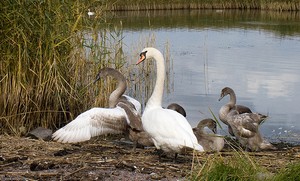
At the next phase of the story, the duckling does find water and finally encounters a new breed of birds, Swans, whom he recognizes as being beautiful. At this point, he is yet not even aware of whom he really is, but is starting to discover that he is also possessing new qualities he was not aware of.
The next phase of the duckling story takes another twist. As he is freezing in the water as the winter has arrived, he is actually helped by a peasant, who saved him from the frozen ice and brings him home to his family. The peasant’s family including his children and his wife welcome the “duckling”, but he is so terrified of others and afraid of being hurt that he rejects the help, the company and love that is being offered to him. Instead, he escapes out of the house and suffers much misery and problems associated with being outside in a hard winter. This is a very typical response when people are victimized and persecuted in their formative years. When they encounter a helping hand or someone who is truly out to help them, they respond by running away and at times hurting those who now want to help them. The mechanism behind this however is fear. At some point the internal judge and the internal victim are fully formed and no matter how great or capable they are; their existence is now limited by those internal factors. Further, oftentimes, such individual will allow and attract others who continue to be abusive or demeaning. That further validates their internalized beliefs and concepts of how inadequate they are and how unworthy they are of anything good.
At the next point in the story, the duckling is now again in the warm weather and is experiencing that he is stronger than he imagined previously, able to fly farther than he thought possible. He ends up in a beautiful garden and once again sees the beautiful white swans. However, he is not happy at all. As a matter of fact, he is now contemplating a “ducky” suicide. He no longer wants to suffer, no longer wants to be pecked by the ducks, beaten by the hens, pushed by the maiden who feeds the poultry or starved with hunger in the winter. And in his mind, he is still an “ugly duckling”.
And so comes the moment of truth. He is ready to end this existence and he is going to do so by exposing his “ugliness” to the 3 beautiful birds (swans), which in his mind, will lead them to kill him. And as he bends his head down to the surface of the water to await death, he finally sees a reflection of his own true self, “no longer a dark, gray bird, ugly and disagreeable to look at, but a graceful and beautiful swan”. According to the author, “to be born in a duck’s nest, in a farmyard, is of no consequence to a bird, if it’s hatched from a swan’s egg”. In other words, regardless of any judgment and/or action by others and eventually ourselves, the true nature of a person will reveal itself and is in its true essence not any worse for the wear.
So, finally, the “ugly duckling” is accepting his true nature as a beautiful swan and is the recipient of affection by other swans. Not only that, there are “little children” who come into the garden to throw “bread and cake” into the water to feed the swans, who not only acknowledge that he is a new swan there, but also that “he is the most beautiful of all; he is so young and pretty”. Further still, the old swans bow their heads before him. In short, this is the ultimate external confirmation of his being and worth.
However, the past experience is alive and well within him and at this proud and happy moment, the beautiful, young swan does not know what to do. He has been persecuted and despised for his “ugliness” and now he is being told that he is the “most beautiful of all the birds”. So he hides his head under his wing.
The story does end well and according to the author, the hero of the story “rustled his feathers, curved his slender neck, and cried joyfully, from the depth of his heart, “I never dreamed of such happiness as this, while I was an ugly duckling.”
There is an old statement “all is well that ends well”. In the story of the “ugly duckling” the suffering which took place enables the young swan to experience happiness at the realization of his beautiful true self. It seems that the author was intimately familiar with the tragedy of the dynamic of the human condition. It is a story written almost as an autobiography or a journal highlighting the various types of human vices with which people hurt others. So in a way, the author is indirectly making a point of realization of his individual self-worth. The closing statement which ends with “…while I was an ugly duckling”, however, makes me think that the association and identification with the past and the hurtful experiences are still very much alive and present.
The “ugly duckling syndrome” is still present and will likely emerge from time to time, especially when it comes to interactions with others, and when one of the many associated triggers will take place. So just as the beautiful swan may re-experience the pain and anger associated with duck, chickens, turkeys, cats and other creatures, the healing is under way. So it is with the human condition, as we need to heal ourselves of all the trauma, judgments and negative emotions from our formative years, and even ongoing. Some have much work ahead of them, others have been fairly well treated and/or have better coping mechanisms than others. There are many words that come to mind in light of the “ugly duckling syndrome”, including self-worth, confidence, self-acceptance and love etc.. For those who have been through difficult journeys in life, the process of healing may be long and require intensive introspection and perhaps professional help.
On a higher note however, the “ugly duckling” was never a “duckling” to begin with. So in a way, the “ugly” component, so prevalent in the story is only as real as one will allow it. Letting go of that and simply releasing it is as quick and simple as realizing and acknowledging the true beauty and magnificence of each and every being and creature, especially the one that is YOU.
Dr. Sergey Sorin
See More Information on Web Site below: