 Good relationships have to be built on honest communciation and that level of communication may need to be given some attention by relationship counselors
SEVEN THINGS RELATIONSHIP COUNSELORS USUALLY WON’T TELL YOU
By Bill Cottringer
Now I realize that this article is going to rile a few people in the relationship counseling profession, but I will at least try to speak the truth gently and kindly. I have been there, done that and paid my hard-earned dues and do think I deserve to speak with well-intentioned authority from substantial personal and professional experience. Here are seven things relationship counselors should consider telling you outright. But they may not for some reason or another. Maybe this will make some of them uncomfortable enough to improve the flow of the truth fountain.
1. If you need to come to a relationship counselor to save your relationship it is probably already lost.
When a relationship gets so bad (addictions, infidelity, incompatibility, value conflicts, terrible communication, etc.) that both people agree to try the last minute desperation ploy of being counseled, the relationship has probably already gone past the point of no return without either of them seeing that reality. The couple really just wants a miracle or more likely, to prove that the relationship is as unfixable as it feels because it is.
This type of counseling is more separation or divorce counseling in reality. Besides all this, time spent in pre-relationship counseling, relationship enrichment retreats or reading and discussing sensible relationship self-help books would be time better spent. There really isn’t any better advice than the many books that are already available, if read in time, before things get so hopeless. Anticipating likely relationship problems ahead of time is always the ounce of prevention that outweighs a pound of cure.
2. If you have a bad relationship and think you can have someone else make it better you are wrong.
Not even the best relationship counselors can fix someone else who doesn’t know what is broken within his or herself. Often bad relationships involve one person who is convinced the other person is mostly at fault and that is in fact frequently the case. What magician can resolve that dispute? None. One person needs to get back to a starting point to be more ready for joint counseling. And during that process the other person may see the light and be done with it, needing more quality than they are likely to get.
When two people don’t agree upon what is wrong, no relationship counselor will be able to make them see the truth. Bad relationships were probably not meant to be and usually involve a poor mate selection process—not getting the most important things you want, need and expect in a relationship. And sometimes people are just moved together on the chess board of life to teach each other some uncomfortable lesson that they only realize when permanently apart. In the end, though, it is only you who can make you right and if you are too wrong, the other person may not have the patience to stick it out.
3. If you think you will be happy if the other person gets fixed, you are mistaken.
Another person can not make you happy, only unhappy. Think about that. The only way you can be happy is when you focus on yourself and you start making progress at fixing your own faults and becoming more likeable and lovable with the right attitudes and behaviors that lead to happiness. The more you wait for someone else to make you happy by fixing their faults, the longer you will remain unhappy.
In the best relationships, neither person wastes time worrying about the other person’s faults, shortcomings and problems because they are each too busy being the best person they can be and loving and accepting each other as they are, not as they want each other to be. They are enjoying being happy about being happy.
4. What starts out badly will likely never finish well.
Simply put, many relationships start out for the wrong reasons or in the wrong way. How can two people who have different definitions and expectations about “love” and get something much different, be turned around? Not likely, at least not without major personality and character transformation which may take as much time to undo as it took to get that way. Incompatibilities in the beginning will just worsen.
The common mistake many of us make in relationships is to quit too soon or to not know when to quit. If there was something wrong with the honeymoon, anything afterwards is likely to go down hill. That may be a dismal way of looking at things, but sometimes the truth will set you free after the disappointment and hurt fade. The best use of effort is in making sure something starts out right, rather than wasting time on trying to build a house on a weak foundation.
5. It’s not what you perceive to be happening in the relationship that is important as much as your possible errors of interpretation.
We are so hung up in the idea of perceptions being reality, that we can’t see through to what we are really looking at. I say BS to this nonsense. Perceptions can run the gamut of being inches close to accuracy (5%) to miles away with total inaccuracy (95%). It is not at all what you think you see that is important, but rather how you feel about what you think you know you saw that really matters. In other words, the personal editing process.
Consider these two different scenarios: First, Jane thinks she worries too much and Bill worries about Jane’s excessive worrying and starts worrying about his own worrying. As an alternative, Jane still thinks she worries too much but Bill thinks she should try to change the things which she worries most about—the things she can change—and then try to let go of the rest. The positive perceptual editing takes infinite, uncontrollable worry to an effective ‘control the controllables’ action. Which is going to help the relationship improve?
6. Relationship repair is dependent upon mutual agreement of three questions.
There are three basic questions which have to have committed agreement by both parties and no relationship counselor can orchestrate this agreement. The questions are: (1) Can this relationship work? (2) Do both parties equally want the relationship to work? (3) Are both people willing to do whatever it takes to make the relationship work?
The irony of this all is that these questions are all answered as committed promises in the traditional wedding vowels. Maybe all relationships should start with commitment to such a covenant or at least a more accurate understanding of the process? Such questions involve conscious choices that only the involved people can make and carry out, without knowing the possible obstacles ahead of time. But I suspect that the hesitant lack of commitment to the choices, because of anticipating potential problems with undesirable outcomes, has more to do with the relationship failure, than the obstacles and problems themselves.
7. The best and happiest relationships are grounded in religious spirituality not psychological spirituality.
This last one is sure to cause a spirited discussion for and against Focus On The Family and similar relationship philosophies. But, life is all about finding purpose and living the good life and you can’t do that until you learn to tune out your psychological conscience (the 95% mental ramblings and personalized feelings) and tune into your moral conscience (the silent voice within that reveals the 5% truth, in simple right-wrong categories).
Spiritual experience is merely unguided experience without meaning unless it has wisely guided theological rules. Sure it is natural to rebel against anything that imposes rules that make you uncomfortable, but you simply cannot escape the reality that life has rules and when you follow the rules you succeed and when you don’t, you don’t. It really is a whole lot simpler than we make ti.
It seems to me that psychology, religion and spirituality should put aside their petty differences and join their fractured wisdom for better, more whole outcomes. The relationship failure epidemic is worse than the Avian flue predictions. Relationships could use all the help they can get. Talking the truth is always a good start.
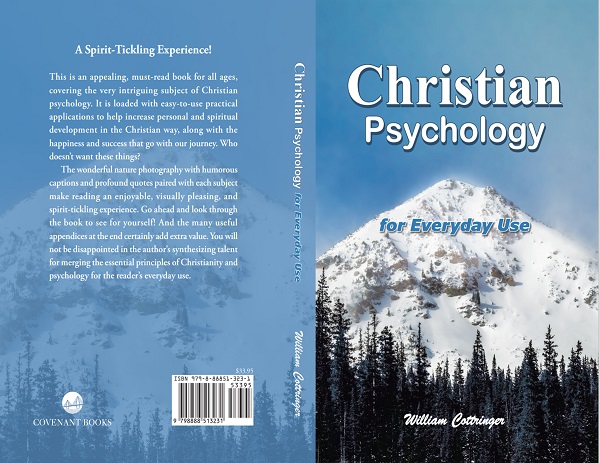
William Cottringer, Ph.D. is President of Puget Sound Security in Bellevue, WA. He is author of Getting More By Doing Less, You Can Have Your Cheese & Eat It Too, and The Bow-Wow Secrets. He can be reached at (425) 454-5011 or bcottringer.pssp.net
|