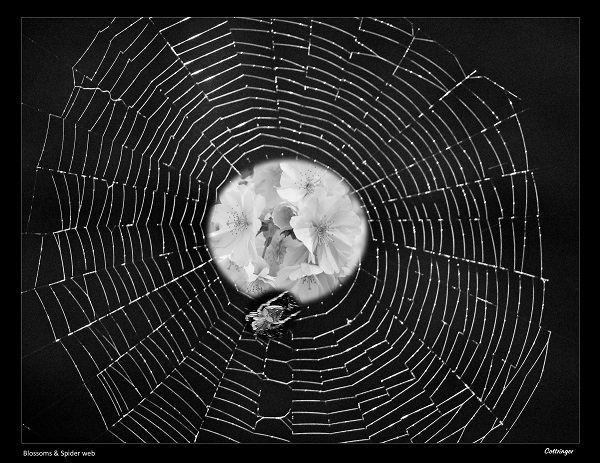
 The only way to bring our dualistic thinking full circle through seemingly irreconcilable conflcits, is with growing into single-mindedness
BECOMING SINGLE-MINDED
By
William Cottringer, Ph.D.
“Self-consciousness creates the illusion that there is a separate self from the rest of reality. That would be the funniest mistake in the world if so many people weren’t so convinced that the illusion is really true .” ~ The author.
Single-mindedness—Creatively divergent thinking which sees through, over, under, between, around and beyond the warring, polar opposite pairs of realities we imagine with our words, thinking, acting and communicating.
I hope the above definition of single-mindedness nudged you away from the typically negative, oppressive and undesirable connotations that are often associated with the term. It is an important idea whose time has come and we could all do a lot worse than making an honest effort to better understand and know more about this idea.
Solving paradoxes in life is not just playing with cerebral candy for recreational fun. Extremely useful truth clues that can increase your happiness and success are hidden away in paradoxes such as, “you can’t have your cake and eat it too,” and “you have to lose yourself before you find yourself.” Becoming single-minded and reaping all the rewards for doing that involves reconciling the greatest paradox of all, which is our fundamental dualistic thinking process.
The most fundamental process our minds engage in is dualistic thinking—dividing things into this or that and then making further dualistic judgments about the pairs of “opposites” we create with our words. Everything is either this or that and this is either good or bad, and that is either true or false. Today, we have just about thought the whole world in half. Now what in the world do we do with the two halves?
This dualistic thinking serves a very good purpose when it isn’t carried on past this originally intended purpose—we know things by comparing and contrasting them to one another. We come to know and appreciate sunshine when we experience its warmth and light and then don’t experience it during a dark, cold rainstorm. And we learn the relative truth of something by peeling away all its irrelevant falseness much like a sculptor sculpting away all the irrelevant aspects of a naked image inside a block of granite.
TWO MAIN PROBLEMS IN THE WAY OF SINGLE-MINDEDNESS
There are two main problems here that often cause us to get stuck half way home.
• The Universe appears to be operating on many fundamental pairs of Yang and Yin opposites continually going back and forth—chaos and order, creation and destruction, separation and union, positive and negative energies, etc. This experience is difficult to step outside of in order to get a more correct and complete perspective of what is really going on between these opposing forces.
• Even dualistic thinking itself has its warring, polar opposite—non-dualistic thinking, or single-mindedness—the knowledge of which doesn’t seem to be accessible before experiencing many pairs of opposites in their entirety. Obviously some can happen quickly and frequently (night and day) and many very slowly and infrequently (life and death).
Regardless of these two formidable obstacles, we finally do begin to realize that the many dualistic pairs of opposites we have experienced and confirmed with our thinking, are really just two halves of a whole—different sides of the same coin like heads and tails of a quarter.
And in the end of our thinking we become more aware of the only inevitable conclusion there is—that there is but one single energy of God’s love—and it flows through the entire universe, undivided. We make choices to use this energy in ways that our minds and other people’s minds interpret dualistically—positive vs. negative, good vs. bad, inclusive vs. exclusive, enabling vs. disabling and so on. Of course we are all trying to get the right perspective to use this energy wisely, but…there are always unwise choices along the way that snare our attention.
IN THE MEANTIME…
In the meantime, here are five things you can do to smooth the way for single-mindedness to appear and finish the full circle of dualistic thinking. The reward is worth the effort—each new moment you can use this single-mindedness to counter dualistic thinking and double your happiness, success, peace of mind, contentment or anything else you want.
1. Begin to question and challenge the artificial harshness and extremeness, as well as the incompleteness and incorrectness, that all dualistic word connotations and judgments over-flavor your mind with and create unpleasant realities and feelings you really don’t want. The toxic psychic pollution can only be stopped one person at a time and one thought at a time.
2. Move to a more balanced perspective of seeing how opposite-appearing things can work together to create something better, more enjoyable or more useful, such as hot apple pie a-la-mode with cold French Vanilla ice cream. Or a jump in the cold ocean on a hot August day.
3. Think about both the purposes and consequences of the words with which you use to think, come to conclusions, act and communicate. Consider the reality that these words are only approximations of the particular realities they represent, not the real things themselves, like a finger pointing towards an object. This is an important gap to be aware of as it allows more room to think in between, over, under, through, around and beyond with the single-minded energy that is all around us.
4. Consider opening up to the best perspective about conflict, which will undo the damage dualistic thinking has done. Conflicts are the most common situations where duality is the main problem, wrapped tightly in strong emotions. “I am right and you are wrong and I am right about that; and I am also better and smarter than you for being that way.” The best perspective to understand and resolve any conflict is to see the next one as an opportunity to learn, grow and improve to create the single-mindedness that reconciles opposites. This takes open, honest, non-dualistic and assertive communication to find whole answers, not convey half-truths in full force. “I am both a little right and a little wrong and so are you, but together we can figure this out for everyone to win.”
5. When all else fails, the best and most reliable default answer is always available. You can get that simple yes-no answer from your conscience—the moral one, not the psychological one, which continually invents more miles of gray procrastination.
If you still want to embrace dualistic thinking and fight for your half of the equation, just consider Dr. Phil’s poignant question—“How’s that working for you?”
William Cottringer, Ph.D. is President of Puget Sound Security in Bellevue, WA., along with being a Sport Psychologist, Business Success Coach, Photographer and Writer. He is author of several business and self-development books, including, You Can Have Your Cheese & Eat It Too (Executive Excellence), The Bow-Wow Secrets (Wisdom Tree), and Do What Matters Most and “P” Point Management (Atlantic Book Publishers). Bill can be reached for comments or questions at (425) 454-5011 or bcottringer.pssp.net
|