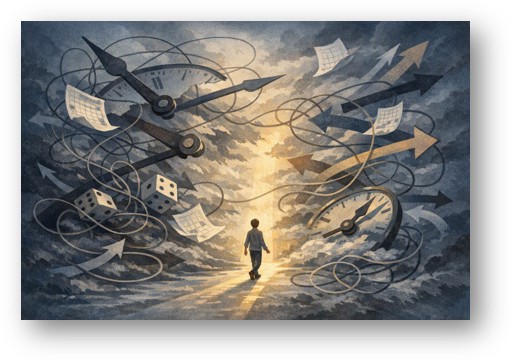
There is a reciprocal cause and effect relationship between conflcits and miscommunication. Here's why.
LANGUAGES OF THE HEAD, HEART AND SOUL
By
Bill Cottringer
“Truth is that sweet spot in time and place where your head, heart and soul hover over something from which nothing can be added, subtracted or changed.” ~The Author.
I have been a student of conflict resolution and good communication for four decades now and think I am finally noticing what I have failed to notice all along—that there is a nearly inseparable, reciprocal cause-effect relationship between conflicts and ineffective communication. Why did it take me so long to uncover this insight? Because of where and how it was hidden from my knowing—by language itself, particularly between the different languages of the head, heart and soul.
Most conflicts between important values, ideas and perceptions are worsened because we get our base information from many different sources including our senses, critical thinking, intuition, feelings and experiences. And then we translate these different sources of information to our mind’s thinking and then end up making a leap of faith about the information’s certainty and figure out how to communicate and apply it with our mouths and hands. The trouble is this multiple “translation” involves three different languages that really have a great deal of difficulty communicating with each other.
It is actually worse than our dual system of communication—verbal communication vs. non-verbal communication. Verbal communication and non-verbal communication play by entirely different rules much like the analog vs. digital revolution. One conveys content and the other style. Content is definitive, fixed meaning and style results in added fluid meaning that get interpreted. The crazy result is that we think we can interpret non-verbal communication verbally. That is like an artist trying to convey pictures to a mathematician who thinks in numbers. It really doesn’t work very well, but we continue trying anyway, increasing miscommunication and making it harder to resolve.
Not only this, but we all approach conflicts with a different perspective—wanting a win-lose or win-win compromising outcome, seeing the conflict as an opportunity for success or failure to avoid, and expecting to get which ever outcome we expect most. Those unresolved conflicts just add up and increase miscommunication even more in a negatively spiraling vicious circle to nowhere. .
Back to the language differences. Our heads think in nouns, our hearts in adjectives and our souls in verbs. That is a very important distinction that has all sorts of enormous consequences when we try getting on the same page with these three things to see the same thing. Being on the same page with them is the only way to find truth and not being on the same page is what worsens conflicts and makes them seem irreconcilable at times, because of not agreeing on the truth of the matter. As the saying goes, conflicts are “frictions between fictions.”
Our heads are aimed at “capturing” information for the ego to get the things we want by understanding, predicting, controlling, and changing the things we don’t like about the ones we don’t want. The mind’s thinking language is very noun-oriented—to focus on and get an object of sorts. One main trouble with thinking is its dualistic nature of diving everything into this or that categories and judging one side as better, righter and more useful than the other. That leaves a lot of things to not get.
Our hearts are aimed and letting us know how we feel about what we think we know. Oddly, despite this animated feeling process, it is really passive in reacting to what we feel in the measurement of this emotional adjective that becomes part of us. Feelings always seem to get in the way of good communication, at least until we refocus on their real adjective purpose. We can have positive feelings that guide us to continue in the way we are headed and negative feelings to warn us that we may need to stop, rethink and redirect our energies to get the positive feelings that we prefer for a very good reason.
Our souls are aimed at experiencing the most meaningful experiences in life that can be thought and felt. These are things like wisdom, understanding, compassion, unconditional love, creativity, empathy and generosity. Soul language is verb-oriented, where we become the means to the truthful ends that our minds are more certain about and feelings confirm. That is when we get on the same page with these three languages, sometimes without even knowing how we got there. That is the true beauty of serendipity. And it has to come about with your head, heart and soul working together as a whole in thinking, feeling and acting with the truth to solve conflicts.
“Conflict is the opportunity to make progress at your main purpose of learning, growing and improving—to apply this purpose to become the means to the ends you hope for in life.” ~The Author.
William Cottringer, Ph.D. is President of Puget Sound Security in Bellevue, WA., along with being a Sport Psychologist, Business Success Coach, Photographer and Writer. He is author of several business and self-development books, including, You Can Have Your Cheese & Eat It Too (Executive Excellence), The Bow-Wow Secrets (Wisdom Tree), and Do What Matters Most and “P” Point Management (Atlantic Book Publishers). Bill can be reached for comments or questions at (425) 454-5011 or bcottringer.pssp.net
|