The Evolution of Our Corrupt Mind Machines
By
Bill Cottringer
“You can’t solve a problem with the same type of language that created it.” Albert Einstein.
The language we invented that created the problems we are now trying to solve was based on words. Without the language of words, there is nothing but direct experience in living life as it comes. But, without words there is no thinking or communicating about our experiences and there is no showing others our experiences and realities, which we wish to share. However, that is where all the problems occur—confused thinking, miscommunication, and misunderstanding. Words—at least the prevalent ones we use now, even with their proper dictionary definitions—can never adequately capture the essence of something we experience. Of course this gets even worse, given the many word connotations we have invented, adding different meanings to the same words by different people.
Originally we did experience and directly know certain polar opposites in a seemingly dualistic universe—birth vs. death, light vs. dark, hot vs. cold, male vs. female, body vs. mind, front vs. back, smooth vs. rough, etc. But then we took things too far by adding dualistic judgments to the quality of these experiences into word connotations like good vs. bad, right vs. wrong, pleasure vs. pain, happiness vs. sadness, rich vs. poor, rain vs. sunshine, fast vs. slow, strong vs. weak, genius vs. ignorance, etc. The secondary judgments of meta-experiences created all the illusions we fight to manage and eventually overcome—time, ego, separation, creation and free will.
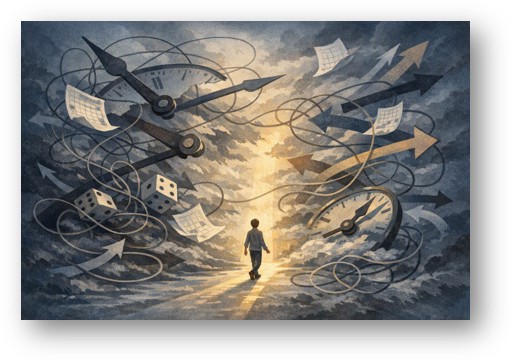
Let’s take the problem of time as a good example. By allowing for a sequence of past, present and future time in our thinking now, we have corrupted our minds into missing out on the only thing we can know for sure at the present moment—the experiences we are having at this very moment. All there really is, practically speaking, is the present experience we have having now. The past experiences we have had are long gone and only trace memories that contaminate and corrupt our present experiences; and, the future itself, only exists in our imagination and not in reality. All there really is, is what we are experiencing with our senses right now at this so-called eternal now moment.
So what is the problem with all this? Two things: (a) the words we use to think about and discuss the realities we are experiencing are only feeble fingers pointing towards something, with a lot of space in between the pointing finger and the real object, and (b) The quality dualistic judgments we make—especially to seek only pleasurable and desirable experiences and avoid painful and undesirable ones—chases all the fun and happiness we can have by just experiencing and enjoying life as it comes, without the over-judgment corruption. The result is two empty hands instead of two full ones. The rest of nature’s beings simply do not make good-bad judgments about their experiences, they just have them and hence, not all the problems we have created, maybe just to be able to solve out of boredom. We are too busy thinking about life and not living it.
The pleasure seeking pain avoidance drive can be useful to a certain extent in protecting us from real danger. But, by over using it and over assigning these qualities to experiences that we think we have had, are having or will have later on, we are completely not living, just thinking about life and wrongly at that. Thinking about a past experience as being unpleasant and unwanted, or doing the same thing with anticipated similar experiences that are surely coming our way sooner or later, is a complete waste of energy. This is because our faulty minds are comparing faulty trace memories about experiences we can’t begin to understand, only fooling ourselves of an adequate understanding in the inadequate words we use to think about these experiences.
And now I have to come to a quick ending because I am becoming aware of my futile efforts in trying to explain the unexplainable for others to comprehend the incomprehensible and think I have arrived at the meaning of the closing quote below. So, enough is enough. “Just don’t take yourself or life too seriously because after all,” as a realistic pessimist continued, “you won’t get out of it alive!” In the meantime, we can probably work on developing a more poetic, metaphorical language to better express our realities clearer and avoid all the senseless hostility and bad feelings. At the end of the day, we will all probably see that we are just trying to talk about the same thing with words that really can’t do that.
“Reality is that which, when you stop believing in it, doesn't go away.” ~Philip K. Dick.
























thought provoking article, well done!
However, I keep encountering writers who seem to want to polarize thinking with their words. I think this goes back long before writing. Our memories are helpful in the moment when we encounter something we have experienced before and as a result of that can deal with it much better. We also can, and the ancients did, anticipate time by knowing how long before the next plentiful season will come along so that we can stock up for the inevitable period of starvation. Elders who could no longer face the day like they could in their youth took on the role of teachers and shamans predicting the future by words. Their vocabularies were probably very small compared to ours, but powerful in persuasion--especially when it came to describing what was good and what was bad.
Ron