Ten Life Lessons You Can Only Learn the Hard Way
By
Bill Cottringer
“Though nobody can go back and make a new beginning... Anyone can start over and make a new ending.” ~ Chico Xavier.
Here are ten valuable lessons about life that lead to success and happiness. Unfortunately these aren’t handed out in the beginning as helpful prescriptions, but instead only learnable the hard way by trial and error. But it is still better late than never, in learning these ten valuable life lessons.
1. What goes around comes around.
Sam’s first wife Sally, whom he left for some good and some bad reasons, learned this wise saying from her grandmother, who was telling her the husband would eventually get back what he was dolling out. Sure enough, his next wife gave him the heave-ho for a younger man. So Sam learned the hard way how this feels. The only trouble is that it had to happen another time to get him to stop his musical marriage chairs, from which he never really recovered. Sadly, he spent the rest of his miserable life alone.
John only had this happen once to him when he learned the value of empathy. He raped a young coed and was given 25 years in prison. There he was gang raped by several bigger inmates and now he can remember the rest of his life what that does to you. It is not something anyone can forget. That is the kind of empathy that permanently prevents something from going around that will eventually come back to you for a painful payoff.
2. You have to give to get.
Harry duly noted that the only place this doesn’t work is with government, who always has to give before it gets, where the getting never seems to stop. Otherwise this first rule of economy and banking—you have to make a deposit before you can make a withdrawal—applies consistently to all things in life and only negative things can happen when the rule is reversed (or at least attempted to be).
Harry found this out after he had to file bankruptcy which took another 7 years to recover from. One other exception he discovered, concerned the love that life gives us all unconditionally in the beginning, which we fail to see or nurture and it often becomes invisible. Fortunately it is always there whether we see it or not and the more love you give, the more you get back, which Harry used to his benefit to offset his financial woes. He was never rich or well-off, but content with a solid marriage relationship where he gave a lot and got a lot in return.
3. Two wrongs don’t make a right.
Sara had to make this mistake over and over again, much like Bob did because he didn’t believe in the truth of the gambler’s fallacy—that the more you put into the slot machine has no effect on the outcome because the probability of winning starts all over again for each new event, regardless of past outcomes. Both failed to make any progress in their work or lives until they learned that righting a wrong with the right is a much more effective approach, because after all, a picture from your own right behavior demonstration is worth a thousand words.
Teresa was fooled into giving herself permission to fight fire with fire or fighting wrongs with bigger wrongs. Eventually the retaliation became so fierce the folly and futility of such a game became too acute to not notice. That is when enough bleeding, broken bones and bruises make you stop doing the wrong thing. And like opera Winfrey used to say, “When life doesn’t like something you are doing, you get a whisper warning and when you don’t listen, then you get a tornado.”
4. A picture is worth a thousand words.
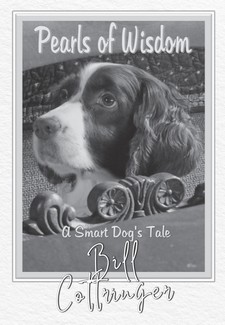
Ah, the author of this article has been caught with this fourth lesson himself. It took me over five decades, after writing 9 books and over 500 articles for magazines and on-line self-help websites, I finally learned that my photography had much more impact on others, than all the thousands of words I wrote. Of course a smart compromise here, that I have learned the hard way, is that by using words that easily conjure up corresponding images—like blinding-bright thundering-loud lightning flashes—often helps bridge the gap between what is spoken or written and what is heard or seen. My last book—“Pearl’s of Wisdom: A Smart Dog’s Tale,” has over 100 pictures, so that should help sales!
Henry is a motivational speaker. He always starts his talks with a serious of slides that depict the epitome of a highly motivated person doing something vs. a sloth not doing much of anything. Jan is an elementary teacher who always starts her day with a picture that captures here desired day ending. And Charles, never fails to include a humorous cartoon in his e-mails pointing out a funny mistake he has made himself, when addressing those of his subordinates.
5. Fortune favors the bold.
Barbara plays it safe with her conservative approach to relationships, work and play, but Diane is a risk-taker in these same areas. Guess who enjoys more success and happiness? The correct answer is alphabetical. But Diane, to assure her own happiness and success avoids potentially fatal risks, by doing a little research to make the risks she is willing to take a little more risk-proof. Sure, she has had her fair share of failures with this adopted approach, but she is the one who walks away with more good memories than bad.
It is commonly known that most brilliant business owners have faced the perils of bankruptcy. But one, Zackary, learned the benefit of embracing his pending failure instead of running from it or denying it. With such embracing, came the success clues to turn the failure around, which he would have missed by running from or denying the reality of the failure. To get happiness and success you have to give something and being bold in taking reasonable chances is the preferred choice.
6. No man is an island.
Physicists like Albert know that everything in the universe is interconnected as one, rather than separated as individual things apart from everything else. The rest of us should take note of this reality and find ways to apply it in our everyday result. Donald, a smart therapist, used this point to have his therapy couples understand that they each were already affecting each other with their experiences before their relationship began. When the couple realized they couldn’t control these things in each other, they learned how to manage their own reactions better and the relationship flourished.
Of course our therapist Dr. Don, learned that his couples in therapy were not an island and that what he was doing or not doing, had impact on others in therapy. For one thing, the importance of what baggage the couples were bringing into therapy wasn’t quite as important as his private assessment. Once this island went under water, the therapist and the couple were freed-up to work on resolving their main conflict, which in these case was to have children or not.
7. Hope for the Best but prepare for the worst.
Bill was an eternal optimist always counting on positive outcomes in his career moves. But sooner or later, as it always seems to happen but usually sooner, the grass on the other side of the fence turned out to be a different shade of brown. This was painfully learned when he went from his average-paying but very secure and stable public sector job, to a much higher-paying, but more insecure job in the lucrative private sector. What he hadn’t anticipated was preparing for the worst—the undue effects of external factors of private business, completely outside of his control.
On the other hand, Carol followed the advice of positive psychologists about the value of leaning in the direction you want to be with the confidence that will happen. But she learned early on from a few setbacks, that you should always have a plan B or even C, in case Murphy’s Law turned out to be more tur than not. She had a little help with this lesson from her lawyer father who always hoped optimistically, but planned realistically. If he was disappointed, he always had a way to get un-disappointed.
8. Keep your friends close but your enemies closer.
Attila the Hun may have been the first to use this rule to his advantage. He always had a short list of loyal soldiers in his inner circle, but a longer list of known enemies with all their known weaknesses and vulnerabilities to exploit when the time was right. Although this rule isn’t the best example of high road ethics, it is smart to at least know as much about your potential enemies as you do with your friends, especially at work.
Ron was new to politics at work and made the mistake of not thinking about the few other people at his workplace gunning for the promotion he wanted badly so he could move from being a renter to a home owner. He did not see them sabotaging his success until it was too late. When the second opportunity came, elsewhere, he didn’t make the same mistake. He paid closer attention to the competition clues and he was a little safer and a lot less sorry in getting that promotion, which eventually led to another.
9. Short cuts make long delays.
We all tend to look for the low hanging fruit when we start out. That is until we usually see that we get what we pay for as that saying goes. Tom wasted about $10,000 painting his house without bothering to scrape, sand and prime the wood for oil based-paint. The redo cost twice that much. The problem with getting to the finish line sooner by taking short cuts is exemplified by a quote form Oliver Wendell Holmes. He said, “For the simple on this side of complexity, I wouldn’t give a fig, but for the simple just on the other side of complexity, I would give my life.” You can’t be more poignant or eloquent than that.
Mary almost learned this lesson too late, in applying low road ethics to her construction business to avoid costs which ended up in OSHA fines. Her lesson learned was that in the long run for log-term gains you have to sacrifice a few short-term pains. All the people who are health conscious with food and exercise know this lesson well. This all has to be incorporated into a lifestyle, not a fad diet or day at the gym.
10. Better late than never.
This saying applies to us all too. After-all, what would the fun be if we knew all these lessons before we had to learn them the hard way? We are all just living out our own life story which to a large part, involves learning important lessons such as these ten. Go back and re-read the opening quote to let this lesson really sink in. At the end of the day, it is rarely too late to learn an important life lesson because the most important time in anybody’s life is now, not the known past or the unknown future.
In conclusion Henry and Harriett both learned at work, that sometimes you learn these lessons early on and then forget them, only allowing them to come back with more vengeance and fury the next time around, making the lesson even harder to learn. This is the one exception for human learning in life—relearning something is generally easier once you learned it the first time. This exception is because the problems are never quite the same.
“The person who doesn’t make any mistakes doesn’t make much of anything; but the person who doesn’t learn from mistakes made, keeps making them. ~The Author.
William Cottringer, Ph.D. is Executive Vice President of Puget Sound Security in Bellevue, WA, along with being a Sport Psychologist, Business Success Coach, Photographer and Writer living on the scenic Snoqualmie River and mountains of North Bend. He is author of several business and self-development books, including, Re-Braining for 2000 (MJR Publishing); The Prosperity Zone (Authorlink Press); You Can Have Your Cheese & Eat It Too (Executive Excellence); The Bow-Wow Secrets (Wisdom Tree); Do What Matters Most and “P” Point Management (Atlantic Book Publishers); Reality Repair, (Global Vision Press), Reality Repair Rx (Publish America); Thoughts on Happiness; Pearls of Wisdom: A Dog’s Tale (Covenant Books, Inc.) Bill can be reached for comments or questions at (425) 652-8067 or ckuretdoc.comcast.net.























I especially liked the illustrations in words (perhaps you should have had a photo or drawing). Some very good examples and I related very well to the one titled, "Ron," although I never made his mistake. ;-)
Under the umbrella, No man is an island. I always comment on your articles so that you know you have someone out there that has your back--or your affront--depending. ;-)
Ron