Some Words Need Re-Defining
By Bill Cottringer
“Poetry is when an emotion has found its thought and the thought has found words.” ~Robert Frost
We originally invented words as a way to “show and tell” things secondhand, especially the ones we couldn’t manage to bring in hand firsthand, like mountains, the sky, the moon and oceans and such. In the beginning there wasn’t any confusion or misunderstanding of what a particular word meant. The representation was close and clear. The word pointed directly at the object.
However, today the space between the invented words we use and the real objects these words are supposed to represent, has widened exponentially. And we continue to fill the space with more and more of our own private connotations of these words and what they mean to us personally. This is usually much different than the intent in which they were spoken, written or interpreted. The result is increased miscommunication and misunderstanding and the undesireable outcomes those things bring to the table.
Maybe it is time to consider redefining some words that have lost their intended denotative meaning and given way to endless connotative meanings resulting in mass miscommunication and all the negativity and even destruction this brings to us. Here is a few of the urgent problem words to consider redefining to start this provoked project.
1. Love. Let’s start with a word that usually means something different to every person who ever says or writes it or hears or reads it. Rarely is there a preciseness along the chain of custody for this word from one person to another. If you must use this word, then you should provide your definition of what it means to the other person to see if it is a good match for what is going on. If you are not concerned about potential misunderstanding, then, by all means, use the word love anyway you want. Just don’t expect the preferred response.
2. Honesty. The word honesty usually implies “total” integrity and complete trustworthiness in all circumstances, without thought about the real exceptions of degrees of dishonesty that we all possess. We can all be dishonest given the right situation and we are all working on improving our honesty, but we are not there yet. So, in the meantime try to not make honesty an issue in analyzing people and situations, unless it is critical to your survival, and then be critical about it.
3. Best. This word probably needs to be replaced with” better.” Best is always temporary and tentative so why try to imply that it is permanent when it isn’t? For instance, there is no end game finishing line to becoming your best self. You just learn, grow and improve to become “better” each day of your life. Best always results in winners and losers, while better results in only winners, with you competing against yourself instead of others.
4. Try. I remember some self-help guru telling me that “trying” was just a noisy way of not doing something. As Yoda used to say, “Do or not.” When you try to do something, you are likely setting yourself up for failing to succeed, because the trying allows for all kinds of excuses to be considered to justify failure. Consider eliminating the trying period of doing something and the interfering thoughts and feelings that accompany that state of mind, and just proceed to do what may be required to succeed. If you fail, you can learn the clues you need to know to succeed the next time.
5. Worry. Compelling words like worry can convince you that you are already in more serious trouble than you really are. Worrying is a variation of trying that gets you nowhere but all tied up in thoughts, feelings and behavior and no way out or energy for action. The best anecdote to worrying is to identify what you are worrying most about and then carry out an action plan to eliminate the source of worry. If that doesn’t work, find something else to eliminate worrying about. Somewherea long that process, you will forget about worrying.
6. Truth. This overused word normally slides to the extreme of being an “absolute truth” that has no exceptions. The last time I checked, there are very few of these and most “truths” are tentative, evolving and very relative to particular situations. This is the better way to use the word truth, allowing it to breathe life and mean what it is supposed to mean—the most likely way something is at the given time and place, or vantage point from which you are concluding the particular "truth."
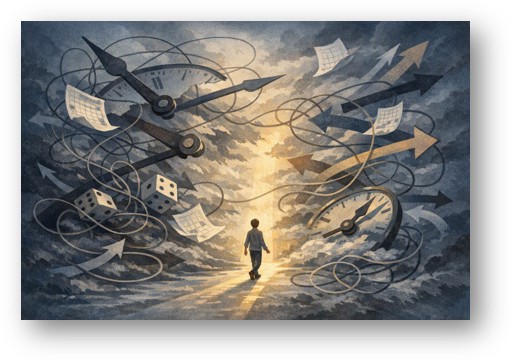
7. Time. There is no room for creativity or real progress when we define time strictly as a mechanical, sequential thing from past to present to future. But the real trouble is the way we measure it. Some say the eternal now, present moment is what keeps expanding and measurement of that movement between events lets time manage you instead of the better approach of managing time to get the most things done in less time.. All I can suggest is to consider not using a word that represents something we don’t really understand very well. That is what happens in religious discussions.
8. Belief. These are the things that get people in the biggest messes. A belief is a collection of thoughts and feelings judged by experiences and contaminated with all these other questionable words that need redefining. Oddly, we protect and defend our beliefs well beyond the plethora of objective proof that they are false beliefs. Maybe we should just keep our beliefs to ourselves, unless we want to critique their validity and utility with “trusted” others. It is a certainly a good idea to not impose your beliefs on others as being superior or absolute “truth.” That is what starts wars.
9. Curse words. These words have all taken on a very nasty, hateful flavor that serves no good purient purpose, unless used in jest or as endearing. A more creative way to swear is to use foreign curse words like, himmeldonnerwetter, merde, cago, kisama, malaka or my personal favorite jebiesz jeze; or similar sounding phrases that are innocent like “Shut the front door” instead of “Shut the F---K up, as often sued by Rachael Ray or Madam secretary.
10. Anger. Real anger leads to violence and neither of these things are acceptable to civil people. Feelings that we include under the term of anger, are often much different things not directly capable of leading to violence themselves, such as frustration, disappointment, uncertainty, insecurity, jealousy, etc. The question becomes why use a word that is more explosive than it needs to be when it doesn’t convey the right intention? This makes no sense when you want to be clear and correct and have the better impact.
11. Contempt. Feelings of contempt are best unspoken and kept completely to yourselves because when spoken as such, they destroy relations completely. Just like truth, honesty and anger, they lead people to extreme, dark places where no one really wants to be, so why go there? The saying “familiarity breeds contempt” is at least partially true , but it insinuates the whole truth and there is always the “rest of the story” in any half-truth. The use of the word contempt is too dangerous to risk because it closes the door permanently and you rarely want to do that.
12. Depression It is unfortunate that the word depression carry’s such a powerfully negative and damaging connotative meaning. The word itself may perpetuate the group of thoughts, feelings and behaviors that are suspected to cause this state of being. A certain amount of depression is a good thing because it helps you identify problems you should, or cant’s do something about. Accepting “depression” as being very normal and natural, allows you to accept the things that are causing what you call depression, and move forward to being undepressed, naturally instead of doing the things that perpetuate the depression.
“Words are, of course, the most powerful drug used by mankind.” ~Rudyard Kipling.
William Cottringer, Ph.D., Certified Homeland Security (CHS) level III, is Executive Vice-president for Employee Relations for Cascade Security Corporation. in Bellevue, Washington, sport psychologist, and adjunct professor in criminal justice at Northwest University. He is author of several business and self-development books, including Finding It, You Can Have Your Cheese & Eat It Too, The Bow-Wow Secrets, Do What Matters Most, ‘P’ Point Management, Reality Repair, Reality Repair RX, Thoughts on Happiness, Pearls of Wisdom: A Smart Dog’s Tale and A Cliché a Day Will Keep the Vet Away coming soon. He can be reached at 425-652-8067 or ckuretdoc.comcast.net.



















Excellent considerations, well said
never stop writing
m
I do like Robert Frost's quote at the opening. We psychologists don't really understand two very important processes about human behavior:
1. the interaction of thoughts and feeling and reciprocal impact on behavior and those thoughts and feelings.
2. The development of language from prima facie baby-talk to abstract adult talk.
Two mysteries to complicate the behavior management process, only to be compounded more by the over-assumption of intentionality and free will of choices and under-appreciation of social conditioning closer to determinism.
Ron