Whole-Brained Thinking
© 2021 William Cottringer
“A wise person uses intelligence to find reasons to support intuition.” ~The author.
Navigating the tricky minefields of adversity and solving the ornery problems and conflicts facing us in life today, requires whole-brained thinking with input from all five different types of intelligence from both hemispheres of the brain—physical, intellectual, emotional, social, and spiritual intelligence. Success in everything from school, work, and marriage to medicine, teaching, and leadership, depends on these essential intelligences of whole-brained thinking.
It humbles me to say that it has taken me a half century of education, work and life experiences to finally see the big picture here. But I suppose it is always better late than never. Maybe learning the science and art of applying the other emotional, social and spiritual intelligences helped supplement my average physical and intellectual intelligence along my journey. Each of these essential five levels of intelligence that are required in whole-brained thinking, are discussed below.
Physical Intelligence.
Physical Intelligence involves the various basic physical skills we may be lucky enough to be born with and later develop fully for excellent performance. These skills include strength, speed, endurance, flexibility, hand-eye coordination, and adaptability. Somehow, I think that common sense, which is not so common today, is a big part of physical intelligence.
Intellectual Intelligence.
Intellectual intelligence involves all the brain-based cognitive abilities of the age-old nature vs. nurture debate, including logic, reasoning, judgment, memory, information and knowledge processing, perceptual speed and accuracy, verbal and performance skills, and creativity. This type of intelligence also has Howard Gardiner’s multiple intelligences from his Frames of Mind and Robert Sternberg’s Triarchic Theory of Intelligence for successful thinking.
Gardner’s multiple intelligences include visual-spatial, linguistic, mathematical, kinesthetic, music, inter-and intra-personal, naturalistic and existential intelligence. Sternberg’s successful thinking model included Componential (book smarts), Experiential (dealing with unfamiliar situations), and Practical intelligence (street smarts), Componential includes analyzing, critiquing, judging, comparing, and contrasting, assessing, and evaluating; experiential includes creating, inventing, discovering, imagining and predicting; practical intelligence includes applying, using, practicing, implementing, and employing. (Multiple Intelligence (MI) – Howard Gardner (cortland.edu)
and http://www.robertjsternberg.com/successful-intelligence).
Emotional Intelligence.
Several earlier researchers and writers, including Michael Bedoch, Wayne Payne, Peter Salovey, John Mayer, Reuven Bar-on and Daniel Goleman used the term emotional intelligence as a valid competitor of the tradition intelligence in the earlier concept of IQ. Today a Google search nets over 5 and a half million references to EI resources on the Internet. The five main components of emotional intelligence are self-awareness, social skills, empathy, emotional regulation, and intrinsic motivation (competing against yourself for internal satisfaction as opposed to chasing external carrots for rewards).
Social Intelligence.
Although there is some overlap between emotional and social intelligence by some authors, the main distinction is that emotional intelligence belongs to the individual whereas social intelligence is associated with inter-personal interactions with others. Social intelligence includes conversational skills, effective two-eared listening with one mouth talking (hearing to understand rather than respond—hearing both what is and isn’t being said and what is being said and how it is being said); social efficacy, impression management, teamwork, and street sense in reading people.
Van Sloan uses what he calls Social Quotient (SQ) to predict non-discriminatory school and work success based on other’s perceptions of highly predictive personality traits (these social skills and some of my likeability traits below: General happiness, positive attitude, upbeat tempo, smiles, liking others, courtesy, verbal skills and physical attractiveness). His research and information can be found at: https://vansloan.wixsite.com/social-quotient.
Social intelligence also includes two larger concepts—one from my own likeability research with psychology students and Jack Gibbs’ supportive vs. defensive style of communication. Likeability includes being honest, positive, polite, humble, attractive, empathic, agreeable, humorous and a good listener. Supportive communication conveys equality, freedom, acceptance, sensitivity, tentativeness, and spontaneity, while avoiding implying their opposites—superiority, control, judgment, insensitivity, certainty, and manipulative strategy. https://www.selfgrowth.com/articles/LIKEABLE_COMMUNICATION.html
Spiritual Intelligence.
The evolution of whole-brained thinking expands these other Intelligences into spiritual intelligence which can help us see past what we are looking at, to discover unknowns and absolute truths from a different place outside our traditional concept of mechanical time. Spiritual intelligence is open-ended and as far as I can see, includes direct knowing from intuition, mediation, mysticism, and spiritual contemplation. It involves becoming fully self-actualized in climbing the ladder of Maslow’s hierarchy of needs, through behaviors such as virtuosity, transcendence, awareness acumen, reconciliation of opposites, exploring the collective wisdom of the universe, and the magic of reversibility thinking. Spiritual intelligence seeks quality answers to big questions like the meaning of life and our purpose here.
Spiritual intelligence allows both hemispheres of the brain to communicate with each other and this is no small accomplishment, since they communicate with entirely different languages (words and thoughts vs. sensations and images). My personal way to develop spiritual intelligence is to realize how little I really know compared to what I think I know and what there is to know. Spiritual wisdom is a special brand of uncommon common sense and starts producing results when your conscious mind starts translating the 95% unconscious stuff to your awareness.
If you don’t already have expertise in using whole-brained thinking and already enjoying the abundance of success that brings, you can improve your success rate in any of your endeavors by learning more about these five intelligences and practicing them together. Don’t forget to seek frank feedback about how you are doing, from trusted sources.
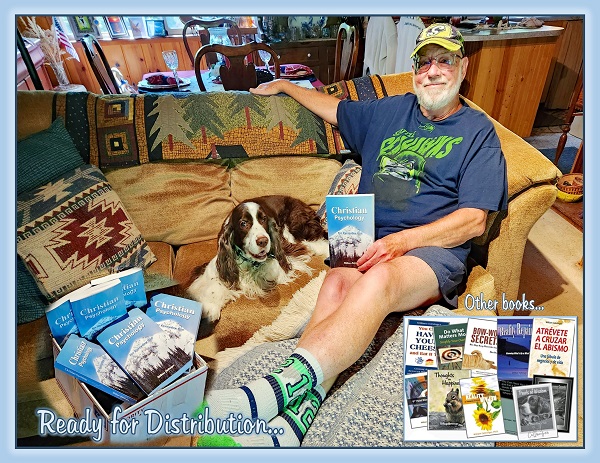
William Cottringer, Ph.D. is retired Executive Vice President of Puget Sound Security in Bellevue, WA, along with being a Sport Psychologist, Business Success Coach, Photographer and Writer living on the scenic Snoqualmie River and mountains of North Bend. He is author of several business and self-development books, including, Re-Braining for 2000 (MJR Publishing); The Prosperity Zone (Authorlink Press); You Can Have Your Cheese & Eat It Too (Executive Excellence); The Bow-Wow Secrets (Wisdom Tree); Do What Matters Most and “P” Point Management (Atlantic Book Publishers); Reality Repair, (Global Vision Press), Reality Repair Rx (Publish America); Thoughts on Happiness; Pearls of Wisdom: A Dog’s Tale (Covenant Books, Inc.) Coming soon: A Cliché a day will keep the Vet Away (Another Dog’s Tale). Bill can be reached for comments or questions at (206) 914-1863 or ckuretdoc.comcast.net.























Pardon me for saying so, but I think you missed the point of this article. Perhaps I wasn't clear enough? This article is an exploration of the "process" of the evolution of intelligent consciousness and not about specific knowledge that can be "outdated." This is more about "wisdom," which is timeless. To access true wisdom, consciousness must exceed the speed of light to the place outside of time. Thanks for your comments. Bill C.
Best regards, Lexi Diaz.
The author of the Essay Map https://essaymap.org/.