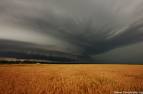
For the last three years from my home in Chevy Chase, Maryland I have been writing in my spare time a novel about an iconoclastic Kansas wheat farmer in the 1890’s. No, I didn’t grow up on a farm and knew nothing about wheat or farm life. Why then I did I pick this subject? I didn’t—it picked me and I pursued it where it led me.
It all began in Charlottesville, Virginia where I met with Bob Grove who was in his early 90’s and had grown up in Pawnee County in south-central Kansas. Bob explained some of the basic farm machinery used in threshing wheat at the turn of the century and that the average size farm was 300 acres. He talked of milo, maize, and cane, all words I had heard but wasn’t sure what use they served on a farm. After my conversation with Bob it hit me that I needed to go to Kansas.
I flew into Kansas City on Sunday morning Nov. 25, 2001 and drove to The National Agricultural Center and Hall of Fame Museum in Bonner Springs, Kansas and was fortunate for this was the last day of their season. I was the only visitor at opening and an employee, Roger Wyatt, gave me a tour of the grounds, which included a building with old farming equipment. After listening to Roger explain all the different machinery, I was beginning to realize that there was much I needed to learn about harvesting and growing wheat to authenticate my story. At the end of the tour my mind was swimming with threshers, binders, headers, and other farm equipment used during the time of my story. After three hours I left the museum feeling as I did my first day in 10th grade French class when the teacher spoke nothing but French.
Monday morning I was at the Kansas State Historical Society twenty minutes before opening and chatted with a grounds keeper who was tending to a garden of indigenous grasses and plants. He patiently explained what they were and how some could be used for feeding livestock. Like everybody else I was to meet in Kansas he was extremely helpful and gracious. Inside the Museum, Rebecca Martin, whom I had e-mailed, took me to the library where I researched the weather and wheat production during the 1890’s.
Tuesday morning I drove south to Marion, Kansas to interview Dorothy and Lawrence Gilbert, whose name I got from Rebecca Martin. Lawrence, eighty years old, had spent his whole life growing wheat, only recently retired due to poor vision. Dorothy gave me a copy of “Sod and Stubble” and a journal on wheat farming. I taped our interview and learned some wheat terminology—stooling, heading out, in the dough, and shocking. I liked those words.
The Gilbert’s were pleased that somebody, a fellow from Back East, no less, wanted to write a story about life on a wheat farm. In listening to them I realized the passion and hard work involved. Lawrence had farmed the “right way” never cutting corners round. Although he said many of the young people today do it differently and that was alright, I knew he didn’t mean it. For him, growing wheat was more than a job, it was a way of life. “Don’t forget the women,” Lawrence told me, “for they had it very hard.” I didn’t and have put in a scene about what they went through in the kitchen during harvest. Driving to lunch, he pointed out a farm owned by Mennonites. I noticed how much greener the wheat seedlings were and the square corners. “They do it right,” he said. Passing various farms, his keen eye missed nothing as he pointed out details that revealed much about those inside the farmhouses. After the Gilberts treated me to lunch at a Mennonite restaurant, they insisted on paying, we drove to the Adobe Museum in Hillsboro and received a guided tour by David Wiebe, a very knowledgeable gentleman who explained scything and sieving of wheat, and the difference between threshers, headers, binders, etc. Will I ever get it straight?
Wednesday morning I drove north to Osborne and phoned Laura McClure, a State Representative, whom I had met on the Internet and had arranged interviews with farmers in her district. Laura’s line was busy so I went to the donut shop and got directions to her house—only in a small town. When she greeted me at the front door she exclaimed, “The author is here, the author is here.” Oh no, I thought to myself. Does she know I’m just some guy on a quixotic quest who has never published a thing? She caught my chagrin and asked if I had published anything. No, I responded. She smiled and said that it didn’t matter, and told me our schedule for the next two days. We drove back into town and met Von Rothenberg who had annotated "Sod and Stubble," the story of a pioneer family in Osborne. He took me on a tour of the farm where the story took place and was a wealth of information. I was beginning to get a feel and understanding of life back then and the sense of what the giant sky and prairie must have looked liked to somebody from Europe.
After lunch Laura and I drove to Lebanon to meet Walt Dillon, a 98-year-old man who had been a wheat farmer up to his mid 80’s. His first memory of farm life was 1906. I asked him if he ever regretted being a wheat farmer. Like everybody else I met, he answered no he couldn’t have imagined a better life.
Laura and I then drove to Norris Maydew’s farm in Lebanon. Pulling into his driveway he waved us over to one of his three barns. Inside he hooked up two Belgian horses to a hayrack and took us of a tour of his farm. Norris crackled with excitement reminiscing about his childhood amongst the wheat and horses, his two great passions. He mentioned he was 73, which surprised me greatly—he could have passed for 55. After the tour we went inside a barn that was full of old buggies and harnesses and a variety of tools that hung from the walls. He too, told me there was no other life for himself and wanted me to come back in April for a thrashing bee in Mankato, Kansas.
It was approaching nightfall, but Laura was just getting warmed-up. Would I like to drive 60 miles to Woodston and meet Leo Oliva, a local historian, and his wife for dinner? Sixty miles! For dinner. Laura told me that was nothing in Kansas. Sure no problem, I said. Am I ever glad we did for Leo was a wealth of information. Headers, binders, threshers, etc didn’t seem as foreign to me now as Leo talked about wheat farming. He gave me his e-mail address and has been a great source for there seems to be nothing he doesn’t know about farm life in Kansas at the turn-of-the-century. After leaving Leo and his wife, Laura and I drove to Russell and Irene Phalen’s bed and breakfast in Osborne where I would spend the night. They were gracious hosts, and told me some of their experiences growing up on a wheat farms. Irene mentioned that she always remembered storms coming from the east to my incredulity, since on the East Coast they come from the west. I became a believer the following day returning to Kansas City as I drove east into a storm. I added this little bit of authenticity to my story.
Thursday, Laura and I were off bright and early for Warren Inskeeps farm in Cawker City. His home was a beautiful farmhouse with rich wood paneling and floors, and I felt immediately welcomed. Warren was 81 but looked twenty years younger. Every farmer I met looked younger and I surmised that hard physical work and happiness played a major role. Warren got out scrapbooks containing some articles on farming equipment and patiently explained how the mechanics of a thresher worked in harvesting the wheat. The two hours flew by and we said goodbye to Warren on his long front porch with a vista of his wheat field and the great Kansas sky stretching to forever. What a sight. I asked Warren if he ever regretted his life as a wheat farmer. He told me that no, he had many opportunities; he was a pilot in Europe during WW11 and had graduated from Ottawa University in Kansas, and from his scrapbook I gathered he was a star athlete, which wasn’t difficult to believe for at 81 he still appeared formidable. He had loved his life amongst the changing seasons and the wheat, and for him there could have been no other. His blue eyes glimmered as he spoke; his time on this earth was almost at an end and the good lord willing he’d soon be going to a better place. When he finished, he looked at me straight and true —I felt a shiver run down my spine for I realized I was in the presence of a bright and shining example of “The Greatest Generation.”
We had one more interview and that was in Beloit at the senior center to interview Arnold Hackett who was 93 years old and had just quit wheat farming a few years past. Laura had told me he had been telling anybody who would listen that a fella was coming from Back East to interview him. We sat at a table and I turned on the tape recorder and began asking questions. His answers were short and uninformative. I kept probing, getting nowhere. His daughter, who was sitting at the table, told him, “dad you been waiting for three days for this man to come why won’t you give better answers?” “He needs to ask the right questions,” was his reply. So I asked him what were the right questions and he smiled and then we all laughed. He relaxed—his eyes sparkled mischievously—and began to tell stories of his youth, one when he and a buddy “slugged” a separator when they got mad at the operator. I asked him about another life other than wheat farming. No, he replied, he liked the independence of working your own farm. That hit a chord in me for independence was at the core of my protaganist in the story.
After lunch at the senior center I had a plane to catch and said goodbye to Laura and thanked her for everything she had done for me. Two things struck me on the ride back to Kansas City—the people of Kansas and the land, both intertwined and inseparable.
Since returning home I have been reading books about all aspects of life on the Kansas prairie. I have authentic scenes and tidbits here and there that have brought life and vitality to my story. Also I have the life-long memory of Kansas and the unforgettable people I met along the way.
Dennis McKay
December 2001