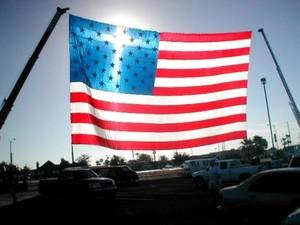
If you are a RED-BLOODED PATRIOTIC AMERICAN - you should enjoy learning a little bit here, about our Nation's Origins.
Because the greater majority of this compilement consists of the copying and pasting from the works of others, I can only claim the format and order of this presentation.
The Intro, Notes, and Summary are mine, and were highlighted with bold text, but AD changes whatever it pleases - Que Sera, Sera!
OH SAY CAN YOU SEE -
Tom Hyland - 08-19-08
The Star Spangled Banner, the 15 Star Flag 1795:
This Flag became the Official United States Flag on May 1, 1795.
Two stars were added for the admission of
(14th) Vermont - March 4, 1791
(15th) Kentucky - June 1, 1792
This was the official flag for 23 years. The five Presidents who served under this flag were; George Washington (1789-1797), John Adams (1797-1801), Thomas Jefferson (1801-1809), James Madison (1809-1817), and James Monroe (1817-1825).
The 15-star, 15-stripe flag was authorized by the Flag Act of January 13, 1794, adding 2 stripes and 2 Stars. The regulation went into effect on May 1, 1795.
This flag was the only U.S. Flag to have more than 13 stripes.
It was immortalized by Francis Scott Key during the bombardment of Fort McHenry, Sept 13, 1814. The image above is representative of the actual flag that flew over Fort McHenry on that day and which is now preserved in the Smithsonian Museum. You can notice the "tilt" in some of the stars just as in the original Star Spangled Banner.
My Note - SORRY - the website did not allow copying the picture. Note that I have lived my entire life in Baltimore, played and dipped Maryland Bluefin Crabs from the seawall at Fort McHenry as a child, visited the various monuments of the War of 1812, such as The Battle of North Point, and NEVER KNEW that this famous flag had 15 stripes. Tom.
Where the original Star Spangled Banner went...
1814 The battle occurred, and the flag won its glory. Armistead was promoted to Lt. Colonel by Madison, and given the flag when he retired.
1818 Armistead died, and legend says that the flag was used in his funeral. Afterwards, his daughter Georgiana Armistead retained possession of the flag.
1824 The flag was used in a reception for General Lafayette. Sometime afterwards, Georgiana gave the flag to her son, Even Appleton.
1860's The flag, ironically, was sent to England for safe keeping during the Civil War.
June 24, 1873 The flag was displayed in the Charleston Naval Yards, and one of the first photographs was taken of it.
1876 The flag was loaned to the Smithsonian for the Centenial Celebration.
1912 Even Appleton donated the flag to the Smithsonian.
1914 Almari Flowler was commissioned to replace the original "sack cloth" backing with linen.
??
http://americanhistory.about.com/mbiopage.htm
The Thirteen Colonies
Key Colony Facts By Martin Kelly, About.com
Virginia
Year Founded: 1607
Founded by: London Company
Royal Colony: 1624
Massachusetts
Year Founded: 1620
Founded by: Puritans
Royal Colony: 1691
New Hampshire
Year Founded: 1623
Founded by: John Mason
Royal Colony: 1679
Maryland
Year Founded: 1634
Founded by: Lord Baltimore
Lord Baltimore
By Martin Kelly, About.com
Sir George Calvert, Lord Baltimore
Sir Cecil Calvert, Second Lord Baltimore
Birth of Second Lord Baltimore: 1605
Death of Second Lord Baltimore: 1675
Nationality and Background:
Sir George and his son Cecil were British subjects rewarded with land in the new world. George was a Secretary of State to King James I. He was at first rewarded with a title to land in Newfoundland. He later asked James I's son, Charles I, for title to land north of Virginia that would become Maryland. This land was not signed over until after his death and was given to his son Cecil. The Calverts were Roman Catholic, a religion which most inhabitants of the New World were prejudiced against.
Historical Significance:
When Cecil Calvert, second Lord Baltimore, created the colony of Maryland, he formed it based on the ideas of freedom of religion and separation of church and state. Maryland, in fact, became known as a haven for Roman Catholics in the New World. Cecil governed Maryland for 42 years.
Motivation for Founding the Maryland Colony:
Lord Baltimore was motivated both by the desire for profit and the desire to create a refuge for Roman Catholics who were still being persecuted in Protestant England.
Significant Events:
Maryland was a proprietorship which means that the proprietor had executive authority. Tobacco was very profitable for the colony.
Religious freedom for different sects of Christianity was widespread, especially after the passage of the Act of Toleration in 1649 which allowed for toleration to all Christians. Maryland eventually became known as a 'haven for Catholics'.
http://www.msa.md.gov/msa/mdmanual/01glance/html/nickname.html
MARYLAND AT A GLANCE
NAME
NICKNAMES
Maryland is known as both the Old Line State and the Free State.
Old Line State. According to some historians, General George Washington bestowed the name "Old Line State" and thereby associated Maryland with its regular line troops, the Maryland Line, who served courageously in many Revolutionary War battles. For a closer examination of the background on this nickname, see: The Origin of the "Old Line State" , by Ryan Polk (2005).
Free State. The nickname "Free State" was created by Hamilton Owens, editor of the Baltimore Sun. In 1923, Georgia Congressman William D. Upshaw, a firm supporter of Prohibition, denounced Maryland as a traitor to the Union for refusing to pass a State enforcement act. Mr. Owens thereupon wrote a mock-serious editorial entitled "The Maryland Free State," arguing that Maryland should secede from the Union rather than prohibit the sale of liquor. The irony in the editorial was subtle, and Mr. Owens decided not to print it. He popularized the nickname, however, in later editorials.
My Note - although a citizen here my entire life (will be 68 on the 25th of this month) - I never knew the origins of these nicknames. Tom.
Connecticut
Year Founded: c.1635
Founded by: Thomas Hooker
Rhode Island
Year Founded: 1636
Founded by: Roger Williams
Delaware
Year Founded: 1638
Founded by: Peter Minuit and New Sweden Company
My Note - although Delaware’s Nickname is The First State, because it was the first to ratify the Constitution in 1787, it was not the first colony - six others were founded before it. Tom.
http://www.netstate.com/states/intro/de_intro.htm
On December 7, 1787, Delaware, became the first state to ratify the United States Constitution. Before that, it was the only colony to be claimed by Sweden, Holland and England. And before that, there is some evidence that Egyptian explorers found their way to the state.
The log cabin was introduced by the Swedes. The first regularly operated steam railroad began operations in New Castle in 1831.
Today, Delaware has become a farming and industrial state. At one time the center of this country's flour industry, it is today the leading producer of chemicals in the United States and, because of its corporate laws, more corporations are headquartered in Delaware than in any other state.
THE NAME:
One name goes a long way in this small state. The Indians and the state were both named after the Delaware River. And where did the river get its name? The Delaware River was named after Sir Thomas West (Lord de la Warr), the Virginia Company's first governor.
Source: Shearer, Benjamin F. and Barbara S. State Names, Seals, Flags and Symbols Greenwood Press, Westport, Connecticut - 1994
THE NICKNAMES:
The First State: (Official) Delaware was the first state to ratify the United States Constitution in 1787. There is only one First State and Delaware is it.
The Diamond State: This nickname for Delaware is echoed in the State Flag. The buff colored diamond serves as a frame for the state Coat of Arms. This nickname originated with Thomas Jefferson who compared Delaware to a diamond; small but very valuable. According to the Delaware Government Information Center, Thomas Jefferson described Delaware as "...a 'jewel' among states due to its strategic location on the Eastern Seaboard."
The Blue Hen State: This historical nickname, sometimes Blue Hen Chicken State, originated during the Revolutionary War. According to W.A. Powell's History of Delaware, 1928, the story traces back to a Captain Caldwell from Kent County who carried with him a pair of fighting game cocks.
These chickens, descendents of a famous Blue Hen, were well known in Kent County for their superior fighting qualities. It is said that upon seeing these game cocks fight, one soldier cried "We're sons of the Old Blue Hen and we're game to the end" comparing the fighting prowess of the chickens to the fighting prowess of the Delaware soldiers.
These regiments from Kent County became known as "Blue Hen's Chickens." This name was soon applied state wide. In 1939, the Blue Hen Chicken was adopted as Delaware's official State Bird.
The Peach State: In the 1500s, the Spanish brought peaches to Delaware. By the 1600s, peaches were so plentiful in the state that farmers used them to feed their pigs. Supported by the Delaware Railroad in the early nineteenth century, Delaware became the leading producer of peaches in the United States.
Almost 6,000,000 baskets of peaches were shipped to market in 1875, Delaware's peak production year. Many problems beset peach farmers throughout the latter part of the century. The peach blight, called the "yellows" forced the collapse of the industry and, in the early 1900s, many peach farmers faced bankruptcy.
New Sweden: Refers to the first permanent settlement in Delaware in the present day Wilmington. Delaware was under Swedish rule from 1638 to 1655. The first Swedish settlement was at "The Rocks," on the Christina River, near the foot of Seventh Street. The Christina River was named after the young queen of Sweden as was the fort that was built.
Uncle Sam's Pocket Handkerchief: This obscure nickname probably refers to the small size of Delaware.
Corporate Capital: Delaware has been called the "Corporate Capital" because so many corporations have incorporated in the state because of its business-friendly law. According to the Delaware Division of Corporations (2002), more than 308,000 companies are incorporated in Delaware. This includes 60% of the Fortune 500 and 50% of the companies listed on the New York Stock Exchange.
Small Wonder: A new nickname developed to promote the state's contributions to the nation and its natural beauty.
Delaware has also been called "The Chemical Capital" and the "Home of Tax Free Shopping."
Source: Shearer, Benjamin F. and Barbara S. State Names, Seals, Flags and Symbols Greenwood Press, Westport, Connecticut - 1994
?Shankle, George Earlie, Phd State Names, Flags, Seals, Songs, Birds, Flowers and Other Symbols H. H. Wilson Company, New York - 1938 (Reprint)
THE CITIZENS:
People who live in Delaware or who come from Delaware are referred to as Delawareans.
Nicknames have included "Blue Hen's Chickens," as mentioned above. Delawareans were also called "Muskrats" because of the large number of muskrats present in the early days of the state. It was humorously asserted that because of the small area of Delaware, only muskrats could get a foothold in the state.
THE QUARTER:
The first state to ratify the United States Constitution was also the first state to have its own commemorative state quarter minted. This quarter, minted in 1999, depicts Caesar Rodney, in 1776, braving thunderstorms and a severe summer heat wave on his way to Philadelphia to cast the deciding vote for the independence of the British colonies.
For more on the state commemorative quarters, visit this page.
North Carolina
Year Founded: 1653
Founded by: Virginians[/link]
Royal Colony: 1729
South Carolina
Year Founded: 1663
Founded by: Eight Nobles with a Royal Charter from Charles II
Royal Colony: 1729
New Jersey
Year Founded: 1664
Founded by: Lord Berkeley and Sir George Carteret
Royal Colony: 1702
New York
Year Founded: 1664
Founded by: Duke of York
Royal Colony: 1685
Pennsylvania
Year Founded: 1682
Founded by: William Penn
Georgia
Year Founded: 1732
Founded by: James Edward Oglethorpe
Royal Colony: 1752
Well, that’s it Folks! I started out researching The Star Spangled Banner, found the info on the original 13 colonies, got side-tracked with Maryland, and our neighbor state Delaware, and am now finally finished.
I can only suggest that you take the time to visit the other links, to learn about your own state origins.
Please also note that it took hours to copy and paste all of this wonderful historical data, and when pasted into WORD all of the blue-text links appeared properly, and were clickable -
BUT - I know that when posted to Authors Den, they will be reformatted and screwed up -
I have no control over that. Q.E.D.
Hopefully, you will be able to Copy and Paste individual links in order to navigate to places
or states of your choice.
OOPS! Just found more ‘good stuff’ - I never knew the full text of Key’s beautiful anthem, nor another origin - our Nation’s Motto - “In God is our trust.”
http://www.ushistory.org/documents/banner.htm
The Star Spangled Banner
September 20, 1814?By Francis Scott Key
Oh, say can you see, by the dawn's early light,?
What so proudly we hailed at the twilight's last gleaming??
Whose broad stripes and bright stars, through the perilous fight,?
O'er the ramparts we watched, were so gallantly streaming??
And the rockets' red glare, the bombs bursting in air,?
Gave proof through the night that our flag was still there.?
O say, does that star-spangled banner yet wave?
O'er the land of the free and the home of the brave?
On the shore, dimly seen through the mists of the deep,?
Where the foe's haughty host in dread silence reposes,?
What is that which the breeze, o'er the towering steep,?
As it fitfully blows, now conceals, now discloses??
Now it catches the gleam of the morning's first beam,?
In full glory reflected now shines on the stream:?
'Tis the star-spangled banner! O long may it wave?
O'er the land of the free and the home of the brave.
And where is that band who so vauntingly swore?
That the havoc of war and the battle's confusion?
A home and a country should leave us no more??
Their blood has wiped out their foul footstep's pollution.?
No refuge could save the hireling and slave?
From the terror of flight, or the gloom of the grave:?
And the star-spangled banner in triumph doth wave?
O'er the land of the free and the home of the brave.
Oh! thus be it ever, when freemen shall stand?
Between their loved homes and the war's desolation!?
Blest with victory and peace, may the heaven-rescued land?
Praise the Power that hath made and preserved us a nation.?
Then conquer we must, for our cause it is just,?
And this be our motto: "In God is our trust."?
And the star-spangled banner forever shall wave?
O'er the land of the free and the home of the brave!
Even here in old Baltimore, most inhabitants are lucky to know the First stanza, let alone the complete composition.
Perhaps after reading this, each time that you watch the opening of a ballgame, or the presentation of Olympic Gold Medals, and our National Anthem is played -
You may thank GOD for our Deliverance thus far!
© - TKH
For NOTES, not QUOTES!
|


As Usual Informative...
Etal: How Bad (They Screwed It Up)Is It,i.e. 99 Cent Store Raising Prices Probably On Food!
TRASK
Elizabeth