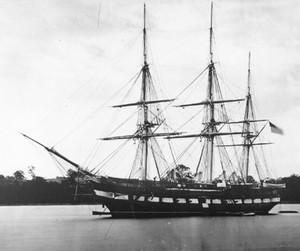
As Sir William Shakespeare so aptly put it -
"What's in a Name?"
OUR NAMESAKE
© - Tom Hyland - 8-31-08
When we were little kids in elementary school, we were taught that the Italian explorer, Christopher Columbus, sailing under the flag of Spain, discovered America, in 1492.
“In 1492, Columbus sailed the Ocean Blue “
Some of us were also taught that our country was named after an Italian explorer, Amerigo Vespucci. Notice that I said ‘our country.’ But the real fact is that, at the time, it was ‘The Americas’ - the Plural, the western hemisphere - South America, Central America, and North America - in essence, three separate and distinct areas of the globe were named after him! No small accomplishment, right?
What else were we ever taught about our Namesake? In Grammar school? In High school? In College? Can you give me one other significant fact? I couldn’t!
Because I was working on a tough crossword puzzle, and didn’t have a clue to the answer (arctic explorer William) I GOOGLED the term. When I then chose a website which provided an alphabetic listing of all historical explorers, and slowly reviewed it, old familiar names from the past were recognized. Way down almost at the bottom, there he was - Amerigo Vespucci. The following site and information therefrom is Copyrighted by the source. I trust this acknowledgement will absolve me from any wrongdoing:
LINK - http://www.infoplease.com/ce6/people/A0850759.html
OH - I did find my answer - William BAFFIN - never heard of him!
Vespucci, Amerigo
Vespucci, Amerigo (äm?r?'g? v?spOOt'ch?) [key], 1454–1512, Italian navigator in whose honor America was named, b. Florence. He entered the commercial service of the Medici and in 1492 moved to Seville.
He accompanied Alonso de Ojeda in 1499, but by agreement the two separated shortly before land was sighted in the West Indies, and Vespucci alone explored the mouths of the Amazon. Subsequently he sailed along the northern shore of South America and among the islands.
He returned to Spain in 1500, and in 1501 he entered Portuguese service to explore the southern coast of South America. Vespucci found the mouth of the Río de la Plata and probably went as far as lat. 50°S. He explored c.6,000 mi (9,700 km) of coastline, but it is in the scientific application of his discoveries that his achievements are remarkable.
He evolved a system for computing nearly exact longitude (previously determined by dead reckoning); he arrived at a figure for the earth's equatorial circumference only 50 mi (80 km) short of the correct measurement.
Vespucci accepted South America as a new continent, not part of Asia. Consequently cosmography was radically altered, and in 1507, with the publication of Martin Waldseemüller's Cosmographiae introductio, the name America first appeared as applied to the continent.
His voyage completed in 1502, Vespucci returned to Spain, where in 1508 he was made pilot major, a high and prestigious position. He died of malaria contracted on his voyages.
Vespucci's achievements were long belittled by scholars, but the conclusions of Alberto Magnaghi in the 1920s and 30s are now widely accepted, and the pilot major is given his due.
An edition of Vespucci's letters and other documents appeared in English in 1894.
See biographies by G. Arciniegas (tr. 1955) and F. J. Pohl (1966); J. B. Thacher, The Continent of America (1971).
The Columbia Electronic Encyclopedia, 6th ed. Copyright © 2007, Columbia University Press. All rights reserved.
More on Amerigo Vespucci from Infoplease:
Amerigo Vespucci - Biography of Amerigo Vespucci, The explorer after whom the Americas are named
America - America [for Amerigo Vespucci], the lands of the Western Hemisphere—North America, ...
Curaçao: History - History Visited by Alonso de Ojeda and Amerigo Vespucci in 1499, Curaçao was not settled by ...
Todos os Santos Bay - Todos os Santos Bay Todos os Santos Bay [Port.,=all-saints bay], inlet of the Atlantic Ocean, 25 mi ...
END OF CITATION -
Can you imagine how intelligent this guy was? Five Hundred years ago, he was only off by 50 miles, in estimating the Equatorial Circumference of the entire Earth! No small accomplishment!
Perhaps now, with this newfound knowledge, whenever you hear the heart-warming words of “God Bless America” - you will think not only of ‘Our Country’ but also of Our Namesake - Amerigo Vespucci.
Shouldn’t there be a VESPUCCI DAY?
© - TKH
OOPS!
Some more interesting stuff:
http://www.infoplease.com/spot/columbusfood1.html
Columbus's Unknown Legacy
How food from the Americas revolutionized Europe
by David Johnson
What would Italian cooking be without the tomato? How would Irish history have been different without the potato? What would the Swiss have done without chocolate? These and such products as tobacco, corn, cassava, and most species of bean were unknown in Europe before the voyages of Columbus. As the early explorers encountered these exotic items in the Americas, they brought them to Europe and Africa, where they eventually revolutionized eating habit
Until Columbus, the only beans known in the Old World were soybeans and some uncommon species. Other types of bean widely used today—shell, string, kidney, lima, and pea beans—were cultivated by indigenous peoples of the Americas.
Cassava, also known as manioc, this starchy root is native to the Amazon region of South America, where Indians cultivated it. As trade between Africa, Europe, and the New World blossomed, cassava gradually became a staple in parts of Africa.
The Aztecs drank a chocolate drink, which intrigued the Spanish when they arrived in Mexico around 1500. The Spaniards introduced chocolate to Europe where it quickly became an exotic luxury. In 1657 a London store began selling chocolate and started a trend. As people gathered to drink chocolate and talk, conversation clubs arose. The Cocoa Tree was the most famous. Chocolate was first manufactured in the U.S. at Milton Lower Mills outside Boston, Mass. In the 1870s the Swiss began making milk chocolate, by adding condensed milk to the formula.
What is known in the U.S. today as corn is actually maize, or was sometimes called Indian corn. In England, "corn" meant wheat, while in Scotland and Ireland it referred to oats. Indians cultivated several varieties of corn—white, yellow, red, blue, sweet corn, popcorn, and corn to make corn meal. Corn is a mixture of several types of wild grass.
From its origins among the Inca of the Andes Mountains, potato cultivation spread through wide areas of the Americas, where it was often a staple crop. The Spanish introduced it to Europe. The English first began to grow potatoes on a large scale. English settlers brought the potato with them to North America after 1600, thus reintroducing it to the New World. In Europe, the potato became a staple in many areas. Failure of the Irish potato crop in the mid-1800s prompted a massive migration to the Americas.
Early explorers reported seeing Indians smoking tobacco. By the mid-1500s, Spain and Portugal had introduced tobacco to Europe where it gradually became popular. The English began experimenting with the crop in Virginia, which remains a major tobacco producer. Tobacco use and production have circled the globe. The Middle East, Turkey, Pakistan, India, China, Russia, Indonesia, and the Philippines all produce tobacco. Cuba and Puerto Rico also grow tobacco and have become important cigar manufacturers.
The Incas and the Aztecs raised tomatoes. Officially a fruit, the tomato, sometimes called the "love apple," did not catch on at once in Europe. Many people believed tomatoes were poisonous. Around 1800, the tomato was reintroduced to the Americas when Europeans brought it to the U.S., where it is the third most common vegetable crop today.
END OF CITATION -
I found the above article totally fascinating, and hope you did also.
It seems we, as well as the rest of the world, owe a lot more to those old explorers than we ever thought about.
Peace, Tom.
|




As a sidebar: The English/Europeans WERE, actually, being poisoned by eating the tomato...on their lead dinnerware. The acid from tomato loosened the lead of dishes/plates, and was consumed. Took 'em a while to figure out it was the "lead", not the tomato that was poisoning 'em!
Blessings and Love - Micke