Another excerpt from a new essay entitled "Way of the World" included in my upcoming book of essays "on the human condition: to be published early in 2016.
THE WAY OF THE WORLD
Seeking a Unified Theory of Planet Earth
JOHN HERLIHY
If you don’t know where you are, you don’t know who you are.
—Wendell Berry
When we think of the world, our world, this world as opposed to the next world, we might ask ourselves: What does the world have to offer its inhabitants beyond the baubles and bubbles of a transient life? Is it worth the effort to construct a grand theory of the world that embraces such critical questions relating to its mystery, purpose, origin? When we leave it behind, do we leave ourselves behind with it, bare bones buried into the earth’s crust as the remnant of a life once lived and now forgotten? No doubt, there is mystery in the air when we see butterflies in flight and fire flies in the night. When we look toward the horizon from the near shore, there is magic in the distance where dolphins roam and the sea-lanes meet the grand esplanades in the sky. We have heart-felt questions that have been explored down through the centuries and are still worth exploring as long as people speculate about the hidden nature of their surroundings and wonder about the true nature of Reality.
The Qur’anic scripture freely lends its insight when it mentions the world as “nothing but play and amusement” (Qur'an 6:32) and worse a form of “pomp and mutual boasting.” (Qur'an 57:20) One verse states plainly enough: “It is the life of this world that deceives them.” (6:130) Is the world merely a venue of habitation that we take for granted, and life itself merely a rite of passage from birth to death that amounts to nothing more than a parenthetical moment in time between two eternities out of which where we were born and into which we shall return? Does the human experience of living and dying on earth only highlight the personal destiny of a short life on a slow-moving sphere, here to experience the dramatic hills and valleys of our untamed emotions? Are we investing our deepest sympathies in a vagabond world that roams through the darkness of outer space like a marble rolling aimlessly down the corridors of the universe, reflecting the moody colors of blue, green, and bone-grey from the light of the sun, borrowed light no less, that gives color to our lives? How do we lift the weight of the world from our shoulders, transforming the spirit of this world into the remarkable and infectious world of the Spirit that “hovers over the waters” of our lives in premonition and promise to an unseen reality within the shell of the physical world?
The earth is cloaked in the vestments of universal Nature, nature being none other than our beloved Earth Mother, represented across the globe through the vision of majestic mountains and serene valleys, vast oceans and tranquil lakes, undulating deserts and broad savannas, snow-clad, pine forests and tropical jungles awash in monsoon rains. Such things as a sea-shell, spider web, or butterfly wing require no genie to work their magic, all these things are complete unto themselves and serve as symbols of a Supreme Intelligence working on our behalf. “Nature is painting for us, day after day, images of infinite beauty,” writes British art critic John Ruskin (1819-1900). Unless we do the unpardonable and leave Shakespeare out of the mix, we are reminded of Nature’s magnanimous quality in touching our hearts with serenity and peace when the Bard writes in Troilus and Cressida (1602) one of his most moving and perceptive insights: “One touch of nature makes the whole world kin.”
We look upon the sublime panorama of nature as we look at pictures at an exhibition, yet in nature’s presence, as in the presence of all great art, we are as nothing, inconsequential, humbled, speechless with nothing to say that can echo the mighty roar of the oceans or the stillness of a forest glen. “Mountains are earth’s undecaying monuments,” writes Nathaniel Hawthorne in his lesser known work The Notch of the White Mountains (1868) in tribute to their enduring quality. “Nature, even when she is scant and thin outwardly, satisfies us still by the assurance of a certain generosity at the roots,” exclaims Henry David Thoreau with characteristic insight, adding “if only to suggest that the earth has higher uses than we put her to. Nature is always there in full dress seemingly ready to knock on our door, detached, serene, powerful, and yet it never stoops low enough to acknowledge us in her presence. “How strange that Nature does not knock, and yet does not intrude!” writes Emily Dickenson in a letter to a friend. It is up to us to recognize nature’s powerful message, written into the color of precious stones, the sounds of bubbling streams and the stern face of storm clouds.
In Islam, according to the Quran, universal nature is a revelation on a par with the Qur’an itself in terms of the secrets it contains within its heart. “We are surrounded and embraced by her,” Goethe writes, “powerless to separate ourselves from her and powerless to penetrate beyond her. We live in her midst and know her not. She is incessantly speaking to us, but betrays not her secret.” “In Nature’s infinite book of secrecy, a little I can read,” Shakespeare echoes in his play Antony and Cleopatra. Franz Kafka has clarified the point in this way: “Remain sitting at your table and listen. Do not even listen; simply wait. Do not even wait; be quite still and solitary. The world will freely offer itself to you to be unmasked; it has no choice, it will roll in ecstasy at your feet.” To read the book of Nature is to read the message of the traditional symbols that constitute the elements and forms of that nature. “And in the earth are signs for those whose faith is sure, and within yourselves. Can you then not see? And in the heavens is your sustenance and that which you are promised. By the Lord of Heaven and Earth, this is the Truth.” (Qur'an 51: 20-23).
A limitless range of traditional signs and symbols exist within the manifested world of nature. They confront the mind and the imagination of humanity with their revelatory knowledge of other worlds, their premonition of higher realities and their numinous message of the unity and oneness of the Supreme Being. They exist within this world as created forms that remember God through their very existence. Through their presence, they express something of the transparent reality that exists within and beyond every external form. According to the traditionalist perspective, the entire created universe is a form of revelation and a sign of the Divinity.
Dressed in the refinements of nature, can we call the planet home? The short answer must be yes, for a while at least, during a continuum of time that acts as a parenthesis between two eternities. This may sound strange since there can be only one eternity into which earthy time seems but a parenthetical expression. However, from the human point of view, it does indeed seem like we exist “in time” - in circumambulation of the earth around the sun — but a measured time that exists between two eternities, the one from which we were born and the one into which we shall return as an eternal soul. For now, the earth is familiar and dear to our hearts, our garden to nurture and hearthstone to keep afire; but when we look around we are not sure where we belong or even if we belong. There is no mystery in the march of the seasons, the phases of the moon, the predictability of the tides: seasons change, the green leaves of summer die in a blaze of color to give way to the stark bareness of trees in winter. The rhythms of the tide obey the gravitational attraction found in the mag-netism of the lunar embrace. Rain turns to snow to melting icicles to early morning dew. Rivers make valleys through mountains. We build castles into the sky. We are sojourners on a journey of return to that origin from which we have taken our leave in order to partake of the mystery and miracle of the human condition, with all of its foibles, its contradictions, its reason and logic, its beauty, its varied, sometimes troubling emotions, its intrinsic creativity and its spacious imagination, its wise perception and its illuminating vision.
“The planet itself is a sojourner in airless space, a wet ball flung across nowhere,” writes the poet and naturalist Annie Dillard in a flash of customary insight. Is there any wonder that we ourselves feel as sojourners and exiles on a planet that itself roams through the universe as though in search of a final resting place. “For we are strangers before thee, and sojourners, as were all our fathers: our days on the earth are as shadow, and there is none abiding.” (1 Chronicles 29:15) Dillard echoes these sentiments when she writes further: “We don’t know where we belong, but it doesn’t seem to be here,” For the time being, this world is our world, as hard as a marble and as playful as a bauble, as sacred as a bead on a misbaha (or rosary) and as precious as a gem-stone buried in a cavern. It is carpeted, bejeweled and crowned by a rainbow whose prism of color reveals all the hopes and aspirations of humanity through a single mirror.
The earth is oceanic, a virtual sea of blue when seen from the darkness of the heavens, inspiring the question: Who created the earth, the solar system, indeed the universe we live in and experience in the routine of our daily lives? “To Allah belongs whatsoever is in the heavens and the earth” (31:26), leading to another in a procession of countless questions: “What is the source of knowledge about our world, this world, not to mention the grand spectacle of the universe that we see around us? “And if all the trees of the earth were pens, and the sea (with the ink therein) with the seven seas behind it to add (to its supply), yet the worlds of Allah would not be exhausted” (31:27). This is the venue in which we experience the tidal surges of our destiny and write the story of our lives as though on vellum parchment with the indelible ink of God’s pen.
Why, then, do we try to contain the grandeur of the world within the thimble of our lives as a tiny treasure worth preserving when we can throw our hopes and aspirations by the bucketful into the domain of God’s eternity to see what we find there? We could set our sails across vast distances with nothing in sight but the hope of a bird or the shadow of land to beckon our forsaken desires and world-weary dreams. The earth is in the palm of our hands, no more substantial than cotton balls falling at harvest to the ground. We are standing on glass structures looking from great heights, but with the weight of the world on our shoulders. A vision of the world lays before us, in addition to the mountains, the savannahs, the forests and oceans of the world, displaying all the kingdoms of the earth arranged side by side and in rows, like checkers on a board. Lady Success wears her neon taffeta dress and the Wizard Fame rises from the pipe of the world like a smoky ghost, the wolf of avarice plays havoc in our hearts and the scarecrow of self confidence, propped up and bounded with ropes, gapes wide-eyed from a wooden stake looking for more praise to prop itself up in this world.
There was a time when we could only contemplate the neighboring planets of our solar system circling the sun like some distant cousins in faded photo-graphs we will never meet. Now with the aid of gigantic telescopes strategically placed in outer space and our modern-age ability to travel into space beyond the stratosphere, we have close-up pictures taken by adventurous space probes of all of the planets, including the fiery war-like Mars, the gas giants Jupiter (the largest planet in the solar system) and Saturn (wreathed in icy rings), the ice giants Uranus and Neptune, Mercury which according to Babylonian records was called “the jumping planet” possibly because of its erratic orbit around the sun. The Greeks called the planet Mercury “the gleaming”; in ancient China, the planet was known as “the hour star”, modern Asian countries such as Vietnam and Korea referred to it as “the water star”. Venus, our near neighbor often called earth’s twin sister, is enveloped in clouds of sulfuric acid and its surface is often described as hellish. Nor can we forget our lonely, side-kick lunar satellite, the airless moon, seen as an old man with a lumpy face from the surface of the earth. What, then, of the glorious vision of earth when viewed from the pit and galleries of the solar system. The sun rises over the horizon of the earth’s sphere in full splendor, ready to bathe the surface of the earth in flooded light. The moon, however, peeks wearily from behind the globe, in pale repose like a sickly child looking out from beneath the blankets, ready to bathe the earth in borrowed light, like a beggar with a shallow bowl. Every dip and ridge of the lunar landscape looks remote and desolate of anything we associate with the familiarity of tradition, culture, society, civilization, a lonely outpost indeed wishing to be touched by the blessing of the regal scepter of humanity.
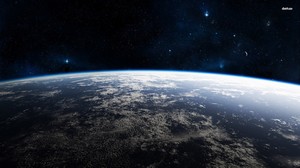
The serene image of a pale blue, cloud-covered crescent of the earth that we see in those remarkable photos from space turns majestically, imperiously, imperceptibly, in the pitch darkness of the universal night. Is there anything colder and darker than the eternal night that visits its mystery upon the earth once daily, wrapped in the folds of an enveloping velvet gloom and painted by the pale light of the moon? Is there anything more brilliant and living than the eternal day that spreads her glittering cloak across Nature’s cornucopia and around the curious heads of God’s reasoned creation? What do we see from outer space but a living planet, floating like a hand-made kite among comets and stars as though blown by a salutary wind across an ocean of darkness. There is awe and wonderment in this magnificent spectacle that becomes our awe, our wonderment from the depths of our mind down to our fingers and toes. In remembrance of the great earth-globe that we as children turned on its stand exploring the many far-flung countries with our pudgy fingers, we as adults now stand bewitched on the very orb that makes this journey across the firmament of the heavens, pretending to be a Nobel laureate and looking as big as a cathedral bell.
When we view the planet from the vantage point of nearby outer space, what do we see but a glittering marble painted in the fair colors of powder blues and bone whites in various stages of departure and return. The globe turns rhythmically and with pin-point regularity on its own axis creating the variances of night and day. The earth in turn makes its way with snail-like procession amid a grand display of celestial spheres all in circumambulation around, not a sun-star but a white light creating rhythms out of universal laws that offer a convincing proof if one be needed of a Supreme Intelligence behind the wise creation of the universe.
The vision of the earth in outer space is spellbinding indeed and leaves us weak-kneed and wobbly as the sun lifts its owl-eye from the darkness of outer space to place its flaming kiss on the burnished land. One misstep, one further tilt of the earth’s axis, one slip in the finely-tuned orbit around the sun would spell disaster to the human race and the world as we know it. For half the year, in its Keplerian gyre, the earth bears its great bulk like the bead of a necklace down a path of silence and darkness away from the sun, which is Heaven’s most essential star, until it arrives at the summer solstice in June, when the earth stands still momentarily before embarking on its return journey back to the sun and its rendezvous with the winter solstice in December.
Is this our world we wonder from this vantage point in the heavens, transported momentarily into outer space as earth-gazers from afar, as though we are alien beings from some other planet gazing down benevolently from this wondrous platform to inform our perceptions of some other world? Has the world and all its contents been transformed by an inner alchemy of its own, transmuting the dark despair of dead matter into a revelatory flame in mirror reflection of a world beyond our imagining, multi-colored and perfect in shape, wandering down the corridors of God’s eternal domain? Indeed, in its solemn solar progress, the earth pays tribute to the graciousness of the ellipse it follows around the sun rather than the perfection of the circle and in doing so acknowledges the uniqueness of its timely trajectory. Of particular interest from our perch in the heavens is the stunning lack of sound in this frictionless void. The earth moves and never stops moving, as do virtually all the celestial bodies, but while the corruptibility of the earth dictates that music becomes sound, the incorruptibility of the greater universe dictates that base sound give way to celestial music, the planets, asteroids, moons and comets being nothing more than musical instruments set in motion to soften the silence of the deep with their eternal beauty.
|







Ron