Tennis is a sport I’ve played and cherished most of my life, but even after all these years, some of its on court rituals still make me shake my head and smile. This dispatch explores a few of those quirks — the shoe tapping, the ball inspecting, the point exploding — that give tennis its own peculiar charm.
The Strange Rituals of Tennis
By John Herlihy
I have been an avid tennis fan for most of my life. I learned the game in high school, kept at it over the decades, and even sought out coaching here and there so the experience could deepen and sharpen. I’ve stayed fit enough to still play a mean game of singles at eighty‑one, and I follow the sport with the same enthusiasm I had as a teenager. I watch all the major tournaments, especially the Grand Slams — Australia, Roland Garros, Wimbledon, and the US Open — and I know the rules, the players, the rankings, and the rhythms of the sport.
But this dispatch is not about my credentials. It’s about the curious little rituals of tennis that, after all these years, still make me wonder.
The first is the emotional explosion some players have after losing a single point. A point — not a game, not a set, not the match. One point. Even with electronic line calling removing most disputes, some players still go berserk, shouting at the sky or pounding their racquets as if the universe has betrayed them. I’ve never understood it. One point is not earth‑shattering. It shouldn’t be mind‑shattering either. Yet there it is — the drama, the theatrics, the tempest in a teacup.
Then there is the clay‑court shoe‑tapping ritual. Between nearly every point, players stop, lift a foot, and smack the sole of their shoe with their racquet. Then the other foot. Tap‑tap. Tap‑tap. Over and over again. I don’t see clumps of clay falling off. I don’t even see tiny grains. But the ritual persists, as if the match depends on it. Perhaps it’s habit, perhaps superstition, perhaps a way to reset the mind. Whatever it is, it’s a lot of shoe‑bashing for very little clay. How about staying focused on the challenge of the next point in support of the mind game that tennis is.
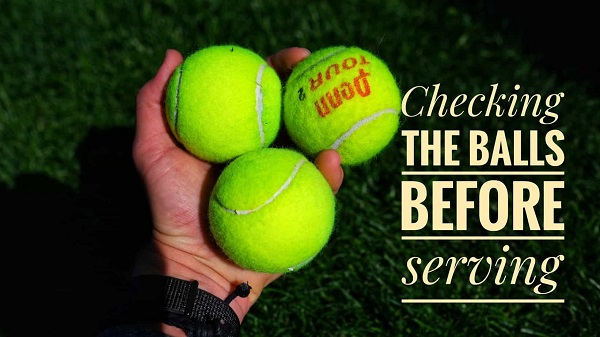
And finally, the ball inspection. This one has always amused me. The server calls for all the balls, examines each one with the seriousness of a jeweler inspecting diamonds, and then discards all but two with a flick of the wrist almost as if in contempt. These are new balls, mind you — changed regularly throughout the match to maintain consistency. What exactly are they seeing? Levels of fluff? Degrees of wear? A hint of destiny? Even if there is a difference, is it enough to alter the outcome of the point? Not likely. Presumably, winning the point comes from precision, focus, and skill — not the state of fluff on the tennis balls. Yet the ritual continues, point after point, match after match, as if the fate of the universe rests on choosing the right ball.
I play tennis. I watch tennis. I love tennis. But these little routines — the outbursts, the tapping, the ball inspection — still puzzle me. Perhaps that’s part of the charm of the sport: the blend of grace and absurdity, precision and superstition, athleticism and ritual. Tennis is a beautiful game, but it is also, at times, a mysteriously strange one that no one ever talks about.
|











THANKS FOR SHARING MY FRIEND. LOVE, BLESSINGS AND FAITH...HIS+INSPIRATIONS
Like every high level sport, those that reach the top of tennis, probably are intensely focused on every drive or return. For some, those emotional outbursts get them more attention and fame. Also, at that level, like I have seen in golf, the players may want to get rid of any little pebble of dirt that might cause them to slip. And it could be a habit, like so many in sports. There's probably a lot of superstition about which ball is going to work in one's favor. Again, the high level makes people do eccentric things as though they were normal.
I find most sports like tennis to be rather boring to watch, probably because I didn't play the game and understand the difficulty. However, I did play ping-pong and understand the same kind of difficulty trying to catch up with where the ball is going to return it.
Ron