Right whales were so named by early whalers because they were the "right" whale to kill — they are slow swimmers, and were therefore, easily caught, floated when dead, and produced large quantities of oil and baleen.
Consequently, right whales were decimated decades ago by the world’s whaling industries, and little hope is seen for a recovery.
By the 1860s, Right Whale numbers were so severely depleted that whalers could no longer hunt them profitably.
From an estimated world population of over 100,000 Right Whales, many scientists believe that only a little over 1,000 remain in the world’s oceans, with about 100 constituting the North Atlantic population.
Right Whales are slow, lumbering, gigantic skimmer-feeders. They feed by skimming through concentrations of krill.
And for such gigantic animals, they are surprisingly acrobatic and may be seen waving their flippers above the surface, breaching, lob-tailing, and flipper-slapping.
Southern Right Whales will also ‘head-stand,’ waving their flukes high in the air for up to 2 minutes. They sometimes raise their flukes at right angles to the wind and use them as sails. This allows them to be blown along through the water and appears to be a type of play as they will often swim back and do it again.
Right whales also produce a variety of fascinating vocal sounds as well as percussive sounds of breaching, flipper slapping, and tail slapping.
A distinctive clacking sound has been described for these whales as they feed at the surface. Termed the ‘baleen rattle,’ this sound is produced by small wavelets rattling the baleen plates when they are partially held out of water.
Right Whale sounds appear to differ with changing behavior and, thus, may be important in communication. As with other baleen whales, Right Whales probably do not echo-locate.
They spend spring, summer, and autumn at high latitude feeding grounds and migrate to more southerly, warmer waters in winter for mating and calving. Northern and southern populations do not interbreed due to asynchronous seasons between the hemispheres.
Right Whales migrate to warmer temperate waters to give birth and mate. They also teach their young how to swim in the warm sheltered waters.
The new-born calves have virtually no blubber to insulate them from the cold. They are fattened on rich whale milk which has a 40% fat content. This produces spectacular results, and whale calves may double their weight within a week. However, there is no food in these warmer waters for the mothers, who must fast while they raise their young.
Most births occur in early winter, after which the adults begin their courtship displays of breaching, tail splashing, jostling and caressing.
Calves stay close to their mothers, suckling for a year or less and playing together. Calves learn skills they need to survive in one of our planet's few remaining great wilderness areas, the Ocean.
All Right whales are protected internationally under the convention for the regulation of whaling, and have not been actively hunted since 1935.
Today, these remaining animals can be found swimming near large Atlantic ports, where they often become entangled in fishing nets and drown; and sadly, they often collide with ships. In these collisions, the whales never win.
Right Whales are listed as Endangered today.
The Right Whale may never recover, and it may already be doomed to extinction.
Order Cetacia: Family Balaenidae: Eubalaena glacialis Borowski
Another of our extremely fascinating nonhuman earthly neighbors that faces an extremely grim future, by the hands of man.
The Right Whale, Trapped in The Wrong Time


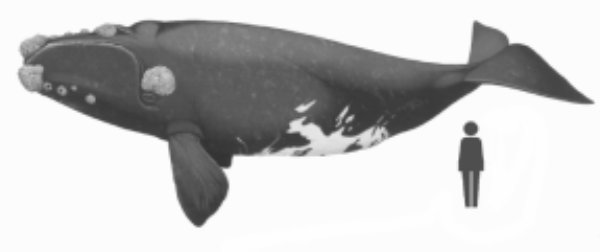




















Pic a little tooo "Whalesize" Methins...lol!!
Love Tinky