Leatherback Turtles have traveled the seven seas for over 100 million years.
One of the world’s oldest living species, they are true survivors, finding ways to triumph – even when the dinosaurs could not.
Species: (Dermochelys Coriacea)
Dermochelys, loosely translated, means ‘skin-covered turtle,’ coriacea means leather-like, hence the common name of the leatherback turtle.
It is the largest of all turtles, and the leatherback, can weigh almost 2,000 pounds and reach a length of more than 8 feet.
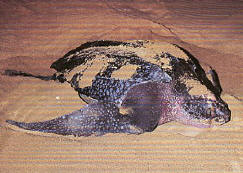
Its shell lacks the scales or shields of other turtles and is covered by a firm, leathery skin, with seven ridges or keels running lengthwise along the back. Color is usually black with white blotches. The carapace is an elongate oval, somewhat pointed toward the rear.
The endangered leatherback turtle is the largest and most active of earth’s sea turtles. They travel thousands of miles. They have been sighted near Labrador in the Atlantic, and Siberia in the Pacific
And they can dive thousands of feet deep. A leatherback fitted with a time-depth recorder made a dive of more than 3,300 feet off the Virgin Islands.
The leatherback is truly the Champion of all Sea Turtles.
It grows the largest, dives the deepest, and travels the farthest. The largest leatherback ever recorded was almost 10 feet long from the tip of its beak to the tip of its tail, and weighed in at 2,019 pounds.
Leatherbacks approach coastal waters only during breeding season. Nesting occurs throughout the Caribbean, on the northern coast of South America, the Pacific Coast of Central America, and on the east coast of Florida.
Nesting season runs from March through July. Leatherbacks nest every 2 to 3 years, laying 6 to 9 egg clutches in a nesting season. Each clutch contains approximately 80 fertilized eggs the size of billiard balls and 30 smaller, unfertilized eggs. There is an average of 10 days between nestings. The eggs incubate for approximately 65 days.
A truly fascinating creature, yet, after millions of years of survival, these gentle sea giants now face threats which they may never overcome – wiping them from the face of the planet – forever.
The Pacific Leatherback Turtle may sadly become extinct within the next two decades.
Estimated number of nesting female leatherbacks in the eastern Pacific:
1980: 90,000
2004: 3,000
And leatherbacks in the other oceans are not far behind.
Sadly, the threats all marine turtles face today have been brought on by callous human behavior, much of it illegal, and much of it preventable:
- Egg Hunting and Poaching
- Destruction of Nesting Beaches
- Entanglement in Fishing Gear
- Litter and Debris
- Ocean Warming
Please do your small part to save them by:
- Reporting egg poaching and destruction
- Keeping our beaches clean
- Picking up your garbage
- Never disposing your fishing gear in or near the ocean
It will be a terrible tragedy if we just sit by and watch the destruction of yet another wonderful earthly neighbor and an utterly fascinating nonhuman species.






















Thank you for sharing this!
Love, Sheila
Really very interesting to learn more about nature via your pen!!
Than you Prof! Ortsok...lol!!
No joking this is great...really great!!
Love Tinka