The gray wolf, which once ranged all across the United States in the hundreds of thousands, now numbers only an estimated 3,700 individuals who dwell in only a few regions.
Yet the U.S. government apparently believes these numbers are strong enough to merit a reduction of federal protection, despite the objections of many conservationists who say wolves still face many threats to their long-term survival.
On March 18th, the Department of the Interior issued the much-anticipated ‘Final Rule,’ which down lists most gray wolves in the lower 48 states from endangered to threatened under the Endangered Species Act.
On the same day, officials from the U.S. Fish and Wildlife Service told conservationists that the agency is already making plans to remove federal protections entirely for gray wolves in two major geographical areas.
These ‘delisting’ plans, which could be implemented within the next year, will leave most wolves bereft of federal protection - again. And their continued survival will be in the hands of individual states, the same states that have shown these animals very little mercy.
A Brief History
The gray wolf (Canis Lupus) and the red wolf (Canis Rufus) once ranged throughout the United States, in numbers thought to be near 400,000 for the two species combined.
Think about that number for a moment: 400,000.
But from the moment European settlers first stepped foot on North America, they began large-scale eradication efforts. Federally funded eradication programs, which lasted through the mid-1900s, employed bounties, poisons, trapping, and aerial shootings.
They succeeded in extirpating wolves from all of the lower 48 states except Minnesota, where a tiny remnant population sought refuge in the great northwoods.
The gray wolf finally earned protection under the Endangered Species Act in 1974, but those protections have constantly been under attack by livestock and hunting interests. The protections, though undermined by illegal killings and continued habitat loss, have allowed wolves gradually to make their way back to parts of Wisconsin and Michigan.
Reintroduction projects have also allowed the gray wolf to begin recovery in the west and southwest.
Approximately 3,700 wolves, 2,400 of them in Minnesota, are now known to live in the contiguous 48 states, and most of the wolves outside of Minnesota exist in small, isolated populations, surrounded by lands where wolves are certainly not welcome.
What's more, the habitat that gray wolves now occupy represents only a small fraction of their historical habitat.
Substantially more suitable habitat is available in unpopulated regions of the United States where wolves have not yet naturally re-colonized and where no plans for reintroduction exist.
Gray wolf populations are currently found in Minnesota, Wisconsin, Michigan, Montana, Idaho, and Wyoming. Wolves from these states have also made short-lived forays into neighboring states such as Oregon, Washington, Utah, and North Dakota.
Until March 18th, gray wolves were listed under the Endangered Species Act as threatened in Minnesota and endangered in the remaining lower 48 states.
In places where they have been reintroduced (such as Yellowstone National Park and central Idaho), wolves were (and still are) classified as ‘experimental, non-essential,’ a designation that allows for more relaxed management, which translates into more killing.
One of the many gray wolf subspecies, the Mexican gray wolf (Canis Lupus Baileyi), or ‘Lobo,’ has been reintroduced in eastern Arizona and allowed to disperse into New Mexico.
There are only about 200 Mexican gray wolves left, most of them in captive breeding programs. Of the 34 Mexican gray wolves released since 1998, only 22 are still free-ranging. Five have been shot, one disappeared, one was hit by a vehicle, and five were returned to captivity.
One of my author friends in Arizona, Penny Porter, wrote a marvelous story about a wounded Mexican gray wolf that her daughter found dying on their ranch. Her compassionate daughter demanded that the wolf be saved. He was saved, and he became her constant companion for many years, even diligently walking her to her school bus stop each morning, and valiantly waiting at the bus stop for her return. She affectionately named him ‘Ralph.’
Surely, in the vastness of North America, room can be, and should be found, for these extremely intriguing, and extremely intelligent creatures.
But it appears that sad days have truly returned once again for the beleaguered wolf.
I’ve been fortunate enough to hear the gray wolf howling in my beloved north woods; and I truly believe his howls these days are truly sad ones.






















(((HUGS))) and much love, your friend in tx., karen lynn. :( >tears < for the wolf
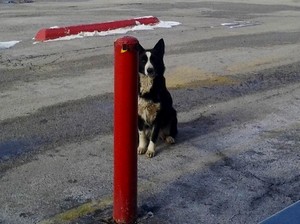
To me the wolf is one of the most gorgeous animals...reminds me of my dog "Killer" they just have the "look"!!
Love Tinka