Photos Courtesy of the Exxon Valdez Oil Spill Trustee Council
Right now, in March 2005, the stage is set for a battle over the future of numerous species of wildlife and numerous designated wildlife refuges throughout the United States, including currently unmolested wildlife refuges that are desperately needed for migratory birds.
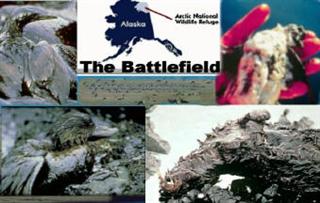
The battlefield is the 1.5 million acre Alaskan Coastal Plain - the biological heart of the federally designated and protected Arctic National Wildlife Refuge (ANWR).
Oil companies and pro oil legislators want to weave a vast spider web of wells, pipelines, and crude oil processing plants all across this pristine wilderness sanctuary, which is used by hundreds of wildlife species, including millions of migrating birds.
Recently, more than 1,000 leading U.S. and Canadian scientists called on President Bush to protect the Arctic National Wildlife Refuge from oil drilling. In a letter to the President, these scientists questioned assertions that oil could be safely extracted from the Refuge without harming wildlife, and they urged President Bush to "support permanent protection of the coastal plain's significant wildlife and wilderness values."
And many of us remember all too vividly the disastrous consequences of the massive Exxon Valdez oil spill off the coast of Alaska in 1989.
Partly because of this devastating oil spill, lobbyists for the ‘Big Oil’ interests and their Congressional allies have repeatedly failed over the years to get Arctic National Wildlife Refuge oil drilling proposals approved through Congress.
But, they simply won't take ‘NO’ for an answer:
So, they are presently cleverly attempting to slip an Arctic National Wildlife Refuge Oil Drilling Proposal into the 2006 federal budget bill - which isn’t subject to a filibuster, and which only needs 51 votes to pass instead of 60 - and where it won’t have any chance at all of being fully and fairly debated - out in the open - as it should be – and as it always has been.
Supporters of drilling and pumping the refuge's oil believe they have the 51 votes needed to get the measure through as part of this current budget process. Opponents aren't ready to concede that, although they remain certain that pro refuge oil drilling legislators still don't have the 60 votes needed to overcome a certain filibuster by opponents if ANWR drilling is considered in separate legislation once again – as it certainly should be.
This cleverly drafted budget proposal amounts to a gross and callous sneak attack against both our nonhuman neighbors – and we U.S. citizens - in the name of so called ‘progress’ and big business concerns.
Even the plan's most optimistic backers agree that any oil extracted from the Arctic Refuge would meet only a tiny fraction of America's future oil needs.
And although drilling in ANWR would provide huge profits for oil companies, most also agree that it would have absolutely no effect on current gasoline prices, and hardly any effect at all on this country's enormous foreign oil dependence.
A 1998 study by the U.S. Geological Survey estimated that the Arctic Refuge at best might hold 10.4 billion barrels of recoverable oil.
The world currently uses roughly 75-80 million barrels of crude oil per day, of which the United States greedily consumes about 20 million barrels per day, or roughly one-quarter of the daily global consumption, and 58 percent of this oil has to be imported.
At 42 gallons per barrel, every man, woman, and child in the U.S., on average, consumes nearly three gallons of crude oil every single day of their lives. And that amount is steadily increasing with time.
According to the Energy Information Administration, the United States will have to import 63 percent of its oil in 2015 at estimated rates of ever increasing consumption. If drilling in ANWR is now allowed, 62 percent of America's oil needs will still have to be met through foreign imports by 2015.
And if these statistics are correct, this one percent oil advantage surely would not enhance Homeland Security, as many of the Arctic refuge pro drilling advocates also now claim.
Then why are Arctic drilling proponents so adamant to get this proposal passed with only such a miniscule oil advantage?
"If you can't do ANWR," recently confided an oil industry lobbyist, "you'll never be able to drill in the really promising areas in the U.S."
“And if they are allowed to go into ANWR, where will they want to go next? Big Sur? Olympic National Forest? Puget Sound?" asks the Alaska Wilderness League, a group adamantly opposed to drilling in ANWR.
House Majority Leader Tom DeLay and several other Pro Arctic Refuge Drilling Congressmen also believe that the Arctic National Wildlife Refuge is ‘symbolic’ of this much larger oil drilling battle.
They believe that if they can successfully win approval to drill the Arctic Refuge, even for a mere one percent advantage in our severe oil shortage, they will soon be able to get approval for both the drilling of oil and the harvesting of remaining forest areas – anywhere in the U.S. – including ‘similarly sensitive areas’ – meaning any other currently designated federal wildlife refuges, and, of course, drilling for oil off the coasts of both California and Florida, which until now have both also been blocked in Congress.
But the majority of the American public strongly disagrees with these blatant anti-wildlife, anti-nature, pro business budget maneuvers.
A bipartisan national survey recently found that by a margin of 53 percent to 35 percent, American citizens oppose any proposals to drill for oil in the Arctic National Wildlife Refuge.
And in a finding that is particularly relevant in the current debate over the ANWR, an overwhelming majority – 73 percent vs. 18 percent – agreed with a statement that the issue of drilling in the Arctic Refuge is “much too important to the American public and to future generations of Americans to be snuck through in the budget process,” and vehemently disagreed with drilling proponents’ arguments in favor of allowing drilling as part of this new federal budget.
“DON'T DRILL IN THE ARCTIC REFUGE IS THE MESSAGE FROM WE THE PEOPLE” – BUT IF THIS 2006 BUDGET PROPOSAL PASSES, WE AMERICAN CITIZENS WILL HAVE ABSOLUTELY NO SAY IN THIS MATTER.
Instead of potentially severely damaging our remaining wilderness areas for what appears to be very little return, perhaps our leaders should be diligently working on solutions to develop efficient alternative sustainable sources of energy other than our quickly depleting fossil fuels.
In addition, raising fuel efficiency standards for oil driven vehicles and encouraging energy conservation would do far more to reduce American dependence on foreign oil than would drilling in ANWR.
Please help save both this pristine wilderness area and the precious and varied wildlife species that have relied on Alaska's coastal plain for countless centuries, including:
180 species of birds from six continents and 45 species of land and marine mammals, ranging from the pygmy shrew to the bowhead whale. Best known are the polar, grizzly, and black bear; the timber wolf; wolverine; Dall sheep; moose; musk oxen; and the animal that has come to symbolize the area's true pristine wildness, the free-roaming caribou herds that rely on this wilderness area as their essential calving grounds.
To the Gwich’in Indians of Alaska, the Arctic National Wildlife Refuge is known as the ‘sacred place where life began.’
To a vast number of nature lovers in America, ANWR is known as ‘one of the few truly pristine wilderness areas left in this country.’
If you are a nature lover, or if this ‘under the table’ method of legislation over such an important national issue concerns you, please contact your legislators immediately to vehemently oppose this extremely callous sneak attack, and to urge them to oppose this budget proposal - because in reality, if it passes, this could truly be the beginning of the end for many of our remaining wildlife refuges in the U.S. – and there are far too few of them now.
Senate floor action on the ANWR provision of this new federal budget is very likely to occur before the Congressional Easter recess on March 19th.
Many Americans believe that this is not the legacy we should be leaving to future generations of nature and animal lovers – or to ourselves or to our children.
And the vast majority of Americans believe that this is definitely not the way our elected officials should be legislating such an important national issue.
In his Healthy Forest Initiative speech on May 20, 2003, President Bush proclaimed,
"We must fulfill our promise to the next generation, that's what we must do, and leave behind a world as blessed and beautiful as the one our parents left us."
Please find it in your heart and soul to help insure that our current leaders keep this solemn pledge – NOW – BEFORE IT’S MUCH TOO LATE.


















Niki Collins-Queen
i may be in alaska next year (june, on a cruise) if things go well with our taxes...stay tuned...it would be a dream come true for both of us! :)
(((HUGS))) and much love, your friend in tx., karen lynn. :)
I was truly upset about UT lands! No Drilling!! NO oil from there!! or any national park/refuge or world parks/refuges either!!. Leave the lands alone! Let the Life Live!!!! They need not destroy and kill any more than they have and are already! for their sick and twisted love of money. Bunk. No No NO!!!!!
Thank You Ed! Thank You Very Much!
Love Tracey xooxox
we can and will conserve! We know how and will! We don't need that oil!
put this on google news here. get more voices heard there in behalf of those who cannot speak for themselves!
I'll print this out and post it around town. Thank You Ed!
You can be sure that my Washington reps will hear from me TODAY! I go now to send the necessary and very pointed, angry emails. I also will be sending emails to people in other states... there are many Democrats who welcome the voices of Americans everywhere... Joe Biden, for one.
I heard you weeping, my friend... I ache too. katy xox
Love Tinka
What next? An asphalt parking lot? Soon there will be no more pristine places period ... thanks for this eye-opener - outstanding!!
Best to you,
Robert