U.S. immigration seems to be the ‘hot topic’ these days, and many now want to erect gigantic fences at our borders, extradite millions of our immigrants, make them felons, and stop any further immigration to this country.
And all of this, in a nation truly built by the blood, sweat, and tears of millions of immigrants from nations all across the globe. My ancestors happened to be among them. And my dear departed grandmother, who fled here from a very depressed life in Europe, never learned to speak English very well. But she was as proud as anyone ever born here on U.S. soil, to be ‘an American.’
And I believe that a trip back through U.S. history might be extremely useful in this current debate. Many of our nation’s historical events are very often perceived and interpreted in extremely different ways.
In the mid 1800s, the present state of Texas legally belonged to the newly sovereign nation of Mexico; but many of the new Anglo residents of Texas wanted to revolt against Mexican authority; and they passionately wanted Texas to become part of the United States.
And many of our political leaders at the time were very eager to help them in this revolt against the legal land owners, since a war with Mexico might finally fulfill the U.S. dream and declared doctrine of ‘Manifest Destiny,’ which very bluntly advocated the widely perceived ‘God-given, Divine right’ of the United States to establish a nation that literally spanned from ‘sea to shining sea.’
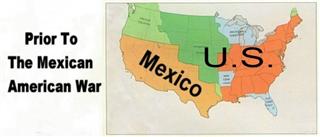
Prior to this period in American history, all the land from present day California to Texas legally belonged to Mexico; and the people who occupied these lands were considered to be Mexican citizens.
So our extremely convenient political solution to this epic problem of eagerly wanting to expand our borders from coast to coast was to invade Mexico, and to confiscate almost half of that nation’s land for our own use.
Hence, what we now know as the states of California, Nevada, Utah, Arizona, Colorado, New Mexico, and, of course, Texas, all now became part of the good old U.S. of A.
Today, many U.S. citizens demanding that America's immigrants are versed in U.S. history in order to gain citizenship here very often want to overlook this perplexing U.S. historical fact.
Many also insist that all new American immigrants must speak fluid English, also wanting to overlook the fact that when we mention virtually all of the states in the western part of the United States, along with a vast number of our western cities and historical landmarks, like it or not, we are all speaking fluent Spanish, not fluent English.
These places didn't get their names from our citizens, or even from our often extremely pompous politicians. These places now located within America’s borders got their names, and the very foundations of their ancient culture, from the citizens of the country directly to our south that used to occupy and own them before we greedily took them away.
If we hadn’t invaded Mexico in the 1840s, and if we hadn’t forcefully taken so much of their territory away from them, the thousands of immigrant workers picking lettuce in Arizona today for $7.00 per hour would probably be picking Mexican lettuce, not American lettuce.
I believe that knowing our U.S. history does matter, for both our current citizens, and for our immigrants; but our history also records that the new state of California's initial constitution after the Mexican American War explicitly declared the language rights for its newly adopted American citizens as such:
'All laws, decrees, regulations, and provisions emanating from any of the three supreme powers of this state, which from their nature require publication, shall be published in both English and Spanish.'
Evidently, the state of California at least started out as a place in the American union with a mind toward respecting the equality, the empowerment, and the dignity of the truly diverse heritage of its residents.
I also have to wonder if Mexico had erected a gigantic wooden fence surrounding and protecting its borders in the mid 1800s – would we have respected their rights and stayed out? Somehow, I sincerely doubt it, especially with our nation’s perceived ‘God-given divine right’ of expansion at any cost.
And depending on one’s perspective, we could all actually be considered illegal immigrants since we forcefully took most of North America away from the indigenous Native Americans who actually lived here first, and a massive chunk of it away from the independent republic of Mexico.
I truly doubt if any of us were then versed in either Native American or Mexican history; and the majority of us surely didn’t speak their languages or hold any entry passports to their lands.
Perhaps the easiest solution today would be to apologize to both the Native Americans and the Mexicans and to give them back their land – but then where would we all go? Who would take all of us in? And would they make us pass a history and language test to reside there? I truly wonder.
While researching this article, I also came across the following statements on the official United States Department of State website. I was quite surprised to see these words posted there, but their frankness is quite refreshing.
“The Mexican-American War (1846-1848) was fought primarily to enable the United States to expand at the expense of Mexico. Texas became the focal point of hostilities between an expansionist United States and a recently independent Mexico. Increasingly dominated by white immigrants from the United States, Texas gained independence from Mexico in 1836. This short-lived Texas republic sought U.S. protection against Mexico and possible interference from the British or other European powers.
At the urging of President James K. Polk, Congress approved the annexation of Texas on March 1, 1845. Polk also sent representatives to Mexico to negotiate the purchase of what are today New Mexico and California, but the Mexicans refused and both sides sent troops to the Texas-Mexico border.
U.S. forces, led by future President Zachary Taylor, provoked an incident with the Mexican army, and Polk quickly obtained a declaration of war from Congress on May 13, 1846.
This conflict had several long-term results:
First, it largely completed the continental republic; other than the Gadsden Purchase in 1854, the borders of what would become the lower 48 states were set in 1848.
Second, the war spawned a legacy of antagonism between the United States and Mexico that exists even today.
Third, through the protests of Henry David Thoreau (of Walden Pond fame) and others, the conflict with Mexico sparked one of the early anti-war movements in the United States.”
As both our politicians and our citizens now get back to wrangling and arguing over what current U.S. immigration policies should be, perhaps it would be beneficial for all of us to keep in mind our nation’s often contradictory, often conflict-riddled, and often multi-sided history.
©2006, Ed Kostro






















BTW. They're going to build a boarder wall along america/mexico. But they need to find illegal immigrants to do it...
California and Arizona etc, were purchased from Mexico.
I keep hearing about America being an immigrant nation and it is repeated by people who haven't a clue to their own histroy. Everyone born here is considered a native, not an immigrant, even though they may have had ancestors that were legal immigrants.
Illegal trespassers are called "illegal aliens" not "illegal immigrants". And 13 million of the little bastards is too many sucking the life out of this country. Every "legal" citizen in this country forks ove $11,000 a year in taxes and other costs to support these whining criminals. Then they marry and breed, as if we are supposed to give them another free ride. Now they want to change our laws.
No thank you. Millions of legal immigrants did it the right way. It isn't asking too much or a hardship for the illegals to do so either.
Take care,
Sherry
a guy who does his homework!
got to respect that!
Good Ed! You deserve a ..........co........ffee.
got ya
anita :)
Thanks for putting the historical perspective to this current " hot " debate..
Peter
B&R