AuthorsDen.com  Join | Login 

 
Where Authors and Readers come together!

Authors | Books | Audiobooks | eBooks | Signed Bookstore | Stories | Articles | Poetry | Blogs | News | Events | Reviews | Videos | Success | Gold Members | Testimonials

Featured Authors:  RickthePoetWarrior, iJennifer Miller, iR.E.E.S Blogs Linda Smith, Publisher, iMaryAngela Nangini PhD, iCharles Keller, iM. R. Mathias, iCynth'ya Reed, i Armand, iPamela Wiedenbeck, iBethany Peterson, i

  Home > Science > Articles
Popular: Books, Stories, Articles, Poetry      Authors: A B C D E F G H I J K L M N O P Q R S T U V W X Y Z     

Mr. Ed

 Follow Me  

· 1,830 titles
· 27,251 Reviews
· Share with Friends!
· Save to My Library
·
Member Since: Apr, 2003

   Sitemap
   My Blog
   Success Story
   Contact Author
   Read Reviews


Books
· My Dog Is My Hero

· Where The Redwing Sings

· Mystery of Madera Canyon

· Cemetery Island

· Gold River Canyon

· Curious Creatures - Wondrous Waifs, My Life with Animals


Short Stories
· Lullabies and Legends of The Loon

· Build It, And They Will Come

· The Dog On The Run

· The Cat Who Came For Christmas

· The 4th of July Kittens

· The Dog At The Drive-Thru Window

· Home For The Holidays

· Two Bonded Street Orphans, In From The Cold

· A Survivor's Tale

· Pigs, Turtles, and Bugs!


Articles
· In Memory of My Little Flower

· The Joys of Relocating With Lots of Cats and Dogs

· The Month of June is 'Adopt A Cat Month'

· The Good, The Bad, and The Ugly In Today's Pet World

· The Easter Skunk

· February is Spay and Neuter Awareness Month

· Stand Up For Senior Pets

· Hurricane Katrina - My Journey Back In Time

· Very Sadly, Not Much Has Changed In The Last Ten Years

· I Am a Dog, Not a Thing


Poetry
· Yet Another 'Holiday of Terror' for Them

· Wildwood at Sunrise

· Ode To My Cat Woman

· They Always Listen To Their Hearts

· Me and My Shadow(s)

· It's 'Be Kind To Animals Week'

· Where The Redwing Sings

· Robin's Return

· All Kinds Of Dogs

· The Midnight Raid On Donuts

         More poetry...
News
· Chicken Soup for the Soul: Loving Our Dogs

· The Daily Mews

· Where The Redwing Sings

· Another Review For Curious Creatures-Wondrous Waifs

· Recipient of the 2006 Merial Human-Animal Bond Award

· International Writing Award

· My Animal Book Wins an Award

Mr. Ed, click here to update your web pages on AuthorsDen.

Books by
Mr. Ed


See all Books
by Mr. Ed


Oceanic Dead Zones Are Increasing
by Mr. Ed
Last edited: Friday, August 15, 2008
Posted: Friday, August 15, 2008


And Many Still Don't Believe We're Killing Our Planet


“It’s getting to be a problem of such magnitude,

That it is starting to affect the resources

That we pull out of the sea, to feed ourselves.

We could end up with no crabs, no shrimp, no fish.”


Professor Robert J. Diaz,

The Virginia Institute of Marine Science


There are now more than 400 oceanic Dead Zones around the world, twice the number the United Nations reported just two years ago.


Earth’s oceans are being starved of oxygen at such an alarming rate today, researchers are now reporting, that vast stretches of water along Earth’s seafloors are already to the point that they can barely sustain life.


And the main culprits, these scientists say, are nitrogen-rich nutrients from our crop fertilizers and our human sewage that spills into Earth’s coastal waters by way of our rivers and streams.


In a new study to be published today in the Journal Science, researchers say that the number of oceanic Dead Zones around the world has doubled about every 10 years, since the 1960s. At the same time, deadly Dead Zones along our coastlines have also been growing in size and intensity.


But the good old U.S.A. still holds the record for the largest oceanic Dead Zone in the world.


This summer, because of severe flooding in the Midwest, the Dead Zone in the Gulf of Mexico got even larger, and it now covers a swath of ocean the size of Massachusetts.  This Dead Zone has horrifically more than doubled in size in the last 20 years.


 “What’s happened in the last 40 to 50 years is that human activity has made our water quality conditions much worse,” says Robert J. Diaz, the study’s lead author and a professor at the Virginia Institute of Marine Science at the College of William and Mary.


“Dead Zones tend to occur in areas that are historically our prime fishing grounds.”


And these horrific Dead Zones now represent a significant portion of the ocean waters that support our many commercial fish and shellfish species.


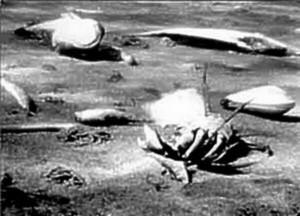
Extremely low oxygen levels are now wiping out fish and crustaceans from bottom waters in places like the Gulf of Mexico, Chesapeake Bay, and the Baltic Sea, leaving little life left other than microbes.


“There are extremely large areas in the Gulf of Mexico where you can’t catch a single shrimp today,” says Nancy Rabalais, executive director of the Louisiana Universities Marine Consortium. Dr. Rabalais has studied the gigantic Dead Zone there for more than two decades. “It’s sort of a losing battle.”


In recent years, Earth’s oceanic Dead Zones have also increased in places like coastal China and the Kattegat Sea, where the Norway lobster fishery has already collapsed. Dead Zones have also cropped up off the coast of South Carolina and in the Pacific Northwest.


Nitrogen from agricultural runoff and human sewage stimulates the growth of photosynthetic plankton on the surface of our coastal waters, and as these organisms decay and sink to the bottom, they are decomposed by microbes that consume large amounts of dissolved oxygen.


And marine life that lives at the bottom of Earth’s coastal oceans will not survive, if these oxygen levels continue to drop.


“The overwhelming response of these organisms in our coastal areas is to migrate, or to die,” Dr. Diaz said. “To adapt to low oxygen water, it has to be a part of your evolutionary history — it’s not something that you can develop in a 40 or 50 year time period.”

And over time, these Dead Zones can permanently kill off entire marine species.


They have already prevented the re-bound of species under protection after over-fishing, like in the Baltic Sea. Cod eggs rely on a delicate balance of oxygen content, salinity, water density, and temperature, to survive.


Many now believe that we’re already experiencing a similar problem with our Pacific salmon.


Low oxygen levels also kill off annelids and other sources of food for Earth’s fish and crustaceans. In Chesapeake Bay, Dr. Diaz estimates that Dead Zones already prevent the production of 75,000 metric tons of fish food.


The marine life lost each year to our enormous Dead Zone in the Gulf of Mexico would supply about 75 percent of the brown shrimp catch with food for a year. In the Baltic Sea, the Dead Zones lead to the loss of about 1.3 million metric tons of fish food each year.


“Once they occur, they are very hard to reverse,” says Donald F. Boesch, President of the University of Maryland’s Center for Environmental Science. “They have major consequences for the ability of fish populations to renew themselves.”


Dr. Boesch, who was not affiliated with this particular study, says that “the global proliferation” of oceanic Dead Zones, once mainly a problem of only the developed world, has been fueled by modern day industrialization, by our changing eating habits, and by human population growth, which has led to more and more fertilizer usage, and much more waste being dumped into the world’s oceanic watersheds.


I truly wonder what the skeptics and the nay-sayers think our very own grandchildren are going to have left to eat one day, when all of the ocean waters on this planet that we call home - are Dead.

And if you still think this is all just science fiction, talk to some folks who are still trying to make a living from fishing these days.


Want to review or comment on this article?


Need a FREE Reader Membership?

Reviewed by m j hollingshead
Reviewed on September 21, 2008
we humans do tend toward stupid at times

Reviewed by Alexandra Midnight (Reader)
Reviewed on August 16, 2008
And people do say that we're not killing this planet. I cant believe people are saying that. The fact that so many species have become extinct in the last four years and so many are near extinction shows how poorly Earth is cared for. The fact that oceanic dead zones have doubled in the last two years is also a clear sign. If only people would open their eyes.

Reviewed by Edwin Larson
Reviewed on August 15, 2008
As an avid Scuba Diver I have witnessed the degradation of costal reef systems around the world. While Europe and the US may legislate reduced toxins, it is highly unlikely that China and myriad emerging third-world countries give a sh*t. Consumption = Waste and there is no easy answer. Education is the best tool it seems.


Good write.


Edwin

Reviewed on August 15, 2008
I said most what I had to say on your wright whale review, I just want to add, that the Mayan Calendar is probably (wright), too!
Remember the story of Noah, nobody listened their either, this time it'll be fire instead of flood, there will be one big thunder bolt coming from the sky, I hope my little critters will survive, like the marmot did the last time, and only a handful of our type, It will take them another million or so years to screw everthing up again. Blessings! Jasmin Horst

Reviewed by Gwen Dickerson
Reviewed on August 15, 2008
Thanks, Ed, for this sad, but valuable and informative article! In the name of greed, profit and power by big business, and by neglect and ignorance by the average person, we are steadily destroying our future and planet. I dare say, everything's coming to a horrid end very soon.

Reviewed by Jeanette Foresta
Reviewed on August 15, 2008
There is a scientist/professor James McCanney www.jmccanneyscience.com, he bought up all the original corn seeds that he could find, and is distributing it out to farmers. He located some the last remaining corn seeds, the kind you would have had on the farm in the 1940's and has been distributing it throughout the world. That is his latest project.


New Articles by Mr. Ed
article Image
She Was Truly Special
In Memory of My Little Flower
article Image
I've Been 'Off Line' For About A Year Now, and This Article Explains Why
The Joys of Relocating With Lots of Cats and Dogs
article Image
The Perfect Time To Adopt A Cat
The Month of June is 'Adopt A Cat Month'
article Image
And Very Sadly, The Bad and The Ugly Far Outweigh The Good Today
The Good, The Bad, and The Ugly In Today's Pet World
article Image
Miracles Do Happen
The Easter Skunk
article Image
But So Very Sadly For Pets, Not Very Many Seem To Care
February is Spay and Neuter Awareness Month
article Image
Save A Senior's Life
Stand Up For Senior Pets
article Image
A Journey Well Worth Taking
Hurricane Katrina - My Journey Back In Time
article Image
The Pets of America Deserve Far Better, From All of Us
Very Sadly, Not Much Has Changed In The Last Ten Years
article Image
If We Were Only As Loyal to Dogs, As They are To Us:
I Am a Dog, Not a Thing
article Image
My latest rescue story posted on the Care2 Animal Welfare Website
Ghost Dog Rescued From Hot Dog Stand
article Image
Help Save A Life, This Holiday Season
The 2014 Home 4 The Holidays Campaign
article Image
One Vet's Mission To Do So
Saving Our Canine Vets, This Veterans Day
article Image
They Are Unjustly Vilified Today
National Pit Bull Awareness Day
article Image
This is Their Second Worst Holiday
Keep Your Pets Safe This Halloween
article Image
Please Help Save A Dog's Life This Month
October is 'Adopt-A-Dog' Month
article Image
Don't Let Your Pet Become Its Next Victim
Pet Theft Is On The Rise
article Image
They Still Care For Many Hurricane Katrina 'Left Behinds'
The Humane Society of Louisiana
article Image
Yet One More Abandoned Dog In America Today
The Story of Chuck
article Image
There Are Far Too Many Just Like Him Today
What Pet Abandonment In America Looks Like