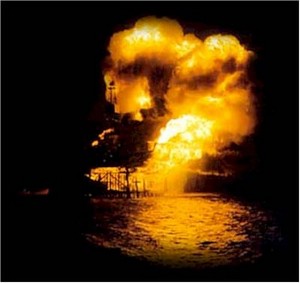
British Petroleum (BP) initially asserted that 1,000 barrels of oil per day (42,000 gallons) were gushing forth from their broken pipeline. The National Oceanic and Atmospheric Administration soon upped this estimate to 5,000 barrels per day (210,000 gallons). Then some experts stated the gusher is more likely to be on the order of 25,000 barrels per day (1,050,000 gallons).
This would mean that the amount already spilled already exceeds the 10.8 million gallons spilled by the Exxon Valdez, making it the worst oil disaster in American history.
And on May 4th, BP officials reported that this oil spill could grow at 12 times the initial estimate, releasing 2.5 million gallons of oil per day into the Gulf of Mexico. If the wellhead fails completely — which hasn’t happened yet — the spill rate could increase to 6.8 million gallons of oil per day.
Oil has already landed on several small islands known as the Chandeleur Islands on the Louisiana coast, including areas of the Breton National Wildlife Refuge. Oil-covered gannets and brown pelicans have already been found, and the refuge has been closed to the public for health and safety reasons.
This area provides key nesting and migratory stopover habitat for thousands of birds, as well as important fishery habitats. Tar balls have already washed up on Alabama's white sandy beaches of Dauphin Island. Some of the oily foam, a mixture of oil, water, and dispersants, is also washing up near the Mississippi Delta.
The stench of crude oil now permeates coastal areas, where it’s causing headaches, burning eyes, and nausea among the people who live there. Meanwhile, a ban on all fishing continues, as this oil horrendously continues to gush out into our Gulf.
Plugging one of the three leaks in BP’s crumpled pipeline has also failed to slow this gush of oil, and BP’s next-best hope of drilling an adjacent well to relieve the pressure from the damaged well, so that it can be capped, is at least 90 days away.
The current surface oil slick now covers an area of approximately 4,500 square miles (about the size of Connecticut). It appears to be circulating counterclockwise; oil continues to gush unchecked into the seas below. It is expanding toward the Mississippi Delta, and there's a large patch of oil that has moved west near Port Fourchon.
If this spill continues to grow at the current pace, it is likely to soon reach the Gulf Stream. This will soon whisk the oil into the Florida Keys, around the tip of Florida, and into the Atlantic Ocean. From there, it could begin fouling Atlantic Coast beaches, bays, and coral reefs. Some predict that some oil filaments may have already reached eddies on the cusp of the Gulf Stream.
BP is also now flooding the surface and deep ocean with hundreds of thousands of gallons of toxic chemical ‘dispersants,’ in a desperate attempt to keep the visible surface slick in check. These dispersants, which scientists agree are toxic wherever they’re applied, have never been pumped into a marine ecosystem in such enormous volumes, or at such depths. No one yet knows what dire effects this will have on marine life.
This BP oil spill is also threatening some of the most productive — and the most fragile — marine ecosystems in the United States. About 25 percent of the nation’s wetlands lie in the Mississippi River Delta, providing habitat for nesting seabirds and resting migratory birds. The Gulf itself is home to dozens of threatened and endangered species, as well as commercially important fish, crab, and shrimp that provide much of the basis of our Gulf Coast economy.
While the response to the oil spill has largely focused on stopping oil from reaching shore, the offshore ecosystem, from plankton to dolphins, will suffer devastating impacts. Endangered sperm whales and dolphins have already been spotted passing through the giant slick — which, on May 7th, hit critical habitat for the federally protected piping plover on the Chandeleur Islands. On May 9th, the Coast Guard reported dead birds and porpoises onshore. Oiled gannets and brown pelicans were the first victims discovered by response teams. The Coast Guard reports that 18 birds, 87 sea turtles, and six dolphins have already been found dead.
And, the timing of this spill could not have been worse for our nonhuman neighbors. Imperiled species including the Atlantic bluefin tuna, Kemp’s ridley sea turtles, loggerhead sea turtles, piping plovers, and sperm whales are flocking to the Gulf right now to spawn, to migrate, and to feed. For many of them, there is nowhere else to go.
The state of Louisiana has identified 210 birds, reptiles, amphibians, and mammals likely to be affected by this horrendous spill. Another 445 fish and invertebrate species will also be impacted. No estimate exists yet as to the number of coral reefs and vital plants such as sea grass and wetland vegetation likely to be covered in oil.
Numerous species of seabirds, dolphins, and sea turtles have already been spotted struggling through the oily muck. Dead seabirds, jellyfish, and numerous types of fish have already started washing up on the shores of Louisiana, Mississippi, and Alabama. Shoals that are favored by spawning blue crabs, a vital food source for sea turtles, and a staple of the regional economy, are now awash in oil.
British Petroleum has the worst environmental and safety record of any oil company operating in America today. Even after the 2005 Texas City Refinery blast that killed 15 people, BP has continued to rack up numerous safety violations. Despite the dangerous nature of all offshore oil drilling and BP’s own egregious safety record, BP’s exploration plan downplayed the possibility of a spill, repeatedly asserting that it was unlikely, or virtually impossible. Amazingly, Secretary Salazar’s Minerals and Management Service approved BP’s exploration plan without any consideration of the environmental consequences of an oil spill.
This enormous Gulf crisis shows that the glib safety claims of both the oil industry, and of many of our politicians, simply cannot be trusted. There is absolutely no way to guarantee that a massive oil rupture will not occur. And, if one does occur, this disaster proves that there is obviously no way to contain it quickly and fully enough to avert unacceptable environmental damage. Ultimately, it is the inherently dangerous nature of offshore oil drilling that has led to this disaster.
That’s why numerous environmental groups and concerned American citizens are now calling on the Obama Administration to:
1) Revoke its 2010 decision to open up Alaska, the eastern Gulf of Mexico, and the Atlantic Coast to offshore oil drilling;
2) Cancel Shell Oil’s permit to start oil drilling in Alaska’s Chukchi Sea immediately;
3) Not permit any new offshore drilling anywhere; and
4) Finally transition our nation away from fossil fuel, so the pressure to continue this offshore oil drilling dissipates.
Will you join us in attempting to avoid the next horrendous oil disaster in our nation, by contacting both your legislators and the White House, and urging our leaders to stop all additional offshore drilling, or will you continue to chant, as so many amazingly still are today – ‘Drill, Baby, Drill?’
The Choice is Yours – and Future Generations of Americans Now Await Your Decision.
















As a result of reading Mr. Ed's Post of:"Disaster on Our Shores" -
I went to The White House Website and sent this email Message.
INTRO -
Whether male or female, if you have any testosterone in your body -
THEN SPEAK OUT!
The following are Keywords I entered for this posting:
corruption, collusion, deception, mis-management, dishonesty, greed -
all descriptive nouns for Politicians!
PREZ EMAIL 2
© - Tom Hyland - 5-15-10
I just finished reading a report giving the honest details of the
DEVASTATING MAGNITUDE of the BP OIL SPILL -
American Politicians have been in the Pockets of the Oil Companies far too long!
ENOUGH IS ENOUGH!
If you do NOT reverse your decision about drilling on our Eastern Seaboard, and ANNOUNCE it publicly - I will be the first in line calling for your Impeachment!
AMERICA NEEDS SAFE, ALTERNATE ENERGY -
EVEN IF ALL THE OIL COMPANIES GO BELLY UP!
WHAT GOES AROUND, COMES AROUND!
Sincerely, Tom Hyland -
69-Year-Old Honest American Patriot.
Please contact the members of Congress who represent you and your state at: http://www.contactingthecongress.org/
and tell them to say "No" to offshore drilling.
Contact President Obama at:
http://www.whitehouse.gov/contact
This is something urgent that is being decided right now! Please help Save Our Environment, not only for us but for many generations to come.
Ed, we cannot do enough to spread this important message but we need to do what we Can do. Thank You for doing your part, over and over again. Death to "drill baby, drill"!
Exxon Valdez was constricted by winds and sea currents to a particular corner, this spill will get to everybody. I don't think British Petroleum have cash enough to survive after paying clean-ups and damages.
Georg
Anna