 Rio Will Be Next
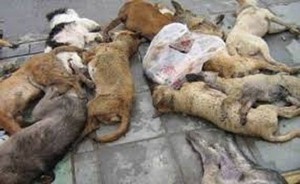
Thousands of dogs have now been killed in Sochi, Russia. Despite promising that there would not be a massive street cull in preparation for the Olympic Games, the local government hired a private exterminating company to kill “as many as possible” for these Winter Olympic Games, referring to these dogs as “biological trash.” And The International Olympic Committee has done nothing to stop this.
These innocent animals were shot with poisoned darts that caused them to suffocate, and then they were thrown into waiting trucks to be disposed of as garbage, at a cost of $25 to $35 per dog. Many of these stray dogs were pets, or the offspring of pets, abandoned by families whose homes were demolished over the past few years to make way for the Olympic venues. The stray dog population in Sochi also increased recently due to their being fed by construction workers in the Olympic construction projects.
Despite the global outrage and the negative media publicity, this killing goes on. A few dogs have been spared, in a rescue effort on behalf of a charity called Volnoe Delo (“Good Will”), which was told, “Either you take all the dogs from the Olympic Village, or we will shoot them.” This charity is being funded by Oleg V. Deripaska, one of Russia’s billionaires, and one of the major investors in the Sochi Games, who paid for several huge projects. His modest $15,000 contribution has been used to construct a shantytown of doghouses on the outskirts of Sochi that now houses about 200 dogs.
These Sochi Winter Olympics are costing Russia an estimated $51 Billion, four times higher than the $12 Billion cost Russia originally projected in 2007, and more than all of the previous Olympic Games combined. Sochi’s government budgeted a paltry $54,000 “to catch and dispose of” the strays, and this amount could have easily funded the cost of several modest dog shelters for hundreds of dogs.
And this massive pet killing for the Olympics is not a new issue, but this time it is receiving more media coverage and global outrage. Both the Athens and the Beijing Olympics caught some bad press for their handling of the local stray animal populations.
In 2004, the Greek authorities ordered the poisoning of 15,000 stray dogs ahead of the Olympic Games in Athens, desperate to show the world that their country is “modern and civilized.” Of course, it showed just the opposite.
In 2008, for the Beijing Olympics, China’s leaders convinced Beijing inhabitants that cats were a serious urban health risk, and they ordered a cull of an estimated 500,000 cats, an extreme measure by communist leaders to ensure that their capital city appeared clean, green, and welcoming during the Olympics. This time, the animals were thrown into overcrowded shelters with no food or water, and they were left to suffer a slow, agonizing death.
The senselessness of this unspeakable Olympic brutality is that this kind of “extermination” does not solve the problem, even in the short-term, and does nothing to address the long-term problem of global pet overpopulation today.
Humane Society International (HSI) and other well-known and well-funded animal welfare organizations have worked with thousands of organizations and government agencies worldwide to address this issue in a scientific, humane, and cost-effective way–using mass dog sterilization and vaccination programs that very successfully control the stray population and eliminate rabies risk, over both the short term and long term.
The Russian government knew that this expert assistance was easily available, and they could have collaborated with HSI or other organizations, with the cost potentially funded in whole or in part by private donations.
Even worse, we will surely see a repeat of this grotesque and inhumane animal slaughter in Rio de Janeiro when they host the Olympics next.
The Olympic Slaughter Goes On and On and On….
|



















difficult to fathom
Ron